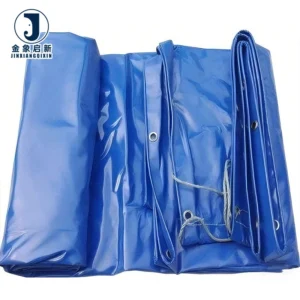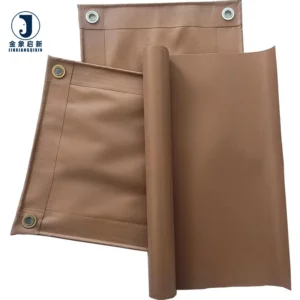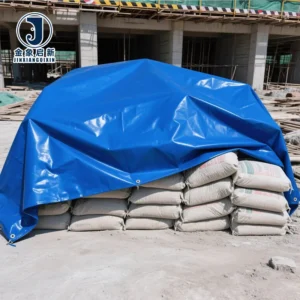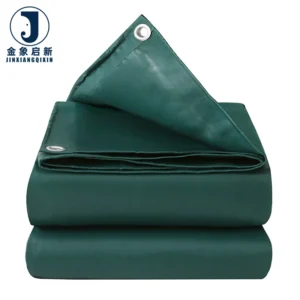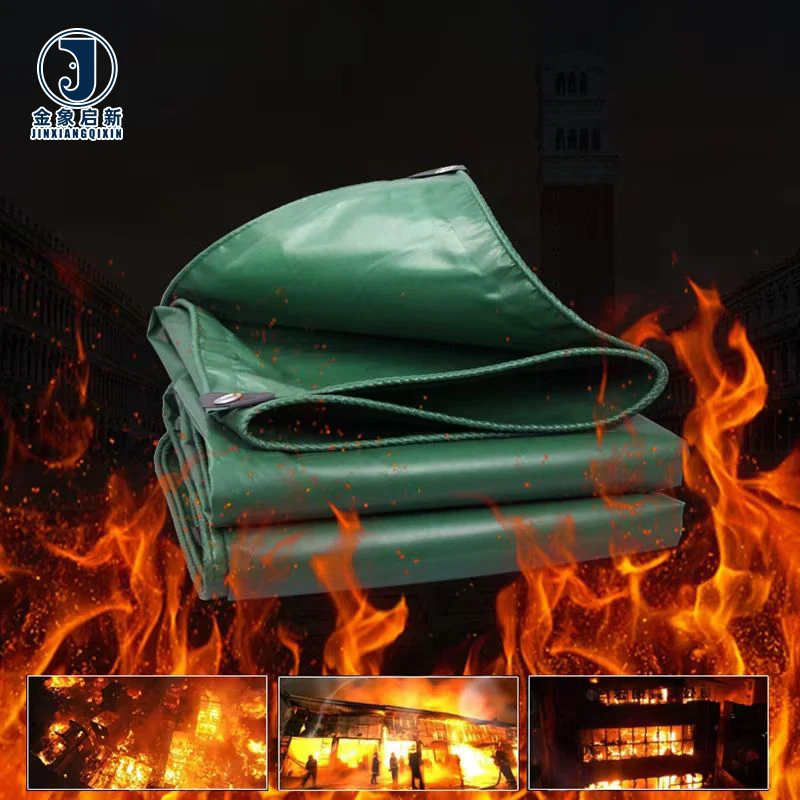
Coating weight control — verified GSM per roll against the quoted specification before dispatch, ensuring the PVC coated tarpaulin truck cover you receive matches the material data sheet.
Technical Specifications
| Parameter | Value |
|---|---|
| Product Type | PVC Coated Tarpaulin |
| Base Fabric | 500D×500D Polyester |
| Coating | Double-Sided PVC |
| Weight Range | 450–900 g/m² |
| Surface Finish | Smooth, leather-like texture |
| Waterproof Performance | Fully coated, sealed construction |
| Abrasion Resistance | High — suited to tie-down and flex-point contact |
| Flame Retardancy | Available in flame retardant grades — confirm the grade required for your market |
| UV Resistance | Anti-UV treatment available — request test basis for your exposure conditions |
| Service Life | Suited to extended outdoor road exposure |
| Repair Method | Hot air welding compatible |
| Packaging | Roll packing, bale packing, carton |
| Standards | ISO, CE |
Application Suitability
| Application | Exposure & Requirement |
|---|---|
| Truck and trailer load covers | Constant road vibration, load flex at seams, UV and weather exposure, tie-down abrasion at eyelets |
| Fleet side curtain fabric | Repeated rolling and unrolling, wind flap fatigue, colour consistency across curtain panels |
| Heavy equipment transport covers | Contact with sharp machine edges, strap tension at tie-down points, long outdoor staging |
| Construction plant and machine covers | Site dust, chemical splash, puncture risk from protruding components |
Why a "Waterproof" Truck Cover Still Fails on the Road
The fabric survives — the seams and hems do not. When a PVC coated tarpaulin for truck cover fails in service, the tear rarely starts in the middle of the panel. It starts where the load flexes against a welded seam, where an eyelet pulls through an unreinforced hem, or where a generic-size cover bunches and abrades against itself on a long haul.
Fleet operators replace covers far more often than the material’s coating life would suggest. The failure pattern repeats: welded seams delaminate under cyclic load movement, hems tear at eyelet spacing that is too wide for the strap tension used, and covers cut to a standard rectangle leave excess fabric that flaps, work-hardens and cracks. [NEED_CITE: common failure modes in heavy-duty transport tarpaulins per field inspection reports]
Specifying the right PVC coated tarpaulin truck cover means matching the cover dimensions to the trailer model, reinforcing hems at actual tie-down positions, and heat-welding seams that carry the same tensile load as the base fabric.
Cut-to-Model Sizing Eliminates the Generic-Fit Gap
A flat-bed trailer, a curtain-sider and a low-loader each demand different cover geometry. Off-the-shelf rectangles force drivers to fold and tuck excess fabric, creating friction points that wear through the PVC coating within months. This PVC coated tarpaulin for truck cover is cut to the specific trailer model dimensions you provide, removing the bunching and flap that accelerate abrasion at road speed.
Reinforced Hems at Actual Tie-Down Positions
Eyelet pull-through is the second most common cover failure after seam delamination. Standard spacing assumes uniform strap tension, but real loads concentrate force at corners and mid-span anchor points. Specify your tie-down layout so that hem reinforcement and eyelet spacing match the strap pattern on your trailer, distributing load across the PVC coated polyester base fabric rather than concentrating it at a single punched hole.
Reading the Specification Sheet Beyond GSM
Weight alone does not predict how a truck cover will perform under road stress. The 500D×500D polyester base fabric provides the tensile skeleton; the double-sided PVC coating adds waterproof sealing and surface abrasion resistance. A heavier coating adds puncture protection but also stiffness, which can increase flex fatigue at fold lines. A lighter coating over the same base fabric yields a more pliable cover that rolls easily for side curtain use. The correct balance depends on whether the cover is removed and refitted daily or left in place for long-haul transit. [NEED_CITE: relationship between base fabric denier, coating weight and tear propagation in coated polyester fabrics per ISO 1421]
Flame retardant grades are available for transport applications where compliance demands certification — always request the test report that corresponds to the grade quoted, and confirm which standard your destination market requires.
The Hidden Cost of Specifying on Price Per Square Metre
When covers are sourced on cost alone, GSM drift is the first compromise. A roll that arrives lighter than the quoted weight may still pass a visual check, but the reduced coating thickness shows up as early seam failure under cyclic flex and faster UV degradation on open loads. Colour variation between rolls in the same shipment becomes visible only after the covers are installed side by side on a fleet of trailers, forcing a full replacement rather than a panel swap. [NEED_CITE: batch colour consistency standards for fleet tarpaulin specifications]
Welded seams that are set at incorrect temperature or speed for the actual coating weight will delaminate before the fabric itself reaches end of life — a failure that reads as poor material quality when the root cause is a fabrication parameter mismatch.
Why Sourcing Through Jinxiang
Three full production lines and 36 sets of professional equipment support bulk roll output with on-time dispatch for fleet-scale orders, so your replacement cycle is not delayed by mill capacity constraints.
A 10-person R&D team develops cut-to-model samples within days, letting you verify fit on your specific trailer before committing to a full production run of PVC coated tarpaulin truck covers.
Dedicated QA/QC at every production stage includes 100% pre-shipment inspection, catching GSM drift, colour shade variation and hem reinforcement gaps before rolls leave the facility.
Deep process control over coating weight and adhesion, built across nearly 30 years of coated fabric production, means the PVC layer bonds consistently to the 500D×500D polyester base across every roll in your order.
Full documentation accompanies each shipment — material specification sheets, test reports for specified treatments, and inspection records that your receiving team can verify on arrival.
Documentation & Verification
- Material specification sheet stating GSM, base fabric denier, and coating weight per roll
- UV and flame retardant test reports matching the grade specified for your transport market
- Pre-shipment inspection record confirming hem reinforcement and eyelet spacing
- Roll packing list with individual roll weights for receiving verification
- Certificate of origin and customs documentation for cross-border shipment
Fabrication, Handling & Storage
- Hot air weld temperature must match the PVC coating weight — heavier grades above 700 g/m² require slower travel speed to avoid scorching the 500D base fabric
- Eyelet setting should use reinforced patch plates behind the hem on double-sided PVC coated panels to prevent pull-through under strap tension
- Store rolls upright on end-caps in shaded, ventilated areas to prevent flat-spot creasing that becomes permanent in cold conditions
- Unroll at ambient temperature — cold PVC coating becomes brittle and may crack if folded or sharply bent below freezing
- Clean with mild detergent and soft brush; solvent-based cleaners can soften the smooth leather-like PVC surface and reduce abrasion resistance
- Field repairs use hot air welding with matching PVC scrap, compatible with the double-sided coating construction
What to Include With Your Inquiry
Provide the trailer make, model and year along with measured deck dimensions so the cover can be cut to fit rather than supplied as a generic rectangle. Specify the tie-down system and eyelet positions so hem reinforcement is placed at actual load-bearing points. State your destination market and any flame retardant or UV treatment requirements so the correct test reports are included with your shipment of PVC coated tarpaulin truck covers.
Frequently Asked Questions
Q: How do I provide dimensions for different trailer models in my fleet?
A: Send the trailer make, model, body type and measured length, width and height including any side curtain track or tailgate frame. We develop a cut-to-fit sample for approval before bulk production, so the PVC coated tarpaulin truck cover matches your specific vehicle geometry without excess fabric that flaps and abrades during transit.
Q: How do I verify the flame retardant grade on arrival matches the quotation?
A: Request the test report for the specific flame retardant grade quoted, issued by a recognised laboratory against a named standard. On delivery, cross-reference the material specification sheet included in the shipment documentation against your purchase order. Any discrepancy should be flagged before the covers enter service.
Q: What is the expected service life compared to standard PE tarpaulin?
A: PVC coated polyester fabric is substantially more durable than PE film-based tarpaulins under equivalent road exposure conditions, with higher tear resistance and better UV stability. Actual service life depends on daily handling frequency, strap tension, and whether anti-UV treatment was specified for your climate zone.
Q: Can you match my fleet colour across repeat orders without shade variation?
A: Colour matching is controlled at the coating stage with reference samples retained on file. For repeat orders, request a batch consistency confirmation and review the pre-shipment inspection record. Rolls within a single order are produced in the same coating run to minimise visible shade differences when installed side by side on adjacent trailers.
Q: What is the minimum order for custom width, colour or printed branding?
A: Minimums vary by specification. Custom widths and colours carry a per-run minimum tied to coating line setup, while printed branding adds a plate or digital setup cost. Submit your required width, colour reference and print artwork for a quotation with the applicable minimum stated clearly.