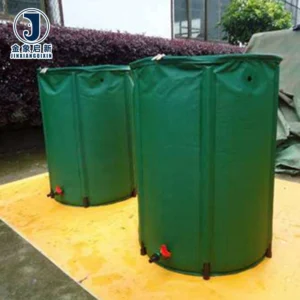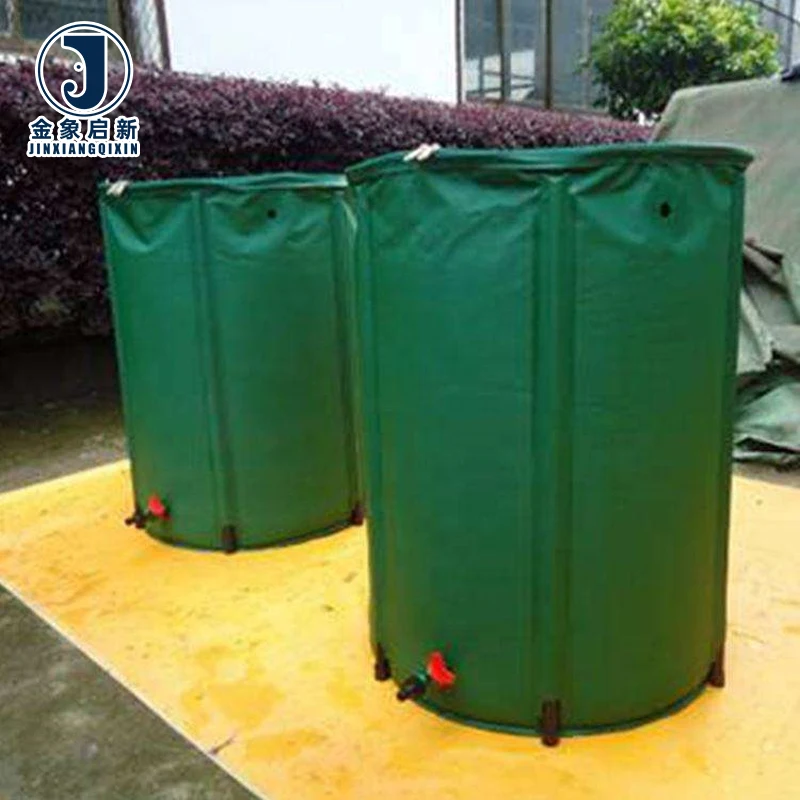
Seam Integrity Focus — Every flexible water storage bladder undergoes 100% pre-shipment water-fill inspection to verify welded seam performance at flex points before dispatch.
Technical Specifications
| Parameter | Value |
|---|---|
| Product Type | Flexible Water Storage Tank |
| Base Fabric | PVC tarpaulin |
| Coating Material | PVC |
| Capacity | 750L (additional capacities available: 100L, 225L, 250L, 1000L) |
| Waterproof Rating | Waterproof (test basis not stated in source) |
| UV Treatment | UV-resistant (test basis not stated in source) |
| Anti-Mildew | Mildew-proof (test basis not stated in source) |
| Collapsible Design | Yes |
Application Suitability
| Application | Exposure & Requirement |
|---|---|
| Garden rainwater harvesting | Continuous outdoor UV exposure, seasonal temperature variation, rooftop collection point |
| Agricultural irrigation storage | Permanent water contact, algae and mildew risk, field deployment and retrieval |
| Hydroponic reservoirs | Indoor or greenhouse use, water purity maintenance, nutrient solution containment |
| Outdoor portable water collection | Transport flexing, rough terrain abrasion, rapid deployment and collapse |
| Industrial water storage | Process water containment, chemical exposure risk, heavy-duty puncture resistance |
Why Weld Line Durability Decides Tank Service Life on a Fleet Yard
A collapsible tank fails first at its seams, not its fabric body.
Generic collapsible water tanks deployed at logistics yards or remote agricultural sites typically show seam separation after repeated fill-drain cycles. The flexing at the waterline and base corners places cyclic stress on the weld zone. When a PVC tarpaulin water storage tank aftermarket supplier controls both the base fabric coating and the welding process in-house, the seam and the fabric body degrade at comparable rates. Without that process integration, field reports consistently describe tanks leaking at the joints while the main body remains intact [NEED_CITE: welded seam failure mechanisms in flexible liquid containment per ISO 1421].
Heat-Welded Seam Construction for Liquid Containment
A Flexible Water Storage Tank built from PVC tarpaulin relies on high-frequency or hot-air welding to join panels. The weld zone must penetrate the PVC coating layer fully to fuse the polymer chains across the seam. When coating weight is controlled during manufacturing, the weld parameters remain consistent across production runs, preventing under-welded or over-welded sections that compromise water-tight integrity.
UV and Mildew Resistance for Extended Outdoor Deployment
Outdoor rainwater harvesting tanks face direct sunlight exposure and standing moisture simultaneously. The UV-resistant treatment claimed for this PVC tarpaulin water storage tank aftermarket supplier product requires a specific test standard to quantify degradation rate — buyers should request the test report to confirm the exposure rating suits their regional solar intensity [NEED_CITE: accelerated weathering test methods for PVC coated fabrics per ISO 4892]. Mildew-proof surface treatment prevents biological growth on the interior wall, which is essential when stored water feeds hydroponic systems or sensitive crop irrigation.
Collapsible Transport Profile and On-Site Deployment
The defining advantage of a flexible bladder over rigid tanks is the transport volume reduction. A 750L tank folds to a fraction of its deployed footprint, allowing containerised shipment of multiple units and rapid manual deployment at the installation site. The PVC tarpaulin construction provides sufficient puncture resistance for placement on graded ground without a concrete pad, though surface preparation remains necessary to eliminate sharp debris.
Coating Weight, Base Fabric, and Containment Integrity
The relationship between PVC coating weight and the base fabric denier determines how the tank wall behaves under hydrostatic pressure. A heavier coating provides better liquid barrier properties but adds stiffness that can hinder folding. The base fabric weave density controls dimensional stability — when the tank is full, the wall must resist bulging without permanent deformation. Specifying a Flexible Collapsible PVC Water Storage Tank for transport and outdoor use requires balancing these two parameters against the intended fill cycle frequency and deployment terrain.
The Hidden Cost of Specifying Capacity Without Verifying Weld Protocol
Purchasing decisions based solely on stated capacity and unit price ignore the manufacturing variable that determines field longevity. A tank with inadequately welded seams will leak at the base corner after repeated thermal expansion cycles, rendering the entire unit useless despite the fabric body remaining in serviceable condition. Fleet operators and agricultural buyers replacing failed tanks seasonally incur cumulative costs far exceeding the initial specification premium for verified weld integrity [NEED_CITE: lifecycle cost analysis of flexible containment systems in agricultural applications].
Why Sourcing from a Coated-Fabric Manufacturer Changes the Specification Conversation
Nearly 30 years of focused PVC tarpaulin production provides the process control necessary to maintain consistent coating weight across the tank body and weld zones. Three full production lines and 36 sets of professional equipment support bulk order fulfilment with reliable on-time delivery for seasonal agricultural demand. A 10-person R&D team handles custom sizing, fitting placement, and sample development for site-specific reservoir footprints. Dedicated QA/QC at every production stage includes 100% water-fill inspection before shipment, catching seam defects that visual inspection alone would miss. Samples developed within days allow buyers to verify material hand-feel, weld quality, and fitting configuration before committing to bulk production.
Documentation & Verification
- Material specification sheet stating base fabric denier, PVC coating weight, and treatment claims for the 750L tank.
- Test report for UV-resistant treatment available upon request — confirm the test basis supports your regional exposure requirement.
- 100% pre-shipment inspection record including seam weld integrity verification and full water-fill leak test.
- Certificate of origin and customs documentation prepared for export shipments.
- Roll packing list detailing unit count, capacity grade, and fitting configuration per container load.
Fabrication, Handling & Storage
- Heat-weld seams using parameters matched to the specific PVC coating weight — incorrect temperature causes delamination at flex points.
- Store folded tanks in a dry, shaded environment; prolonged compression in direct sunlight accelerates surface degradation.
- Avoid dragging the tank body over unprepared ground; the PVC tarpaulin coating resists puncture but not concentrated sharp-point loads.
- Clean interior surfaces with mild detergent only; solvent-based cleaners may compromise the mildew-proof treatment layer.
- Inspect eyelet and fitting attachment points periodically — these concentrated stress zones require reinforced patch panels during fabrication.
Inquiry Requirements for Custom Tank Specification
Provide your intended deployment environment, including ground surface type and maximum ambient temperature range. Specify the required inlet, outlet, and overflow fitting sizes and positions relative to the tank footprint. Confirm whether the target market requires any specific fire classification or potable-water contact certification. State your annual volume requirement and whether sample approval is needed before bulk production commences.
Frequently Asked Questions
Q: How is seam strength verified on collapsible water tanks before shipment?
A: Every unit undergoes a full water-fill test at the factory, pressurising every welded seam under actual hydrostatic load. Inspection records document seam integrity at corners, base panels, and fitting attachment zones before the tank is drained, dried, and folded for packing.
Q: What UV test basis supports the outdoor exposure claim?
A: The UV-resistant treatment applied to the PVC tarpaulin is supported by test documentation available on request. Buyers should confirm the specific test standard cited — typically accelerated weathering per ISO 4892 or equivalent — matches the solar exposure intensity at their deployment region.
Q: Can the tank be custom-sized for specific site footprints or vehicle-mounted use?
A: Custom dimensions beyond standard capacities (100L, 225L, 250L, 750L, 1000L) are available. Provide the required footprint length, width, and maximum filled height, along with fitting placement specifications. Sample development confirms dimensional accuracy and weld configuration before bulk production.
Q: What eyelet, inlet and outlet fitting options are available?
A: Standard and custom fitting configurations are available, including threaded PVC outlets, overflow ports, and reinforced eyelet patches for tie-down straps. Specify fitting diameter, thread type, and position coordinates relative to tank edges during the inquiry stage.
Q: How is batch colour and coating consistency controlled across multiple units?
A: Coating weight and colour formulation are controlled at the mixing and application stage, with in-process QA checks maintaining consistency across the production run. Pre-shipment inspection records document visual and measurement verification against the approved sample specification.