Proven Process Control — Every roll of PVC coated tarpaulin leaving the facility undergoes 100% pre-shipment inspection, with coating weight and edge adhesion verified against the stated specification before dispatch.
Technical Specifications
| Parameter | Value |
|---|---|
| Product Type | PVC Coated Tarpaulin |
| Coating Material | PVC & Polyester |
| Yarn Count Options | 500D840D, 500D1000D, 1000D1000D, 1000D1300D, 1300D1300D, 1000D2000D |
| Weight Range | 350g/m² – 900g/m² |
| Thickness | 0.29mm – 0.65mm |
| Density (Mesh Count) | 3019, 2020, 30*15 |
| Tensile Strength (Warp) | 1650N – 3900N (test basis not stated) |
| Tensile Strength (Weft) | 1600N – 3500N (test basis not stated) |
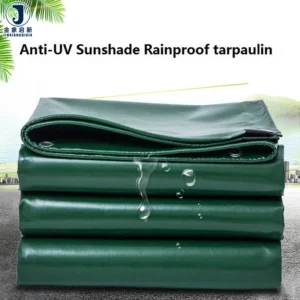
| Features | Water Resistant, Waterproof, Anti-UV (test basis not stated), Flame Retardant (grade not stated) |
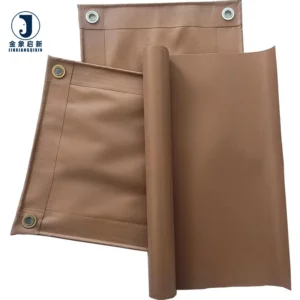
| Edge Treatment | High temperature heat sealed seamless edge wrapping |
| Rope | 5mm thick rope without splicing |
| Eyelets | 3cm enlarged aluminum alloy buttonhole |
| Corner Reinforcement | Reinforced corners on all sides |
| Standards | ISO, CE (specific certificate numbers not stated) |
Application Suitability
| Application | Exposure & Requirement |
|---|---|
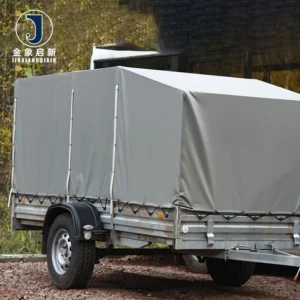
| Truck and trailer flatbed covers | Constant road vibration, UV exposure, flexing at load shifts, tie-down tension on hems and eyelets |
| Side curtain fabric for trailers | Repeated flex cycles, abrasion against cargo edges, wind-driven rain ingress at seams |
| Machine and equipment covers for transport | Outdoor weather between job sites, handling abrasion from rigging straps |
| Awnings and canopy structures | Sustained sun exposure, pooling water on horizontal spans, wind uplift tension |
| Pergola and terrace rain covers | Permanent outdoor installation, UV degradation risk, standing water on low-pitch surfaces |
Why PVC Coated Tarpaulin for Truck Cover Fails at the Flex Points
The weld line carries the same load as the fabric, yet most failures start there.
When a loaded trailer hits uneven road, the tarpaulin flexes hundreds of times per trip. The tension concentrates at the hem, where the welded seam meets the eyelet. If the edge wrapping was done at the wrong temperature or with insufficient adhesion, the seam delaminates before the fabric itself shows any wear. Fleet operators then face cargo exposure mid-route, roadside repairs, and replacement orders that interrupt fleet scheduling. [NEED_CITE: coated fabric seam strength testing per ISO 1421]
This is not a material defect — it is a fabrication gap. The base fabric may have adequate tensile strength for the span, but the finished cover fails because the edge construction was treated as secondary. Specifying heat-sealed seamless edge wrapping with high adhesion and reinforcing every corner addresses this failure mode directly.
Heat-Sealed Edge Wrapping That Holds Under Road Vibration
Standard hem construction uses stitching or low-temperature welding that creates a mechanical bond between the folded layers. On a moving truck or trailer, that bond is subjected to continuous flex cycles combined with tie-down tension. High-temperature heat-sealed seamless edge wrapping fuses the PVC coating layers at a molecular level, producing a bond that matches the coating adhesion of the base fabric itself. This PVC coated tarpaulin for truck cover applications uses this process across all hem lines, with a 5mm thick rope without splicing running inside the hem to distribute tension evenly and prevent point loading at individual eyelets.
Reinforced Corners and Enlarged Eyelets for Multi-Directional Tie-Down
Flatbed loads require tie-downs at multiple angles, and the corner eyelets bear disproportionate stress. The 3cm enlarged aluminum alloy buttonhole distributes the load over a wider fabric area, while reinforced corners on all sides add a secondary layer of PVC-coated material bonded to the primary fabric at every corner point. When a strap is tensioned at an acute angle — as happens when securing a tall load — the reinforcement patch prevents the eyelet from tearing through. This construction is critical for fleet operators covering irregularly shaped cargo where standard spacing does not apply. [NEED_CITE: eyelet pull-out resistance test methods for tarpaulins]
Reading the Specifications Beyond Weight
Weight in GSM is the most quoted specification in tarpaulin procurement, but it does not operate in isolation. A 650g/m² fabric woven at 2020 mesh from 1000D1000D yarn will behave differently from one woven at 3019 from 500D840D yarn, even at the same weight. The denser weave resists tear propagation because more yarns must break for a tear to advance, while the heavier denier provides individual yarn strength. For truck and trailer covers, the yarn count determines how the fabric responds to puncture — a dropped tool or a sharp cargo edge will meet more resistance from higher-denier base fabric. Coating weight also matters: the double-sided PVC coating contributes to waterproof integrity and adds to the overall GSM, so two fabrics at the same total weight may have different base fabric-to-coating ratios, affecting flexibility and low-temperature performance. The available thickness range from 0.29mm to 0.65mm reflects these construction choices.
What Happens When Edge Construction Is Overlooked
A tarpaulin ordered at the correct GSM and yarn count can still fail prematurely if the hem and eyelet specification is generic. The most common consequence is seam delamination at the flex points — the exact locations where the trailer load shifts and the fabric is under the greatest cyclic stress. When the edge wrapping adhesion is insufficient, the PVC layers separate and water enters the cargo area through the gap. Eyelets pulled at angles not accounted for in the reinforcement design tear through the fabric, leaving the cover flapping in the wind. For fleet operators, this means unplanned downtime and cargo damage claims. [NEED_CITE: common failure modes in truck tarpaulin field service]
Sourcing PVC Coated Tarpaulin for Truck and Transport with Confidence
Three full production lines and 36 sets of professional equipment support consistent output across bulk orders, reducing the risk of batch-to-batch variation that plagues smaller operations. The 10-person R&D team handles custom sizing to specific truck and trailer model dimensions, so covers are cut to fit rather than adapted from generic patterns. Dedicated QA/QC runs at every production stage, with 100% pre-shipment inspection covering edge seal integrity and eyelet pull-out resistance before any roll or finished cover leaves the facility. Samples are developed within days for custom requirements, allowing fleet operators to verify fit and material handling before committing to full production. Nearly three decades of focused experience in coated fabric production underpins the process control applied to every PVC coated tarpaulin for truck and transport application.
Documentation & Verification
- Material specification sheet stating base fabric denier, coating weight, and yarn count per roll
- Weight verification per roll against the stated GSM before dispatch
- Pre-shipment inspection record confirming edge construction and eyelet reinforcement match specification
- Test report for flame retardant grades where applicable, confirming the standard referenced
- ISO and CE certificates supporting product compliance documentation
Fabrication, Handling & Storage
- Heat-sealed seams require controlled temperature settings matched to the coating thickness range of 0.29mm to 0.65mm
- 3cm aluminum alloy eyelets should be set with reinforced corner patches to distribute multi-directional tie-down loads
- Rolls should be stored horizontally on racking to prevent permanent creasing in the PVC coating layer
- Allow cold-stored rolls to reach ambient temperature before unrolling to avoid coating crack at low-brittleness threshold
- Clean with mild detergent only; solvent-based cleaners may degrade the PVC surface coating
Planning Your PVC Coated Tarpaulin for Truck Cover Order
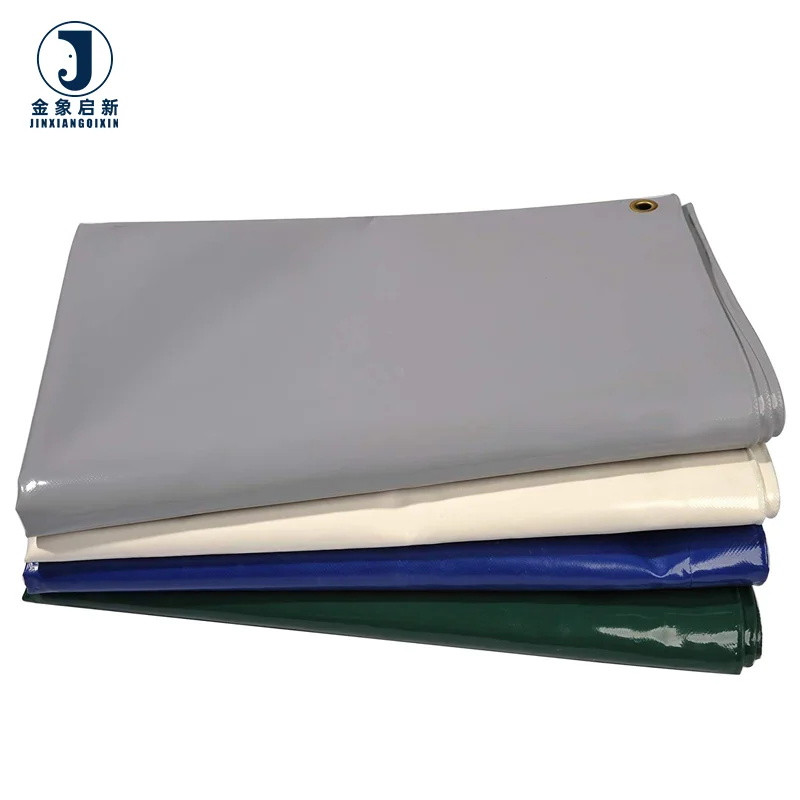
Specify the exact truck or trailer model, including bed dimensions and side curtain drop length, so the cover can be sized to fit without on-site modification. Confirm whether flame retardant certification is required for your operating jurisdiction and which standard applies. Indicate the number of vehicles in the fleet to allow batch colour matching and consolidated dispatch planning.
Frequently Asked Questions
Q: How can I verify the GSM weight matches the quotation when the rolls arrive?
A: Every shipment is accompanied by a pre-shipment inspection record with per-roll weight data. On arrival, you can weigh a measured sample section and calculate the GSM. Any discrepancy between the documented value and the actual weight should be reported with the roll identification number for immediate resolution against the inspection record.
Q: Can the tarpaulin be cut to fit my specific trailer model rather than a generic size?
A: Yes. Provide the exact make, model, and year of each truck or trailer along with bed dimensions and any unusual profile features. The R&D team will develop a cutting pattern specific to that vehicle, and a sample cover can be produced for fit verification before the full fleet order enters production.
Q: What edge and hem reinforcement options are available for trailer flex points?
A: The standard construction uses high-temperature heat-sealed seamless edge wrapping with a 5mm rope inside the hem and reinforced corners at every eyelet position. For high-flex areas such as side curtain attachment rails, additional reinforcement patches can be bonded at specified intervals during fabrication to handle concentrated cyclic stress.
Q: Which flame retardant grades are available for transport use?
A: Flame retardant treatment is available in grades suited to transport applications. Confirm the specific fire safety standard required by your operating jurisdiction or insurance provider so the correct formulation can be applied and the matching test report included with your shipment documentation.
Q: How is colour consistency controlled when ordering multiple rolls for one fleet?
A: All rolls in a single order are produced in the same batch run using matched pigment formulation. The pre-shipment inspection includes visual comparison of adjacent rolls under controlled lighting to identify any variation before dispatch, ensuring uniform appearance when covers are installed side by side across the fleet.