Proven Process Control — deep expertise in polyester-cotton canvas coating and finishing ensures batch-to-batch weight consistency across every roll dispatched for fleet and transport use.
Technical Specifications
| Parameter | Value |
|---|---|
| Product Type | Canvas Tarpaulin |
| Base Fabric | Polyester cotton industrial textile, 8-12 strands of fine cotton yarn |
| Weight | 600gsm |
| Total Thickness | 0.5mm / 0.6mm / 0.7mm (source value — verify against manufacturer catalog) |
| Roll Width | 2m |
| Roll Length | 100m |
| Color | Army Green Camouflage / Custom |
| Finished Product Size | Custom cut-to-model or inventory sizes |
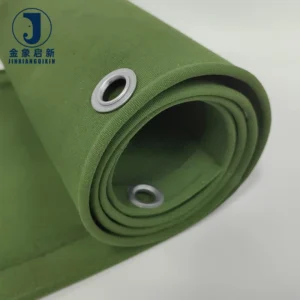
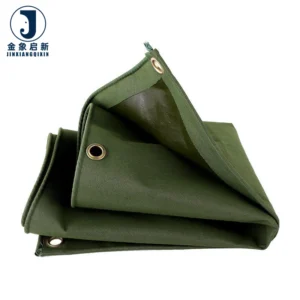
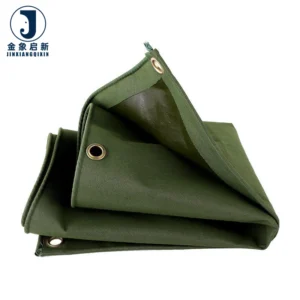
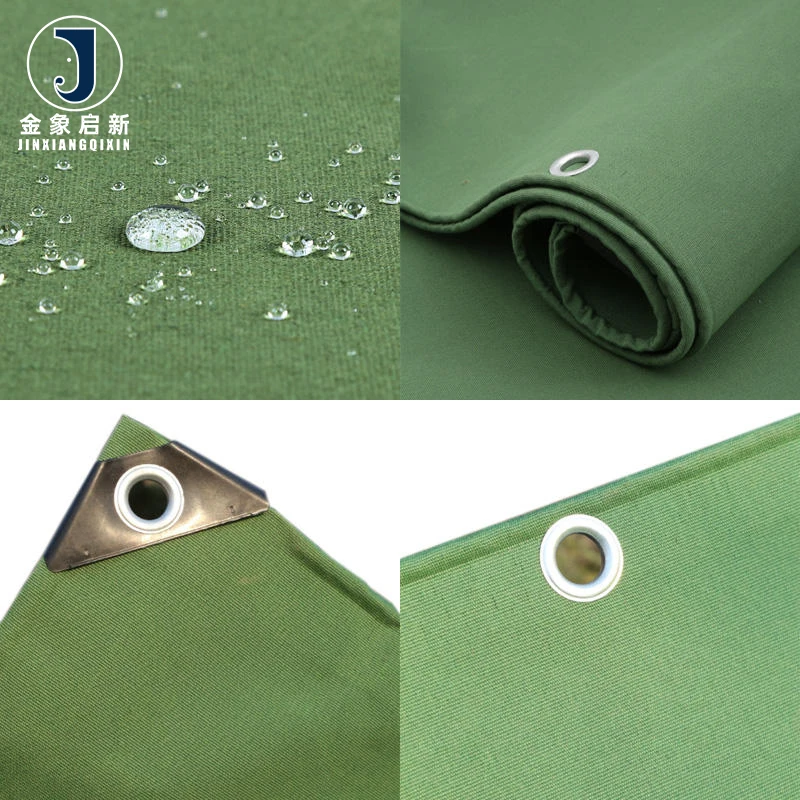
| Grommets | Rustproof aluminum, spaced every 1 meter at corners and hem |
| Edge Treatment | Folding and seams welded and sewn with poly ropes |
| UV Treatment | UV resistant (test basis not stated in source) |
| Waterproof Rating | Waterproof (specific rating not stated in source) |
| Anti-Mildew | Mold resistant (test basis not stated in source) |
| Service Life | 5-8 years even longer (source value — verify against manufacturer catalog) |
| Certification | CE, ISO (specific certification numbers not stated in source) |
Application Suitability
| Application | Exposure & Requirement |
|---|---|
| Truck and trailer load covers | Constant road vibration, wind uplift at speed, weather exposure, secure tie-down via grommets |
| Side curtain fabric replacement | Repeated flexing at load points, abrasion against trailer frame, UV exposure on long-haul routes |
| Flatbed and open-top transit covers | Direct rain and sun contact, high-speed wind load, tie-down stress at corners and edges |
| Canopy tent roofs and camping shelters | Prolonged UV exposure, rain pooling, tension at pole contact points |
| Woodpile and outdoor stock covers | Moisture ingress, mold risk, ground contact abrasion, seasonal temperature variation |
| Construction and asphalt covers | Site dust, mechanical handling abrasion, UV and rain exposure, heat from fresh asphalt |
Why Generic-Size Covers Fail on the Road — and How Heavy Duty Canvas Tarpaulin for Truck Cover Solves It
A cover cut to your exact trailer dimensions eliminates edge gaps and shifts the load off the seams at the points where flex stress concentrates.
Fleet operators ordering heavy duty canvas tarpaulin for truck cover in standard sizes regularly encounter edge lift at highway speed and premature seam failure where the load flexes during transit. Generic covers force the fabric to bridge unsupported spans, placing the full wind and vibration load on welded edges rather than distributing it across the body of the tarpaulin. [NEED_CITE: field reports on tarpaulin seam failure under dynamic load conditions] The result is often a cover that needs replacement well before the fabric itself has degraded — because the seams gave way first.
Cut-to-Model Fitment Eliminates Edge Gap and Wind Catch
Every truck and trailer model has a distinct deck width, side height, and tailboard profile. A heavy duty canvas tarpaulin for truck cover cut to those exact dimensions wraps the load without excess fabric that flaps in the slipstream or short falls that leave the rear corners exposed. This precision also means the grommets align with the vehicle’s tie-down points, so rope tension is applied directly downward rather than at an angle that pulls the hem sideways over time.
Welded and Sewn Seams Reinforced with Poly Rope at Flex Zones
The edges and corners of a truck cover endure the highest cyclic stress — every bump in the road transmits a flex wave through the fabric that concentrates at the hem. This canvas tarpaulin addresses that failure mode by combining welded seams with stitched reinforcement and an internal poly rope cord. The rope carries the tie-down load while the weld and stitch hold the fabric layers together, distributing stress across three structural elements rather than relying on a single seam method.
UV, Water and Mold Treatment for Continuous Outdoor and Road Exposure
Truck covers sit in direct sunlight between loads and are exposed to rain, road spray and humidity during transit. The 600gsm polyester-cotton base fabric is treated for UV resistance, waterproofing and mold resistance — available in grades that can be confirmed against test documentation for your specific market requirements. [NEED_CITE: UV exposure testing standards for coated technical textiles] This multi-treatment approach addresses the three primary degradation vectors that shorten a cover’s working life on the road.
Reading the Specs: What 600gsm Polyester-Cotton Actually Means for Your Fleet
The 600gsm weight of this canvas tarpaulin reflects the combined mass of the polyester-cotton base fabric and its coating — it is not a standalone indicator of strength. What matters for transport use is how that weight is achieved: the 8-12 strands of fine cotton yarn in the weave create a high-density upper layer that resists tear propagation under the vibration and flex loads experienced on the road. The polyester component adds dimensional stability so the fabric does not stretch or sag when wet. Thickness options of 0.5mm, 0.6mm and 0.7mm (source value — verify against manufacturer catalog) allow selection based on whether the cover will be handled manually each day or left in place for longer haul cycles. The 2m roll width and 100m roll length support both full-trailer cuts and smaller finished sizes with minimal waste at the fabrication stage. Rustproof aluminum grommets at 1-meter spacing provide sufficient tie-down points for standard ratchet strap patterns without concentrating load at any single ring. [NEED_CITE: relationship between base fabric denier, weave density and tear resistance in coated canvas per ISO 1421]
The Hidden Cost of Specifying by Weight Alone
A 600gsm canvas tarpaulin built on a low-density base fabric can weigh the same as a high-density weave yet tear far more easily at the hem line under road vibration. When procurement decisions are made on stated GSM without verifying the base fabric construction, the delivered material may pass a weight check yet fail structurally within the first season of fleet use. Welded seams on a loosely woven base also detach more readily because the coating has less yarn surface to bond with, causing the weld to peel before the fabric body degrades. [NEED_CITE: coating adhesion test methods for industrial canvas fabrics] Batch colour drift between rolls — visible only when two panels are installed side by side on the same trailer — is a separate sourcing risk that forces rework or rejection at the receiving dock.
Why Source Heavy Duty Canvas Tarpaulin for Truck Cover Through This Supply Chain
Three full production lines and 36 sets of professional equipment provide the bulk capacity to fulfil fleet-scale orders without splitting production across external workshops where consistency control weakens. The 10-person R&D team develops cut-to-model patterns for specific truck and trailer types, ensuring the cover dimensions match the vehicle rather than a generic size chart. Dedicated QA/QC inspection at every production stage — including pre-shipment verification of grommet spacing, seam integrity and cut dimensions — catches defects before dispatch rather than at the receiving dock. Custom colour and print runs are managed in-house, maintaining roll-to-roll consistency across the full order. Sample development for custom sizing and finish requirements is completed within days, allowing fleet operators to confirm fitment before committing to full production.
Documentation & Verification
- Material specification sheet stating 600gsm weight, polyester-cotton base fabric construction, and colour reference code
- Test report for UV and waterproof treatment confirming the performance grade applicable to your operating region
- Pre-shipment inspection record verifying grommet spacing at 1 meter, seam weld integrity, and cut-to-model dimensions
- Certificate of origin and customs documentation to support cross-border fleet procurement and import clearance
- Roll packing list detailing quantity, individual roll dimensions, and net weight per unit for receiving verification
Fabrication, Handling & Storage
- Weld seams at 600gsm require controlled heat and dwell time — test on an offcut before running production to avoid scorching the polyester-cotton base
- Aluminum grommets set into the 0.5mm–0.7mm canvas thickness need matched die clearance to prevent fabric distortion around the ring
- Store 2m x 100m rolls vertically on end-caps to prevent permanent crease marks across the canvas width during warehouse holding
- Deploy in cold conditions by unrolling and allowing the canvas to acclimatise — stiff polyester-cotton fabric can crack at fold lines if tensioned while frozen
- Clean with mild detergent only; solvents and high-alkaline cleaners can strip the UV and waterproof surface treatment from the canvas
Requesting a Quotation for Your Fleet or Transport Project
Provide the make and model of the trucks or trailers to be covered, along with the operating environment — long-haul highway, urban delivery, or stationary yard storage. Specify whether you require finished cut-to-size covers with grommets and hem reinforcement, or roll stock for in-house fabrication. Confirm the colour or camouflage pattern needed and the target market so the appropriate treatment grade can be matched to your compliance requirements.
Frequently Asked Questions
Q: How is the 600gsm weight verified on arrival to match the quoted specification?
A: Each roll is weighed and inspected during pre-shipment QA against the stated 600gsm specification. The inspection record is included with dispatch documentation so you can verify the delivered material matches what was quoted without needing independent lab testing on receipt.
Q: Can the tarpaulin be cut to fit a specific trailer model rather than a generic size?
A: Yes. The R&D team develops patterns based on your truck or trailer make, model and deck dimensions. This ensures full coverage with grommet placement aligned to the vehicle’s tie-down points, eliminating the edge gaps and wind catch common with generic-size covers.
Q: What is the basis for the UV-resistant claim — is there a test report available?
A: The canvas tarpaulin is treated for UV resistance, and the specific test basis can be confirmed for your market requirements. Request the test report during the quotation stage so the exposure rating aligns with the climate conditions your fleet operates in.
Q: How are welded seams reinforced at flex points to prevent failure under load movement?
A: Seams are both welded and sewn with an internal poly rope cord. The weld bonds the fabric layers, the stitching provides mechanical redundancy, and the rope carries the tie-down load — distributing stress across three elements rather than relying on a single seam method.
Q: What eyelet spacing and hem reinforcement options are available for high-wind tie-down?
A: Standard specification includes rustproof aluminum grommets spaced every 1 meter at corners and hem, with hems folded and reinforced with poly rope. For high-wind routes or heavier loads, additional grommet density or alternative spacing patterns can be discussed during the sample stage.