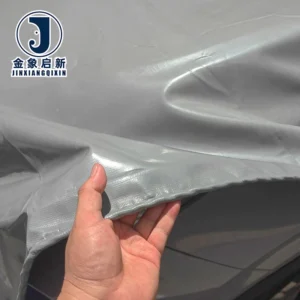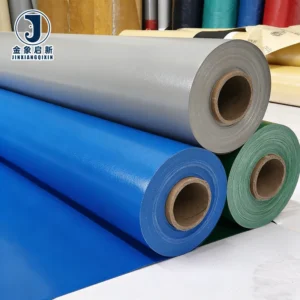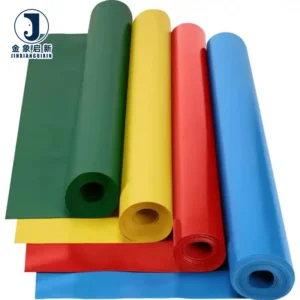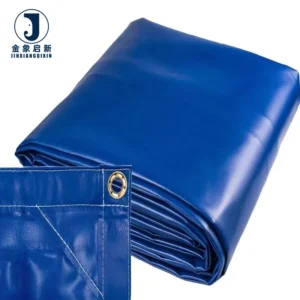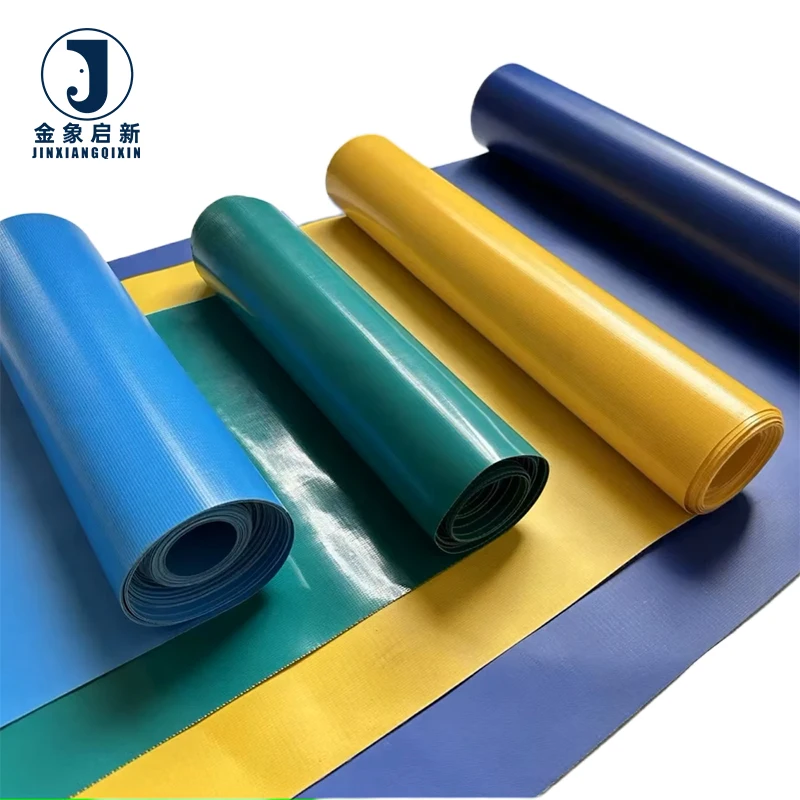
Coating Process Control — three dedicated production lines manage PVC adhesion and weight consistency across every roll, ensuring the fabric performs as specified at the weld line and the hem.
Technical Specifications
| Parameter | Value |
|---|---|
| Product Type | PVC Coated Tarpaulin |
| Weight Range | 250gsm to 1500gsm (confirm grade for application) |
| Base Fabric Denier | 200D×300D, 500D×500D, 840D×840D, 1000D×1000D |
| Surface Finish | Glossy or matte |
| Colour Options | Blue, yellow, black, green, white (custom colours available) |
| Temperature Range | -15°C to 70°C |
| Waterproof | Yes — fully coated construction |
| Flame Retardant | FR treated (grade not stated in source — confirm the grade required for your market) |
| UV Treatment | Customized (test basis not stated in source — confirm exposure class) |
| Anti-Fungal | Treated |
| Key Features | Tear-resistant, abrasion resistant, high flexibility, rain-resistant |
| OEM/ODM | Accepted |
| Standards | ISO, CE |
Application Suitability
| Application | Exposure & Requirement |
|---|---|
| Truck side curtain systems | Constant flexing at load points, road debris abrasion, UV exposure, tie-down load at hems |
| Flatbed trailer load covers | Wind lift stress, rain ingress during transit, repeated folding and strapping tension |
| Construction site equipment covers | Standing water, soil contact, UV degradation, puncture from sharp edges |
| Tent and outdoor structure fabric | Sustained tension, wind load, weather cycling, weld seam integrity |
Why Generic Sizing Causes PVC Tarpaulin Roll Failures on Moving Loads
A truck cover cut to standard dimensions will fail at the flex points long before the fabric itself reaches its service limit.
Fleet operators routinely replace covers that split along welded seams within months of installation. The issue is rarely the PVC coated tarpaulin for truck cover material grade — it is the fit. When a cover is too loose, wind enters underneath and creates a sail effect that concentrates stress at the eyelets and the first weld line past the buckle. When it is too tight, the fabric stretches past its recovery point every time the trailer articulates on uneven road surfaces [NEED_CITE: tensile and tear test methods for coated fabrics per ISO 1421]. Specifying the exact trailer model, door clearance, and tie-down spacing before production eliminates these failure modes.
Fitment Accuracy Eliminates the Most Common Cover Failure Mode
Transport fleets operate with specific trailer configurations — curtain-siders, flatbeds, and refrigerated units all demand different dimensional tolerances. The PVC tarpaulin roll for truck cover aftermarket supplier must work from the vehicle model and load profile, not a generic size chart. Side curtains require hem reinforcement at the buckle line and a fabric weight that balances drape with tear resistance, while flatbed covers need a heavier denier base fabric to resist puncture from shifting cargo.
Weld Line Behaviour Under Road-Induced Flex Stress
The point where two panels join is the most vulnerable part of any truck cover assembly. The base fabric denier — whether 500D×500D or 1000D×1000D — determines how the material behaves at the weld zone. Higher denier fabrics tolerate heat welding at wider seams without compromising the yarn structure, which matters when the cover flexes thousands of times over a single long-haul journey [NEED_CITE: heat weld peel strength testing for PVC coated fabrics]. Confirming the welding parameters against the specific roll grade before fabrication prevents seam failure.
Denier, Weight, and Coating: How They Work Together
The relationship between base fabric denier, GSM, and coating weight determines real-world performance more than any single specification in isolation. A 1000D×1000D base fabric at a mid-range GSM may outperform a lighter denier fabric at a higher GSM because the yarn thickness resists tear propagation independently of the coating mass. The PVC coating provides waterproofing and UV shielding, but the woven base carries the tensile and tear load. Buyers who select on GSM alone risk specifying a heavy but loosely woven fabric that tears easily under point load, or a light but densely woven fabric that lacks the coating thickness to survive sustained UV exposure [NEED_CITE: relationship between base fabric weave density and tear propagation in coated textiles]. The surface finish — glossy or matte — also affects performance: glossy surfaces shed water and dirt more effectively, while matte finishes reduce glare and accept printed branding with better ink adhesion. Temperature range from -15°C to 70°C defines the operational boundary; below this range the PVC coating stiffens and becomes susceptible to cracking if folded under tension.
The Hidden Cost of Skipping Pre-Production Verification
A fleet that accepts delivery without verifying GSM and colour against the approved sample often discovers the shortfall only after installation. Rolls that are lighter than quoted reduce tear resistance at the very points where the cover experiences peak stress. Colour variation between rolls in the same shipment becomes visible once the panels hang side by side on a trailer — a cosmetic failure that reflects poorly on the fleet operator even though the fabric itself is functionally sound. Fire retardant treatment claimed without a supporting test report creates compliance risk at inspection, particularly for operators running routes through jurisdictions with strict transport safety codes [NEED_CITE: regional fire classification requirements for transport cover materials].
Procurement Backed by Process Control
Deep process control over coating weight and adhesion means the GSM stated on the quotation is the GSM delivered on the roll — verified at every production stage rather than spot-checked. Three full production lines with 36 sets of professional equipment support bulk volume while maintaining roll-to-roll consistency, so batch colour remains uniform across a multi-roll order. A 10-person R&D team handles material selection and sample development, enabling custom sizing matched to specific truck and trailer models within days. Dedicated QA/QC runs at every stage, with 100% pre-shipment inspection confirming weight, colour, and weld integrity before dispatch. The production workflow moves from application-specific specification through sample approval to full production, ensuring the PVC tarpaulin roll for truck cover aftermarket supplier delivers exactly what the fleet requires.
Documentation & Verification
- Material specification sheet confirming GSM, base fabric denier, and coating type for each roll
- Test report for flame retardant grade where applicable to transport safety regulations
- UV treatment verification report matched to the exposure class specified at inquiry
- Pre-shipment inspection record documenting weight and colour consistency across all rolls
- Certificate of origin and customs documentation for cross-border shipments
Fabrication, Handling & Storage
- Heat weld temperature and dwell time must match the PVC coating weight — confirm parameters against the roll grade before production runs begin.
- Store rolls upright on pallets in a shaded area to prevent flat-spot deformation and surface marking on the coating.
- Allow rolls to acclimatise before unrolling in cold conditions; PVC stiffens below -15°C and may crack if forced open.
- Use mild detergent and soft brush for cleaning; avoid solvent-based cleaners that degrade the surface finish.
- Plan panel layout on the roll width before cutting to minimise off-cuts and reduce the number of welded seams in the finished cover.
Specify Your Fleet Requirements Before Inquiry
To ensure the material matches your operation, provide the truck and trailer models in service, the type of cover system (side curtain, flatbed, or full enclosure), and the annual roll volume required. If your routes pass through jurisdictions with specific fire retardant compliance requirements, state the applicable standard. Indicate whether you need rolls for in-house fabrication or finished covers cut to model-specific dimensions, and whether sample approval is required before bulk production.
Frequently Asked Questions
Q: How do we measure trailer dimensions for a custom truck cover?
A: Provide the internal cargo area length, width, and height, plus door clearance and tie-down rail positions. For side curtain systems, include the track profile and buckle spacing. This allows the PVC tarpaulin roll for truck cover to be cut with hem reinforcements placed exactly at stress points.
Q: Which fire retardant grade applies to our transport covers?
A: Fire retardant requirements vary by jurisdiction and vehicle class. Confirm the applicable standard — such as regional transport safety codes — before ordering, so the FR treatment applied to the PVC coated tarpaulin matches your compliance obligation and a supporting test report is included with shipment.
Q: How do we maintain batch colour consistency across a large order?
A: Colour consistency is controlled through in-process QC at every production stage. Request a colour reference sample at the inquiry stage, and the pre-shipment inspection record will document roll-to-roll colour verification before dispatch.
Q: What denier and GSM are recommended for side curtain applications?
A: Side curtains require a balance between drape flexibility and tear resistance. Base fabric denier and GSM should be matched to the trailer size and tie-down load. Request a material specification recommendation based on your trailer model and operating conditions.
Q: Can we order custom widths to reduce fabrication waste?
A: Custom widths are available to match your fabrication layout, reducing off-cuts and the number of welded seams in the finished cover. Provide your panel cutting schedule at inquiry so the roll width can be optimised for your production process.