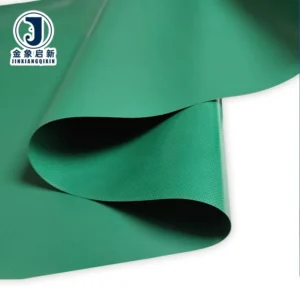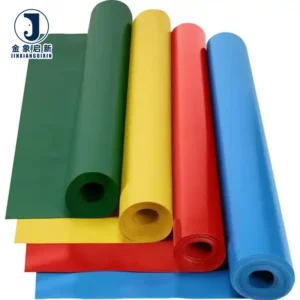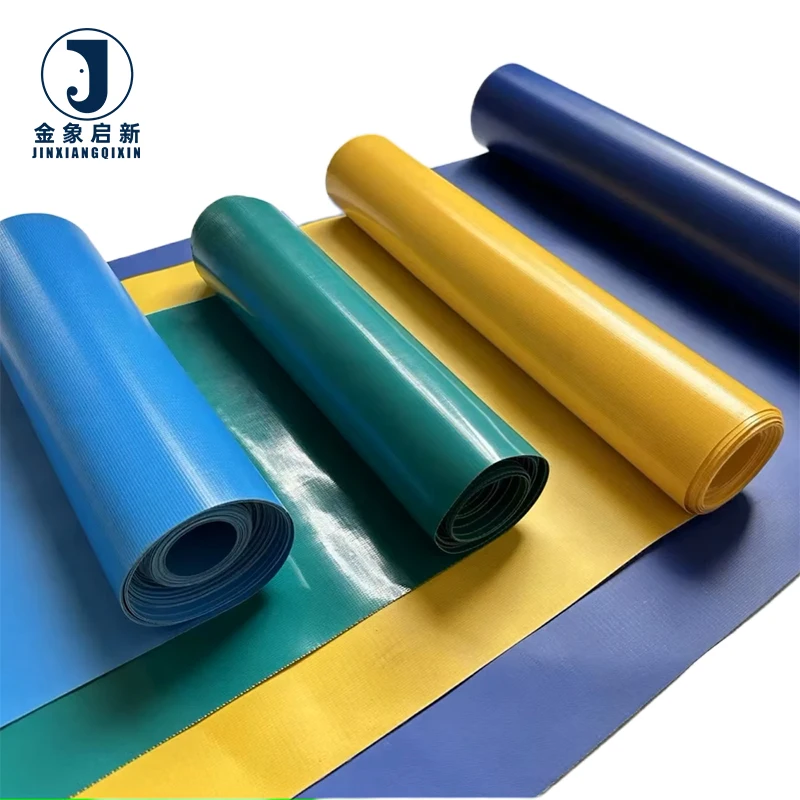
Roll-to-roll consistency — every batch of PVC Tarpaulin Roll produced on dedicated lines undergoes 100% pre-shipment weight and colour verification before dispatch to transport fleets.
Technical Specifications
| Parameter | Value |
|---|---|
| Product Type | PVC Coated Tarpaulin |
| Weight Range | 250gsm-1500gsm (select grade per load and exposure) |
| Base Fabric Denier | 200Dx300D, 500Dx500D, 840Dx840D, 1000Dx1000D |
| Coating Material | PVC |
| Colour Options | Blue, yellow, black, green, white, etc. |
| Size Options | 3x4m, 6x8m, 8x10m, 10x12m or custom made |
| Surface Finish | Glossy or matte |
| Temperature Range | -15°C to 70°C |
| Key Features | Waterproof, anti-fungal treated, available in UV and flame retardant grades |
Application Suitability
| Application | Exposure & Requirement |
|---|---|
| Truck and trailer side curtains | Continuous road vibration, flex fatigue at buckle and tie-down points, weather and UV exposure |
| Flatbed load covering | Abrasion from load shift, wind flap stress, prolonged sunlight on horizontal surfaces |
| Construction site equipment covers | Dust, debris impact, standing water, UV degradation over multi-month site storage |
| Tent and awning fabrication | Tension loading on seams, repeated folding and deployment, colour matching across panels |
Why Specified GSM Does Not Guarantee a Reliable Truck Cover
A quoted weight only matters when the actual roll matches it at the point of delivery.
Fleet operators routinely receive PVC Coated Tarpaulin for Truck Cover shipments that arrive lighter than the specification on the purchase order. The deficit is not always obvious on a single panel but becomes visible once the fabric is tensioned over a load — thinner sections flex more, abrade faster at contact points and fail at the seam before the rest of the cover reaches its expected service interval. Weight variation within a single order also creates visible colour shift between adjacent panels on the same vehicle. [NEED_CITE: tensile and tear test methods for coated fabrics per ISO 1421]
Matching Denier to Load Profile and Route Conditions
The base fabric denier directly controls how the material behaves under the tie-down straps and at the corners where the cover wraps the load. A 200Dx300D weave suits light-duty short-haul covers that are deployed and removed frequently, while a 1000Dx1000D construction is specified for heavy plant equipment and long-distance routes where road vibration and wind flap are constant. Selecting the correct PVC Tarpaulin Roll grade at the inquiry stage avoids the cost of premature replacement in the field.
Controlling Seam Integrity at High-Flex Zones
Truck covers fail most often at the welded joint where the fabric doubles back to form the hem and eyelet line. The coating adhesion and the heat-weld parameters must suit the exact GSM and surface finish of the roll in use. Glossy and matte surfaces respond differently to hot-air welding temperature and dwell time, so the fabrication settings need to be confirmed with a test weld before the full run proceeds. [NEED_CITE: DIN 4102 fire classification for building materials]
Reading the Specification Beyond the Weight Figure
GSM alone does not define how a PVC Coated Tarpaulin for Truck Cover will perform on the road. A 650 gsm fabric woven from 500Dx500D yarns will tear differently from a 650 gsm fabric built on a 1000Dx1000D base with a lighter coating — the first relies on yarn density for tear resistance, the second on coating thickness for puncture protection. Coating adhesion method also affects how well the layers bond under heat welding, which in turn determines whether the seam or the fabric fails first under load flex. Surface finish choice between glossy and matte influences dirt shedding, print adhesion for fleet branding and long-term colour retention under direct sunlight.
The Field Cost of an Underspecified Roll
When a logistics fleet specifies a cover material without matching the denier to the actual load weight and route conditions, the covers develop pinholes at the abrasion points within the first few months. Replacing a full set of truck curtains costs more in vehicle downtime and fabrication labour than selecting the correct PVC Tarpaulin Roll grade at the start. Colour inconsistency between rolls in the same delivery forces the fabricator to sort and match panels manually, adding days to the production schedule. [NEED_CITE: common failure modes in heavy-duty transport covers]
Production Control Behind Consistent Delivery
Three full production lines and 36 sets of professional equipment support bulk roll output with controlled coating weight across every batch. A 10-person R&D team develops samples within days for custom width, colour and print requirements. Dedicated QA/QC inspection at every stage checks GSM, colour and adhesion before the roll is cleared for packing. Full material specification sheets, test reports for applicable grades and pre-shipment inspection records accompany every dispatch.
Documentation & Verification
- Material specification sheet confirming the exact GSM, base fabric denier and coating weight for each roll shipped
- Flame retardant test report matching the grade and standard required at the destination market
- Anti-UV treatment documentation stating the test basis and exposure rating achieved
- Roll packing list with individual roll weights and batch traceability numbers
- Pre-shipment inspection record confirming colour consistency across all rolls in the order
- ISO and CE certificates available for compliance documentation
Fabrication, Handling & Storage
- Confirm hot-air weld temperature and dwell time against the exact GSM and glossy or matte surface of the roll
- Reinforce eyelet and hem zones with an additional layer matched to the base fabric denier
- Store rolls upright on end cores to prevent flat-spot creasing on the coating surface
- Allow cold-stored rolls to acclimatise above 10°C before unrolling to avoid coating micro-cracking
- Use mild detergent for cleaning; solvent-based agents can degrade the anti-fungal treatment layer
- Plan panel cutting layout to minimise off-cuts, especially on custom width rolls
Project Specification and Sample Request
Provide the specific truck or trailer model, the typical load profile and the climate conditions on your main routes so the correct denier and treatment grade can be recommended. Confirm whether your target market requires a specific flame retardant classification and whether you need the material supplied in roll form or as finished cut panels. Include your annual volume estimate and colour requirements to receive a lead time and sample development schedule.
Frequently Asked Questions
Q: How do you match the truck cover size to a specific trailer model?
A: We work from the exact trailer dimensions including the curtain rail profile, buckle spacing and corner radius to recommend the panel size and eyelet layout. Custom sizing eliminates field trimming and ensures the PVC Coated Tarpaulin for Truck Cover tensions correctly without excess material that flaps in transit and accelerates wear at the edges.
Q: Can flame retardant grades be verified with documentation?
A: Available in flame retardant grades — confirm the grade required for your market. Where a specific classification is needed, the test report is supplied with the shipment showing the standard and result. This avoids rejection at site inspection or during fleet compliance audits in jurisdictions that mandate documented fire performance.
Q: How is colour consistency maintained across multiple rolls?
A: Every roll in a single production run is checked at the dedicated QA/QC stage before packing. The pre-shipment inspection record confirms colour match, and any roll falling outside the tolerance is held back. This prevents the visible panel mismatch that occurs when adjacent truck curtains are sewn from rolls with slight colour drift.
Q: Do welded seams hold up at the high-flex points on a load?
A: The weld strength depends on matching the heat and dwell settings to the exact GSM and finish of the roll. We provide fabrication guidance with each PVC Tarpaulin Roll shipment and recommend a test weld on the actual material before the production run starts, ensuring the seam matches the fabric strength at the points where the load flexes most.