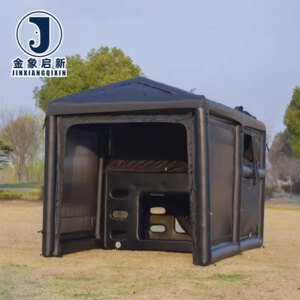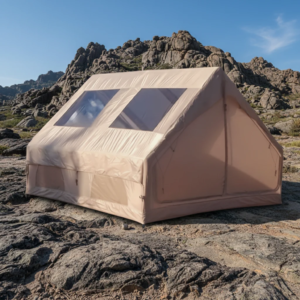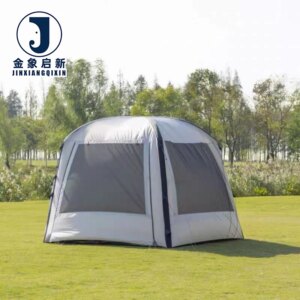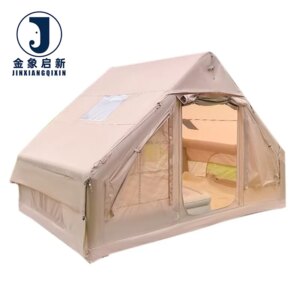
Deep process control over coating weight and adhesion — Nearly 30 years focused on coated PVC fabric, applied here to inflatable disaster relief tent structures that must hold internal pressure without delamination at the seams.
Technical Specifications
| Parameter | Value |
|---|---|
| Product Type | Inflatable Disaster Relief Tent |
| Core Material | PVC Tarpaulin |
| Waterproof Rating | 3000mm |
| Season Rating | 4-Season |
| Capacity | 2-8 Person |
| Product Form | Extended Type |
| Construction | Single Layer |
| Deployment | Quick Automatic Opening |
| UV Treatment | Anti-UV (test basis not stated in source) |
| Flame Retardant | Available in flame retardant grades — confirm the grade required for your market |
| Temperature Resistance | High heat and freezing conditions |
| Customization | OEM & ODM (size adjustments, pattern printing, material thickness modifications) |
| Standards | ISO9001, ISO14001, ISO45001, CE |
Application Suitability
| Application | Exposure & Requirement |
|---|---|
| Emergency response logistics hubs | Rapid deployment under time pressure, frequent relocation, exposure to rain and wind |
| Temporary storage during infrastructure projects | Continuous outdoor weathering, UV exposure, dust and debris ingress prevention |
| Mobile command centers at construction sites | Structural stability under wind load, repeated inflation cycles, temperature fluctuation |
| Equipment sheltering in remote locations | Prolonged sun exposure, freezing nights, limited maintenance access |
| Disaster preparedness stockpiles | Long-term storage before deployment, readiness after extended warehouse storage |
Why Waterproof Ratings Matter More Than Marketing Claims in Emergency Shelters
A stated 3000mm waterproof rating only holds if the seams and valve interfaces are tested to the same standard.
Procurement teams ordering inflatable disaster relief tents for emergency stockpiles often discover after deployment that water ingress occurs not through the fabric but through welded seams and inflation ports. The fabric itself may perform as specified, yet the assembled unit fails under sustained rainfall. [NEED_CITE: seam waterproof testing methods for inflatable structures] This gap between material specification and assembled performance causes site teams to improvise secondary covers, delaying operations when speed matters most. An inflatable disaster relief Tent manufacturer that verifies waterproof integrity at the finished-unit level — not just the roll — closes this gap before shipment.
Covering a Moving Operation: Shelter That Deploys When Infrastructure Does Not Exist
Fleet operators and emergency logistics managers need shelters that arrive flat-packed, inflate with minimal personnel, and hold their shape through wind and rain. The quick automatic opening mechanism on this inflatable disaster relief tent reduces setup labor, which matters when a two-person team is managing an entire staging area. The 4-season temperature resistance keeps the PVC tarpaulin pliable in freezing conditions and dimensionally stable under high heat, preventing the sag or brittleness that compromises inflatable structures at temperature extremes.
Fitment and Integration at the Point of Use
Transport equipment builders and disaster response coordinators specify shelters that integrate with existing site infrastructure — anchoring to vehicle decks, connecting to adjacent units, or standing alone on unprepared ground. The extended-type form factor provides usable interior volume for command equipment or personnel rest areas. OEM sizing adjustments allow the inflatable disaster relief tent to match specific footprint constraints at staging areas or alongside parked fleet vehicles. Pattern printing supports organizational identification without aftermarket modification. [NEED_CITE: inflatable structure anchoring standards for temporary installations]
Reading the Specifications That Determine Field Performance
The 3000mm waterproof rating indicates the hydrostatic head pressure the PVC tarpaulin can withstand before water penetrates — relevant for sustained heavy rainfall on horizontal and inclined surfaces. This rating must be read alongside seam construction: heat-welded joints on PVC-coated fabric achieve waterproof continuity only when temperature, pressure, and dwell time are controlled per material thickness. The 4-season designation reflects the plasticizer formulation’s resistance to low-temperature embrittlement and high-temperature softening, both of which affect the inflatable structure’s ability to maintain internal pressure. Single-layer construction reduces packed weight and deployment time while relying on the coating’s inherent insulation properties. The PVC tarpaulin base fabric’s denier and weave density determine how well the inflated form resists puncture from ground debris and handling abrasion during repeated setup and pack-down cycles.
The Hidden Cost of Specification Shortcuts in Relief Procurement
Batch-to-batch inconsistency in coating weight means the first tent in a container may perform differently from the last. Waterproof ratings verified on one production run do not automatically carry to the next without documented in-process checks. [NEED_CITE: coating weight variance impact on waterproof performance in PVC tarpaulins] Inflatable structures are particularly sensitive to this because seam weld parameters must match the actual coating thickness — a lighter coat welds through; a heavier coat fails to bond. Procurement teams that accept quotation specifications without batch-level verification risk receiving units that delaminate at the seams during the first inflation cycle, rendering an entire emergency stockpile unreliable.
Why Procurement Teams Source This Inflatable Fabric Here
Three full production lines and 36 sets of processing equipment support volume orders for disaster preparedness programs without splitting production across external workshops. A 10-person R&D team handles material selection and sample development, producing prototypes within days for custom sizing or pattern printing requirements. Dedicated QA and QC staff inspect every production stage — coating adhesion, weld integrity, valve seating, and final inflation testing — with 100% pre-shipment verification. Batch-specific inspection records accompany each shipment, providing traceability that compliance-driven procurement requires. ISO9001, ISO14001, ISO45001, and CE certifications are maintained and documented, not claimed without evidence.
Documentation & Verification
- Material specification sheet stating waterproof rating, material thickness, and base fabric construction per batch
- Pre-shipment inflation test record with waterproof verification at seams and valve interfaces
- Batch-specific quality inspection report detailing coating adhesion and weld integrity results
- ISO9001, ISO14001, ISO45001, and CE certificates included with customs documentation
- Roll packing list with weight verification against stated material thickness before dispatch
- Certificate of origin and export documentation for cross-border emergency procurement
Fabrication, Handling & Storage
- Heat-weld seams at temperatures matched to the PVC tarpaulin thickness — verify weld parameters with sample before production runs
- Store inflated units dry and out of direct sunlight to prevent UV degradation of the anti-UV treated surface over extended warehouse periods
- Avoid folding the PVC tarpaulin at sharp creases during packing to prevent coating crack initiation at fold lines
- Clean with mild detergent only — solvent-based cleaners attack the plasticizer formulation that maintains 4-season flexibility
- Inspect valve seats and inflation ports before each deployment cycle to ensure airtight seal integrity
- Repair minor punctures with compatible PVC adhesive patches applied to clean, dry surfaces
What to Include in Your Inquiry
Provide the deployment climate range and expected wind conditions at your staging locations so we can confirm the 4-season formulation suits your operating environment. Specify whether you need standard capacity configurations or custom dimensions matched to particular vehicle footprints or site layouts. Indicate any pattern printing or organizational identification requirements, along with your target delivery window and order volume, so we can align production scheduling to your preparedness timeline. Confirm whether flame retardant certification is required for your jurisdiction and which grade applies.
Frequently Asked Questions
Q: What capacity and dimension options are available for custom orders?
A: The inflatable disaster relief tent is produced in 2-8 person configurations with OEM and ODM customization for size adjustments, pattern printing, and material thickness modifications. Sample development is available within days for custom requirements, allowing you to verify dimensions, inflation behavior, and anchoring compatibility before committing to full production volume.
Q: How is waterproof performance verified before shipment?
A: Each batch undergoes pre-shipment inflation testing with waterproof verification at seams, valve interfaces, and fabric surfaces. The 3000mm waterproof rating is documented per batch in the inspection report, which accompanies your shipment. This ensures the assembled unit — not just the raw PVC tarpaulin — meets the stated performance specification.
Q: What production capacity supports large-volume disaster preparedness orders?
A: Three full production lines and 36 sets of processing equipment handle volume requirements for emergency stockpile programs. Production scheduling is aligned to your delivery timeline once sample approval is complete, and batch-level quality documentation ensures consistency across the entire order quantity.
Q: How does the 4-season design perform in extreme temperature conditions?
A: The PVC tarpaulin formulation maintains flexibility in freezing conditions and structural stability under high heat, preventing the brittleness or sag that compromises inflatable structures at temperature extremes. Confirm your specific operating range during inquiry so we can verify the formulation matches your deployment environment.
Q: What documentation is included with each shipment?
A: Each shipment includes a material specification sheet, batch-specific quality inspection report, pre-shipment inflation test record, ISO and CE certificates, packing list, and certificate of origin. Flame retardant test reports are provided where applicable to the grade specified in your order, supporting compliance verification at destination.