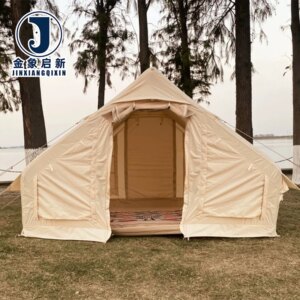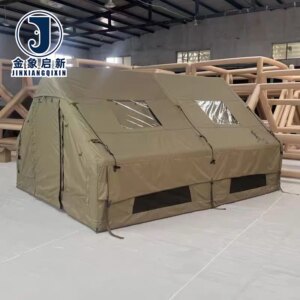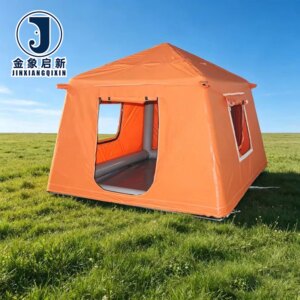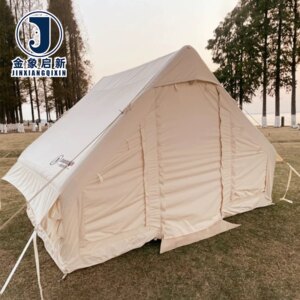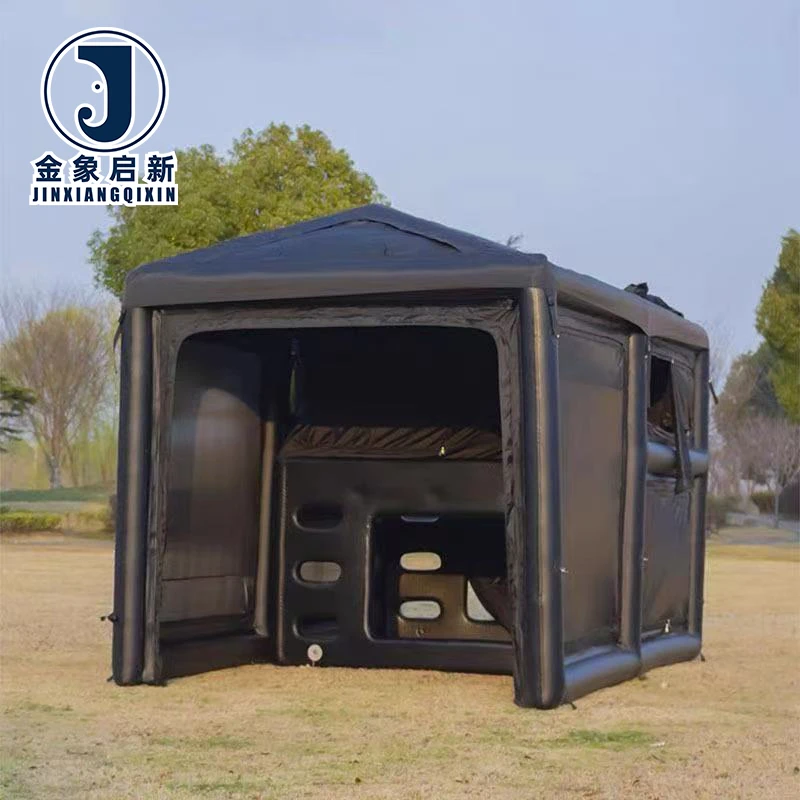
Deep Process Control — Knife-coated PVC fabric produced across three dedicated lines with 100% pre-shipment inspection, ensuring every roll of inflatable tent fabric ships with verified performance data and test-backed documentation.
Technical Specifications
| Parameter | Value |
|---|---|
| Product Type | Inflatable Tent Fabric |
| Core Material | PVC Tarpaulin (knife-coated fabric) |
| Coating Method | Knife coated |
| Waterproof Rating | Hydrostatic head ≥ 5000mm |
| UV Treatment | UPF 50+ (test basis not stated in source) |
| Flame Retardant Grade | EN 13501-1 Class B |
| Tear Strength | ≥ 300N (test standard not stated in source) |
| Anti-Static | Surface resistance 10^6–10^9Ω |
| Material Thickness Range | 0.4mm–1.2mm (range covers product family — confirm the grade for this item) |
| Customization | OEM & ODM, size adjustments, pattern printing, reinforced seams |
| Sample Lead Time | 7–10 days |
| Maximum Lead Time for Custom Orders | 45 days |
| Certifications | ISO 9001, ISO 14001, ISO 45001, CE |
Application Suitability
| Application | Exposure & Requirement |
|---|---|
| Commercial inflatable shelter manufacturing | Repeated inflation cycles, structural flex under wind load, all-season weather exposure, fire safety compliance for public use |
| Construction site temporary inflatable facilities | Abrasive ground contact, UV degradation from continuous outdoor deployment, anti-static requirements in dust-heavy environments |
| Four-season camping equipment lines | Hydrostatic pressure from sustained rainfall, UV intensity at altitude, tear resistance at inflation stress points, certified flame retardancy for campsite regulations |
| Mining and tunnelling inflatable structures | High particulate exposure, anti-static surface requirements, fire-retardant compliance for underground and confined-space use |
| Outdoor event and exhibition inflatable marquees | Frequent assembly and teardown cycles, public safety fire codes, colour consistency across multiple units for branded installations |
Why Certification Gaps in Inflatable Tent Fabric Cost More Than You Think
Every batch ships with test-backed flame-retardant and anti-static certificates — not a claim on a data sheet.
Commercial inflatable shelters face scrutiny from fire marshals, site safety officers, and insurance assessors who demand documented proof of compliance, not a supplier’s assurance. When inflatable tent fabric for commercial outdoor equipment arrives without a verifiable EN 13501-1 Class B certificate or an anti-static test report, the entire installation can be rejected at inspection. [NEED_CITE: fire safety compliance requirements for temporary inflatable structures in commercial venues]
The cost of that rejection extends far beyond the fabric itself — project timelines slip, contractor penalties apply, and the reputational damage with the end client compounds. Sourcing PVC inflatable tent fabric with batch-specific documentation eliminates this risk before production even begins.
Knife-Coated Construction for Inflation Cycle Durability
Inflatable tent structures demand fabric that withstands repeated pressurisation and deflation without delamination or coating fracture. The knife-coated PVC construction bonds the coating directly to the base fabric under controlled tension, producing a composite material with high peel strength at the coating-to-yarn interface. This matters because inflatable tent fabric for commercial outdoor equipment flexes continuously at seam lines and inflation ports where stress concentrates during each setup cycle.
Anti-Static Performance Where Dust and Particulates Accumulate
Inflatable structures used on construction sites, in mining operations, or at outdoor industrial events accumulate fine particulate matter on their inner and outer surfaces. An anti-static surface resistance of 10^6–10^9Ω dissipates charge buildup that would otherwise attract dust, create discharge hazards near electrical equipment, or interfere with sensitive instrumentation housed inside the shelter. [NEED_CITE: anti-static surface resistance standards for temporary industrial structures]
Reading the Specifications That Actually Matter for Inflatable Shelters
The hydrostatic head rating of ≥ 5000mm indicates the fabric can resist water penetration under sustained rainfall and pooling conditions — critical for four-season camping tents and commercial shelters deployed in wet climates. Knife coating, as opposed to lamination or calendering, delivers superior adhesion between the PVC layer and the base fabric, which directly affects how well the material holds up during heat welding at seam intersections. Tear strength ≥ 300N provides a baseline for resistance to tear propagation once the fabric is punctured or cut during installation, though the actual test standard governing this value should be confirmed for your market’s reporting requirements. Flame retardancy certified to EN 13501-1 Class B aligns with European construction product fire classification, but buyers targeting North American or Australian markets should verify whether additional classifications such as NFPA 701 or AS 1530 are required for their jurisdiction. [NEED_CITE: EN 13501-1 fire classification methodology for coated textile products]
The Hidden Consequences of Specifying Inflatable Fabric Without Verification
When flame retardant grades are claimed but not supported by a batch-specific test certificate, the fabric may pass initial visual inspection yet fail when the fire safety assessor requests documentation. Colour inconsistency between rolls in the same order becomes visible once panels are heat-welded side by side on a branded inflatable marquee, forcing a complete teardown and reorder. Anti-static treatment that degrades after the first few inflation cycles leaves the structure vulnerable to dust adhesion and static discharge in environments where electrical equipment operates. Welded seams that fail before the fabric itself does typically trace back to incorrect heat-weld temperature settings for the specific coating formulation — a problem that surfaces under load at the flex points of the inflatable frame. [NEED_CITE: common failure modes in welded seams of PVC-coated inflatable structures]
Why Production Capability Matters for Inflatable Fabric Orders
Three full production lines and 36 sets of processing equipment support volume roll orders with consistent coating weight and thickness across the entire batch. The 10-technician R&D team develops pre-production samples within 7–10 days, allowing OEM buyers to validate material behaviour under their specific inflation pressure and seam construction before committing to mass production. A 100% pre-shipment inspection protocol checks dimensional accuracy, coating adhesion, and surface quality on every roll before dispatch. Dedicated quality control at each production stage — from base fabric inspection through coating, curing, and winding — catches deviations before they compound into batch-wide defects. Customisation options including pattern printing, reinforced seam zones, and size adjustments are handled in-house rather than outsourced to third-party converters, maintaining traceability throughout the supply chain.
Documentation & Verification
- Material specification sheet stating coating method, thickness, and colour reference for each roll
- EN 13501-1 Class B flame retardant test certificate included with every shipment
- Anti-static surface resistance test report verifying 10^6–10^9Ω performance per batch
- Pre-shipment inspection record covering dimensional accuracy and surface quality
- ISO 9001, ISO 14001, ISO 45001, and CE certificates available for compliance auditing
- Five-year batch traceability records linking roll data to raw material origin
Fabrication, Handling & Storage
- Heat-weld parameters must be calibrated to the specific knife-coated PVC formulation — request recommended temperature and dwell time settings before production
- Reinforced seam zones should be specified at inflation ports and high-stress junctions to prevent peel failure under cyclic pressurisation
- Store rolls horizontally on padded racks in a dry, shaded environment to prevent surface embossing and coating compression marks
- Allow cold-stored rolls to acclimatise to workshop temperature before unrolling to avoid cracking the PVC coating at low flex temperatures
- Use PVC-compatible cleaners only — solvent-based products can degrade the knife-coated surface and compromise flame-retardant treatment
- Plan cutting layouts to minimise waste across the available thickness range and confirm usable roll width before finalising panel dimensions
What We Need to Quote Your Inflatable Tent Fabric Order
Provide your target thickness within the available range, the inflation pressure your frame design operates at, and the fire-safety classification required by your end market. Let us know whether you need rolls for in-house fabrication or pre-cut panels with reinforced seam allowances, and share any colour or pattern printing requirements for branded tent production.
Frequently Asked Questions
Q: Does the flame retardant grade EN 13501-1 Class B meet fire safety codes outside Europe?
A: EN 13501-1 Class B is widely referenced across European and Middle Eastern markets for temporary structures. Buyers in North America, Australia, or other regions should confirm whether local fire codes accept this classification or require supplementary testing to standards such as NFPA 701 or AS 1530. We provide batch-specific test certificates with every shipment and can arrange additional testing upon request.
Q: How is anti-static surface resistance verified before the fabric ships?
A: Each production batch undergoes surface resistance testing to confirm performance within the 10^6–10^9Ω range. The test report is included in the shipping documentation package alongside the flame retardant certificate. This ensures inflatable structures deployed in dust-heavy or electrically sensitive environments meet workplace safety requirements from the moment they are inflated on site.
Q: What thickness should I specify for my inflatable tent frame design?
A: The available thickness range spans 0.4mm to 1.2mm across the product family. Thinner grades suit lightweight camping shelters with lower inflation pressures, while heavier grades provide greater tear resistance and air retention for commercial and industrial structures. Share your operating pressure and expected wind load so we can recommend the appropriate grade for your application.
Q: How do you control colour consistency across multiple rolls for a single order?
A: Pigment batching is controlled at the coating stage with spectrophotometric verification against the approved colour reference. Rolls within the same order are produced sequentially on the same line to minimise variation. This is critical for branded inflatable tents where panels from different rolls are heat-welded side by side and any colour shift becomes immediately visible.
Q: What seam reinforcement options are available for high-stress inflation points?
A: Reinforced seam zones, additional coating layers at weld lines, and custom heat-weld parameters can be specified during the sample development phase. Our R&D team validates seam peel strength on pre-production samples before mass production begins, ensuring the welded joint matches or exceeds the base fabric performance under repeated inflation cycles.