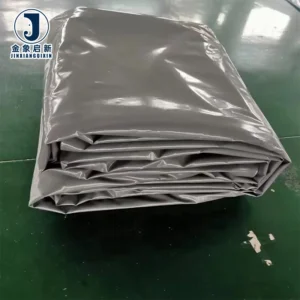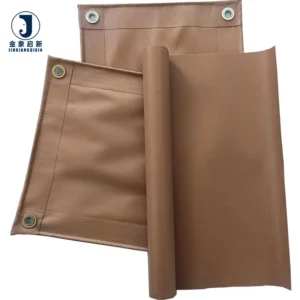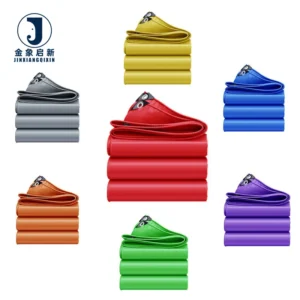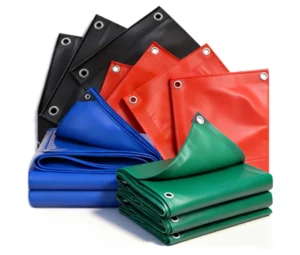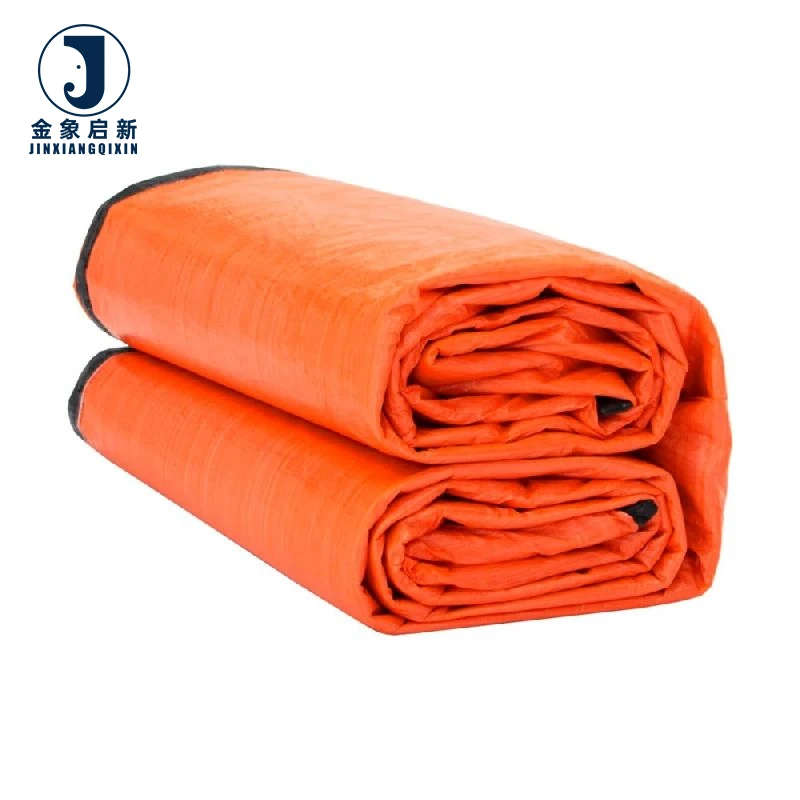
Proven Coating Process Control — Nearly three decades of coating fabric production experience with dedicated QA/QC at every stage, ensuring thickness, color and grommet spacing match the agreed specification for every insulated tarpaulin roll or cut piece.
Technical Specifications
| Parameter | Value |
|---|---|
| Product Type | Insulated PE Tarpaulin |
| Dimensions | 6ftx24ft, 8ftx25ft, 12ftx20ft, 12ftx24ft |
| Thickness Options | 2x2mm, 3×1.5mm, 1x4mm, 5mm, 6mm, 8mm, 12mm |
| Material Structure | PE cloth + closed cell PE foam core + PE cloth |
| Color Options | Orange, Black, White, Silver, Customized color |
| Grommet Configuration | Aluminum holes, hole distance 61cm and 91.5cm |
| Waterproof | Yes |
| UV Treatment | Yes (test basis not stated) |
| Mildew Resistant | Yes |
| Edge Finish | Finished stitched edges with reinforcement stitch |
Application Suitability
| Application | Exposure & Requirement |
|---|---|
| Concrete curing blanket | Low temperature exposure, thermal retention for controlled slab curing, ground moisture contact |
| Construction cold weather enclosure | Wind pressure, snow loading, heated interior temperature differential, abrasion from scaffolding contact |
| Heated enclosure insulation | Temperature differential across fabric, repeated installation and removal cycles, tie-down stress at grommets |
| Building enclosure and wind block | Sustained wind load, UV exposure on vertical surfaces, water shedding from rain and sleet |
| Transport load covering | Road vibration, wind deflection at highway speed, thermal protection for temperature-sensitive cargo |
Why Grommet Spacing Matters More Than Grommet Count on Insulated Tarps
Generic grommet spacing leads to wind-induced flapping that tears the fabric before the foam core ever reaches its service limit.
When an Insulated PE Tarpaulin for truck and transport covering is cut to a standard panel and grommets are punched at arbitrary intervals, the unsupported span between tie-down points becomes the failure zone. In crosswinds or at highway speed, the fabric billows between anchors. That billowing concentrates stress at the edge stitch line, not at the grommet itself. I have seen insulated panels where the brass ring held perfectly but the surrounding PE cloth tore in a straight line between two anchor points. The thicker the foam core, the more surface area catches wind, and the shorter the grommet distance must be to keep deflection under control. [NEED_CITE: wind load calculation methods for flexible temporary enclosures]
Closed-Cell Foam Core and Thermal Separation
The triple-layer build — PE outer cloth, closed cell PE foam core, and PE inner cloth — creates a thermal break that separates the exposed surface temperature from the protected side. Closed-cell structure means the foam does not absorb moisture when the outer layer is breached or when condensation forms on the cold face. This keeps the insulation value stable through wet and freeze-thaw cycles. The Insulated PE Tarpaulin is available in thickness grades from 2x2mm to 12mm, allowing specifiers to match the core depth to the temperature differential the panel must handle.
Reinforcement Stitching at Flex Points
Finished stitched edges with reinforcement stitch address the most common failure line on insulated panels. Where a flat tarp simply folds at the hem, an insulated panel carries a rigid foam core that creates a hard transition between the flexible edge and the stiff body. That transition point flexes every time the panel is installed, removed, or loaded by wind. The reinforcement stitch distributes load across a wider thread path than a single needle line, reducing the chance that edge failure propagates into the panel body. This matters on construction sites where curing blankets are repositioned daily and enclosure panels are rolled and unrolled with the season. [NEED_CITE: edge failure modes in multi-layer insulated fabric panels]
Reading the Thickness Specification Beyond a Single Number
The thickness options listed for this Insulated PE Tarpaulin — 2x2mm, 3×1.5mm, 1x4mm, 5mm, 6mm, 8mm, 12mm — describe the total composite build, not the foam core alone. A 2x2mm panel sandwiches a thinner foam core between two PE cloth layers, resulting in a flexible sheet suited to wrapping curved surfaces or draping over irregular loads. A 1x4mm panel carries a thicker core behind a single outer layer, offering higher insulation value with less overall weight. The 8mm and 12mm grades provide maximum thermal separation for applications like heated enclosure walls or concrete curing in sub-zero conditions. Selecting the right build depends on the balance between insulation requirement, panel weight, and the flexibility needed for installation. The PE cloth outer layers provide the waterproof surface and UV-exposed face, while the closed cell foam core carries the thermal resistance. Understanding this layer breakdown prevents specifying a thickness that is heavier than needed for the actual temperature differential on site.
The Hidden Cost of Ordering Off-the-Shelf Sizes
When a contractor orders a generic panel size and forces it to fit a specific trailer deck or enclosure frame, the excess material either bunches at the edges or falls short of the anchor rail. Bunched material traps water and creates a path for wind to get underneath. Short panels leave gaps that defeat the insulation purpose entirely. On concrete curing jobs, a panel that does not fully overlap the slab edge lets cold air undercut the blanket, creating a strip of under-cured concrete along the perimeter. Custom sizing eliminates both problems. The same applies to grommet spacing: if the tie-down rail on a trailer sits at 61cm intervals but the panel grommets are punched at 91.5cm, every third anchor point goes unused and the load shifts to the remaining rings. [NEED_CITE: tie-down load distribution on flexible transport covers]
Why Source Insulated PE Tarps Through a Coating-Fabric Manufacturer
Nearly 30 years of focused coated fabric production means the PE lamination and foam bonding process is controlled in-house rather than assembled from outsourced layers. Three full production lines and 36 sets of professional equipment support bulk panel runs with consistent bonding across the foam core, reducing the risk of delamination at the edges. A 10-person R&D team handles custom sizing, grommet layout and color matching before production begins, so the first panel off the line matches the approved sample. Dedicated QA/QC at every production stage with 100% inspection before shipment catches thickness variation and grommet misalignment before the panels leave the facility. Samples are developed within days for custom size, color and grommet configuration, allowing buyers to verify fit and insulation performance before committing to a full order.
Documentation & Verification
- Material specification sheet stating foam core thickness, PE cloth grade and color reference for each panel batch
- Pre-shipment inspection record confirming grommet spacing at 61cm or 91.5cm as ordered
- Dimensional check per panel against custom size drawing before dispatch
- UV treatment test documentation provided where grade is specified at inquiry stage
- Roll and cut-piece packing list with panel count, thickness grade and color allocation
- Certificate of origin and customs documentation for export shipments
Fabrication, Handling & Storage
- Stitch reinforced edges require UV-stable thread matching the PE cloth weight to avoid differential degradation
- Grommet insertion on 12mm panels needs longer barrel brass or aluminum rings to span the full composite thickness
- Fold insulated panels foam-side inward to prevent permanent crease marks on the closed cell core
- Store rolls flat or vertically supported to avoid compression flat spots on the foam core
- Clean PE cloth surfaces with mild detergent; solvent-based cleaners can attack the lamination bond
- Field repair of edge stitch failure requires matching thread weight and stitch spacing to the factory reinforcement
What to Include in Your Insulated PE Tarpaulin Inquiry
Provide the exact panel dimensions or trailer model so the cutting pattern matches the tie-down rail layout. Specify the operating temperature range and whether the panel will serve as a concrete curing blanket, enclosure wall, or cargo cover, as this determines the foam core thickness required. Confirm grommet spacing preference — 61cm or 91.5cm — and state any custom color or branding requirement. If ordering for a fleet or a multi-phase construction project, indicate the total panel count and whether you need samples before the full production run.
Frequently Asked Questions
Q: How do I verify the foam core thickness on arrival matches the specification?
A: Each shipment includes a pre-shipment inspection record that documents the measured thickness of every panel batch. On receipt, you can cross-check at the panel edge where the triple-layer structure — PE cloth, closed cell PE foam, PE cloth — is visible at the cut line. Any discrepancy should be reported against the material specification sheet provided with the dispatch documentation.
Q: Can I get grommets configured for my specific trailer tie-down rail?
A: Yes. Grommet spacing is available at 61cm or 91.5cm as standard, and custom distances can be set to match your rail layout. Provide the trailer model or a dimensioned drawing of the anchor points. A sample panel with the proposed grommet configuration is produced for fit verification before the full order runs.
Q: What thickness is appropriate for concrete curing versus site enclosure?
A: Concrete curing blankets typically use thinner builds such as 2x2mm or 3×1.5mm, which provide thermal retention while remaining flexible enough to drape over slab edges. Site enclosures facing sustained wind and larger temperature differentials often require 6mm, 8mm or 12mm panels for structural rigidity and higher insulation value. Confirm the temperature range and wind conditions with your project engineer.
Q: How is color consistency maintained across multiple panels in one order?
A: All panels in a single production run use PE cloth from the same dye batch, and the 100% pre-shipment inspection includes a visual color check across panels laid side by side. The pre-shipment inspection record notes any variation detected. For multi-phase projects spanning separate production runs, color reference samples from the first batch are retained and matched on subsequent orders.
Q: What UV exposure documentation comes with the panels?
A: UV treatment is integrated into the base PE fabric. Where a specific UV grade or test standard is required for your market or project specification, confirm the grade at inquiry stage so the appropriate test documentation can be included with the shipment. Standard panels ship with a material specification sheet noting UV treatment as applied.