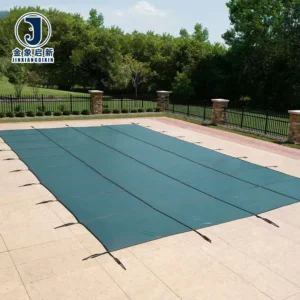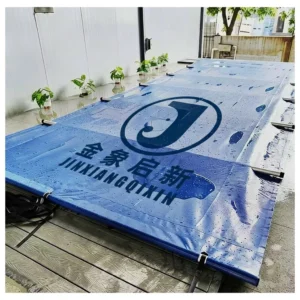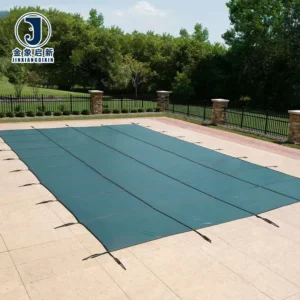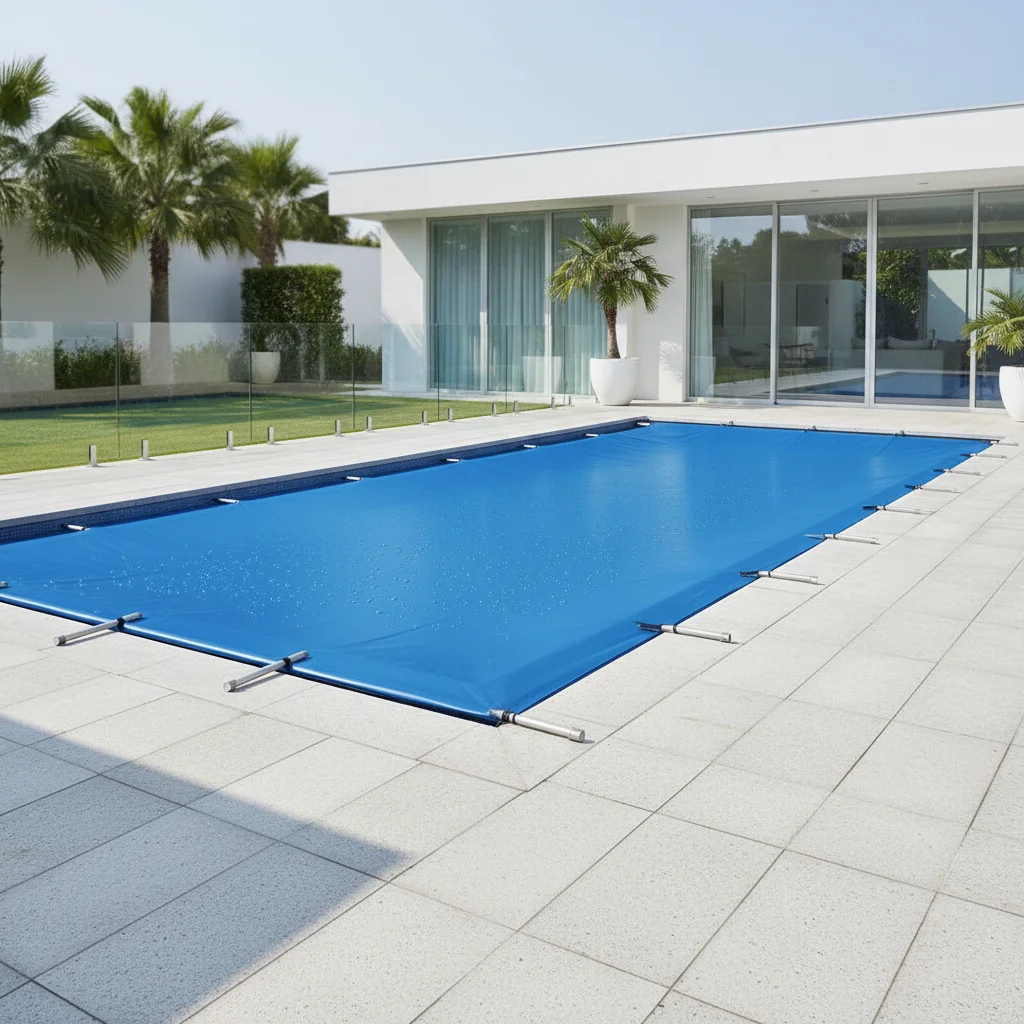
Precision Coating Control — Three full production lines and 36 sets of equipment maintain consistent lamination weight across every roll of PVC pool cover tarpaulin, ensuring the GSM you order is the GSM you receive.
Technical Specifications
| Parameter | Value |
|---|---|
| Product Type | PVC Coated Tarpaulin for Pool Cover |
| Base Material | PVC + High-strength polyester mesh fabric |
| Coating Technology | Laminated technology / Hot-melt coating technology |
| Weight Options | 350 gsm / 420 gsm / 500 gsm / 550 gsm / 600 gsm / 750 gsm |
| Thickness Options | 0.32 mm / 0.35 mm / 0.4 mm / 0.45 mm / 0.5 mm / 0.65 mm |
| Roll Dimensions | 2 m × 75 m / 2.1 m × 50 m |
| Finished Product Sizing | Custom cut to customer dimensions or sold from inventory |
| Colour Range | Blue / Red / Yellow / Light Blue / Grey (customised on request) |
| Key Features | Waterproof, cold crack resistance, anti-mildew treatment, anti-static treatment (grade not stated in source — confirm requirement), outstanding tearing strength for welding, high colour fastness |
| Flame Retardant | Available in flame retardant grades — confirm the grade required for your market |
| Standards | ISO, CE |
Application Suitability
| Application | Exposure & Requirement |
|---|---|
| Swimming pool cover — residential and commercial | Continuous UV exposure, standing water contact, wind uplift tension at anchor points |
| Fish tank and aquaculture pond cover | Permanent water immersion, biological contamination, anti-mildew demand |
| Flatbed water tank transport cover | Road vibration, tie-down abrasion, flex stress at load edges, weather exposure |
| Rectangular pool with aluminium bar fitment | High tension across large spans, ratchet pull-out force at seam lines |
| Custom-contour pool with hook system | Irregular geometry, concentrated stress at hook attachment points, repeated removal and reinstallation |
When a Pool Cover Specification Fails at the Anchor Line
A cover that tears at the tie-down point before the fabric body fails is almost always a lamination adhesion problem, not a GSM problem.
Fleet operators and pool contractors routinely specify weight as the sole performance indicator, yet the most common field failure on a PVC pool cover tarpaulin occurs where the fabric meets the anchor hardware. The polyester mesh base must transfer load into the coating without delaminating. When hot-melt adhesion is inconsistent across the roll width, the cover separates at the hem under sustained ratchet tension or wind uplift — leaving the main panel intact while the edge strips away [NEED_CITE: tensile and tear test methods for coated fabrics per ISO 1421]. We have seen transport covers fail within the first season not because the material was too light, but because the lamination bond at the selvedge was weaker than the centre of the web.
How Lamination Bond Strength Determines Cover Life Under Tension
The PVC pool cover tarpaulin uses a laminated construction where liquid PVC is applied to both faces of a high-tenacity polyester mesh under heat and pressure. This hot-melt coating technology creates a mechanical lock between the yarns and the coating layer. When the cover is tensioned across a pool using an aluminium bar and ratchet system, every newton of pull-out force travels through the lamination bond before it reaches the base fabric. If that bond is uneven — thicker in the centre of the roll and thinner at the edges — the cover will delaminate at the hem while the body remains sound.
Why Roll-to-Roll Colour Consistency Matters for Multi-Cover Fleet Orders
When a transport fleet orders multiple pool or tank covers in the same colour, panels installed side by side on adjacent vehicles must show no visible variation. Batch-to-batch pigment drift during coating is one of the most frequent complaints from fleet operators who receive a second order months after the first [NEED_CITE: colour fastness test standards for coated textiles]. The PVC pool cover tarpaulin is produced with controlled pigment dosing across the full production run, so covers cut from different rolls within the same order match under daylight conditions. This matters most for light blue and grey shades, where even minor variation is immediately visible once installed.
Reading the Specification Sheet Beyond the GSM Number
Weight alone does not predict how a pool cover tarpaulin will perform under load. A 550 gsm fabric woven from 500-denier yarn at a lower thread count behaves very differently from a 550 gsm fabric woven from 1000-denier yarn at higher density. The former relies on coating thickness to reach its target weight, which can mean a stiff panel that resists folding but cracks along the crease in cold weather. The latter carries more strength in the base fabric itself, giving better tear propagation resistance at the weld line. Thickness values from 0.32 mm through to 0.65 mm across the available GSM range reflect different balances between base fabric density and coating weight — selecting the right combination depends on whether the cover will be tensioned permanently or removed and reinstalled frequently.
The Hidden Cost of Specifying by Price Per Square Metre
When procurement prioritises the lowest cost per square metre on a PVC pool cover tarpaulin, the first compromise is usually coating weight at the edges of the roll. The centre of the web receives full lamination pressure; the outer 100–150 mm can receive less if the production line is not calibrated for uniform coating across the full width. Covers cut from roll edges then show premature delamination at hems and eyelet lines — the exact points where transport and pool covers experience peak stress. The repair cost and vehicle downtime from a single failed cover in a fleet operation typically exceeds the saving from choosing the cheaper roll [NEED_CITE: weld seam failure analysis on PVC coated fabrics]. Colour inconsistency between rolls from different production batches is the second consequence, forcing operators to reject panels that do not match the rest of the fleet.
What the Production Floor Delivers for This Cover
Dedicated QA/QC inspection at every production stage means each roll of PVC pool cover tarpaulin is checked for lamination adhesion, coating weight, and colour before it leaves the line — not sampled after the fact. The 10-person R&D team develops custom-sized samples within days, allowing fleet operators and pool contractors to confirm fitment, eyelet placement, and hem reinforcement before committing to a full production run. Three full production lines with 36 sets of professional equipment support bulk orders with consistent lead times, so a fleet covering ten trailers does not wait months between the first and last cover. Hot-melt coating technology is applied under controlled temperature and pressure, producing a lamination bond that withstands the repeated tension cycles of ratchet-tightened pool and tank covers.
Documentation & Verification
- Material specification sheet stating exact GSM, base fabric construction, and coating type per roll
- Pre-shipment inspection record covering colour match, lamination adhesion, and dimensional accuracy
- Test report for flame retardant grades supplied when the specified grade is produced
- UV and anti-mildew treatment documentation matched to the batch number on your order
- Roll packing list with individual roll weights and GSM verification readings
- Certificate of origin and customs documentation for cross-border fleet and project shipments
Fabrication, Handling & Storage
- Hot-air welding at 450–550 °C suits the laminated PVC coating; test seam peel strength before full production
- Reinforce eyelet zones with extra PVC patches — the polyester mesh distributes load but the coating takes the compression
- Store rolls upright on pallets to prevent flat-spot creasing across the 2 m or 2.1 m width
- Unroll in temperatures above 5 °C to avoid cold-crack stress on the laminated surface
- Clean with mild detergent only; solvent-based cleaners degrade the anti-mildew treatment layer
- Allow 150 mm overlap at welded joints on covers wider than the roll width to maintain seam continuity
Before You Request a Quote
Provide the exact pool or tank dimensions, including depth of any side drop panels, along with the fitment method you intend to use — hook system for irregular contours or aluminium bar with ratchet for rectangular spans. Specify the target GSM or let us recommend a grade based on your wind load and UV exposure conditions. If your market requires a specific flame retardant classification, state the standard so we can confirm availability before sampling. Colour references, eyelet spacing, and hem reinforcement preferences should be included with the initial enquiry to accelerate sample turnaround.
Frequently Asked Questions
Q: How is the GSM of my pool cover verified before it ships?
A: Every roll undergoes weight verification against the quoted specification during pre-shipment inspection. We record individual roll readings and include them in the inspection documentation. If any roll falls outside the agreed tolerance, it is held for re-evaluation before dispatch. You receive a weight verification sheet with your shipment paperwork.
Q: How do I specify dimensions for a non-standard pool shape?
A: Send a dimensioned drawing or site photograph with measurements taken at water level, including all curves, steps, and cut-outs for equipment housings. Our R&D team produces a cutting template and sample panel within days for your approval. This ensures the finished cover fits the exact contour before the full order enters production.
Q: What reinforcement options are available at eyelet and tie-down points?
A: We apply welded PVC reinforcement patches at every eyelet position and along hem lines where ratchet straps or hook systems attach. The patch thickness and overlap length are matched to the base fabric GSM, so the reinforcement zone handles the concentrated pull-out force without delaminating from the polyester mesh.
Q: Will colour match across multiple rolls in a large fleet order?
A: All rolls within a single production order are coated from the same pigment batch under controlled dosing conditions. This eliminates the panel-to-panel colour shift that occurs when covers are sourced from different production runs. We supply a colour reference swatch with the shipment for your on-site comparison.
Q: What UV and anti-mildew documentation comes with the shipment?
A: Test reports covering UV exposure and anti-mildew treatment performance are supplied with the batch documentation when the specified treatment grade is produced. Each report references the production batch number so you can trace results back to the exact rolls used for your covers. Confirm the required test standard with your enquiry.