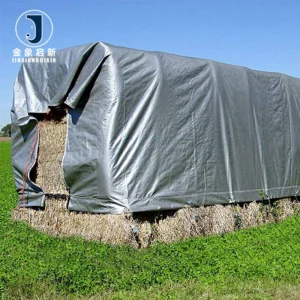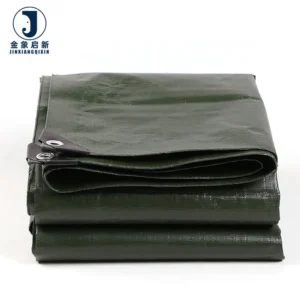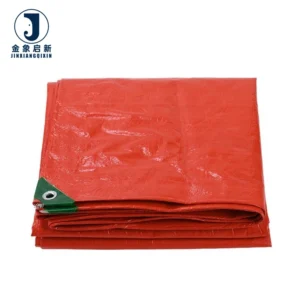
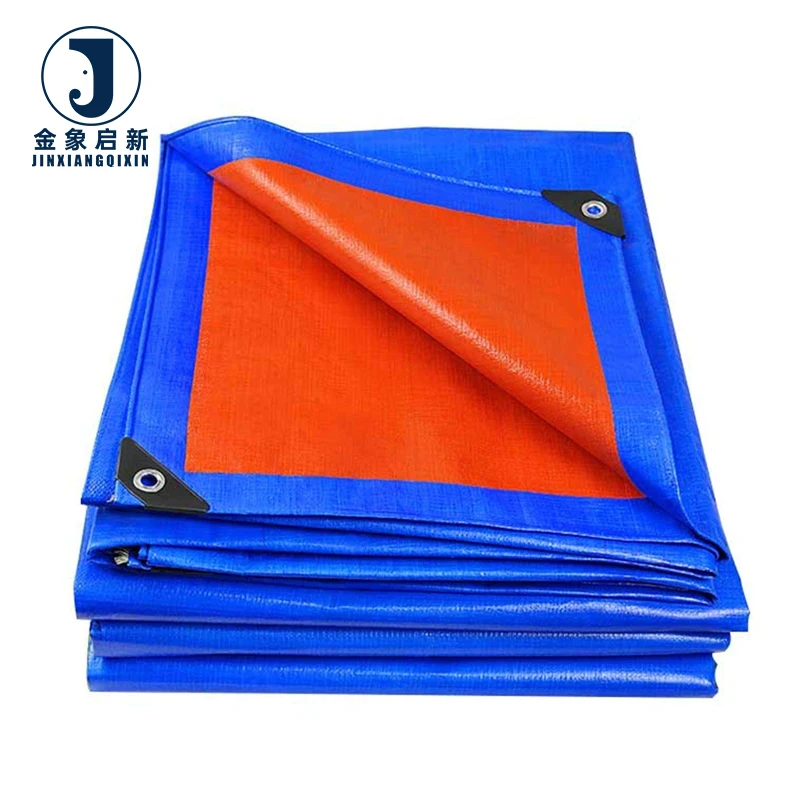
Batch-matched rolls for fleet replacement — every roll of PE tarpaulin for truck and trailer covering is weighed and colour-checked against the order specification before dispatch, so side-by-side installations on a mixed fleet show no visible shade shift.
Technical Specifications
| Parameter | Value |
|---|---|
| Product Type | PE Tarpaulin Roll / PE Tarpaulin Sheet |
| Material | HDPE woven fabric with LDPE coat on both sides |
| Density (Mesh Count) | 6×6 to 16×16 mesh |
| Weight (GSM) | 50 g/m² to 300 g/m² (available across the product family — confirm the grade for your application) |
| Color Options | Blue, Orange, White, Black, Grey, Yellow, Green, Red, or custom |
| Print Option | Logos or company information; reinforced strip option |
| Tarpaulin Sheet Size | 2×3, 3×4, 3×5, 4×5, 5×6, 6×8, 10×10, 10×12, 12×14, or custom |
| Tarpaulin Roll Size | 100 m per roll or custom |
| Edge Making | PP rope hem on all edges |
| Corner Reinforcement | Black plastic triangle corner patches |
| Eyelets | Rustproof aluminum eyelets every 1 m or 1.5 m |
| Special Treatment | Fire resistant and UV protection available in treated grades — confirm the grade required for your market |
| Anti-Aging | Anti-oxidant additive package |
| Corrosion Resistance | Acid and alkali resistance claimed |
Application Suitability
| Application | Exposure & Requirement |
|---|---|
| Flatbed and curtain-side trailer load covering | Highway-speed wind flap, road debris abrasion, continuous UV and rain exposure, tie-down strap stress at eyelets |
| Fleet operator replacement covers for specific trailer models | Model-by-model fitment, colour consistency across a batch, rustproof hardware for repeated strap cycles |
| Construction and plant-hire equipment covers | Site dust, road salt, diesel splash, mechanical abrasion from loading and unloading |
| Agricultural and aquaculture stockpiles | Extended outdoor weathering, moisture contact, chemical exposure from fertilisers or feed |
Why Generic-Size PE Tarpaulin for Truck and Trailer Covering Fails on Real Fleets
A cover that is even 30 cm wider than the load will flap at highway speed, concentrate stress at the first eyelet, and tear within weeks.
The most common complaint from fleet operators is that a truck cover arrives in a generic dimension that does not match the actual trailer registration. The excess fabric creates aerodynamic lift. Strap tension pulls the eyelet through the hem before the body of the PE tarpaulin for truck and trailer covering ever reaches its rated tensile load. This pattern repeats across logistics networks where procurement specifies a standard size rather than a trailer-specific pattern. [NEED_CITE: aerodynamic lift forces on loose-fitting transport covers at highway speed]
Cut to the Trailer, Not to a Catalogue
Every trailer model has a distinct deck height, side rail profile, and corner radius. We build a pattern template from the vehicle registration or the operator’s dimension drawing, then cut each PE tarpaulin sheet to that outline. The result is a cover that sits flush against the load with minimal free fabric to catch crosswinds.
Hem and Eyelet Spacing That Matches the Strap Pattern
Fleet operators typically use ratchet straps on a fixed interval. The rustproof aluminum eyelets on this PE tarpaulin are placed at 1 m or 1.5 m centres to match standard strap spacing, so every strap passes through a reinforced point rather than pulling against unsupported fabric. The PP rope hem and black plastic triangle corners absorb the peak load where the strap meets the edge.
Specification Choices That Hold Up Under Road Conditions
The HDPE woven base with double-sided LDPE coating gives balanced tear resistance in both warp and weft directions, which matters when a load shifts and the cover flexes across the diagonal. Mesh density from 6×6 to 16×16 is available across the range, letting the buyer select a lighter grade for short-haul curtain-side work or a denser weave for long-distance flatbed runs where abrasion is continuous. [NEED_CITE: relationship between woven mesh density and tear propagation resistance in HDPE fabrics]
The anti-oxidant additive package addresses the slow embrittlement that polyethylene experiences under prolonged UV and heat cycles. For routes that pass through tunnels, depots or port areas with specific fire safety rules, fire-resistant grades are available — confirm the grade required for your market and request the test report before placing the order.
Weight is stated in GSM on the quotation, and every roll is weighed during pre-shipment inspection to verify that the delivered material matches the quoted value. This is the single most effective check against the "lighter than agreed" problem that causes early failures on the road.
What Happens When the Specification Is Wrong
Ordering a 50 g/m² sheet for a flatbed that carries steel coil will produce a cover that punctures on the first loading cycle. Selecting a 16×16 mesh for a short urban delivery run adds cost and weight without a corresponding gain in service life. Colour specified without a reference swatch often leads to visible mismatch when two covers sit side by side on adjacent trailers — a problem that only appears after the fleet is parked in the yard. [NEED_CITE: batch colour variation tolerances in LDPE coated fabrics]
Fire-resistant treatment claimed without a test report can fail a depot inspection and delay an entire shipment. Welded seams that are set at the wrong temperature for the chosen GSM will delaminate at the flex point long before the base fabric reaches its rated tear load.
Why This Source Supports Fleet-Scale Ordering
Three full production lines and 36 sets of professional equipment maintain output continuity across large roll batches, reducing the chance that mid-order changeovers introduce shade variation. A 10-person R&D team develops pattern templates from trailer drawings and produces cut-to-fit samples within days, so the buyer can verify fitment before committing to volume.
Dedicated QA/QC runs at every production stage, ending with a 100% pre-shipment inspection that checks GSM per roll, colour consistency against the reference, eyelet pull-through strength and hem adhesion. ISO and CE documentation ships with the batch, and the dispatch package includes a roll packing list with individual roll weights so the receiving warehouse can spot-check immediately.
Documentation & Verification
- Material specification sheet stating GSM, HDPE base fabric density, LDPE coating and colour reference
- UV and fire-resistant test reports supplied with treated grades where applicable
- Pre-shipment inspection record confirming GSM per roll and colour match across the batch
- Roll packing list with individual roll weights and dimensions for receiving checks
- ISO and CE certificates included in the shipping document set
- Certificate of origin and customs support documentation for export shipments
Fabrication, Handling & Storage
- Heat-seal at moderate temperature settings suited to LDPE coating; excessive heat will melt through the HDPE base and weaken the joint
- Space rustproof aluminum eyelets at 1 m or 1.5 m to align with fleet ratchet strap intervals and prevent unsupported fabric between tie-downs
- Store rolls on pallets away from direct sunlight and stacked no more than two high to prevent permanent creasing of the LDPE surface
- Unroll in temperatures above 5 °C to avoid cold-cracking the LDPE coat, especially during winter dispatch
- Clean with mild detergent and a soft brush; solvents can degrade the LDPE coating and reduce water resistance
- Repair minor site cuts with LDPE-compatible adhesive patches applied to a clean, dry surface
What to Include in Your Enquiry
To receive a PE tarpaulin for truck and trailer covering quotation that matches your fleet, provide the trailer model or exact deck dimensions, preferred eyelet spacing, and the GSM range suited to your route exposure. If your depot or terminal requires fire-resistant certification, state the grade and the regulatory standard your market enforces. Specify whether you need finished sheets with hems and eyelets or roll stock for in-house fabrication, and indicate your annual volume so the production schedule can be planned around batch-consistent colour runs.
Frequently Asked Questions
Q: How do I supply trailer dimensions so the cover fits my specific fleet model?
A: Send the vehicle registration, trailer make and model, or a dimension drawing with deck length, width, and side rail height. We build a pattern template and produce a sample cover for fitment verification before bulk cutting begins.
Q: How is GSM verified on arrival and what happens if the material is lighter than quoted?
A: Each roll is weighed during pre-shipment inspection and the weight is recorded on the packing list. On arrival, your warehouse can weigh a sample against the stated GSM. If the delivered weight falls outside tolerance, replacement rolls are produced at no additional cost.
Q: What eyelet spacing and hem reinforcement options suit highway-speed tie-down loads?
A: Rustproof aluminum eyelets are standard at 1 m or 1.5 m spacing to match common ratchet strap intervals. PP rope hems distribute strap tension along the full edge, and black plastic triangle corner patches reinforce the highest-stress points.
Q: How do you control colour consistency across multiple covers ordered for the same fleet?
A: All rolls in a single order are produced from the same LDPE coating batch using a shared colour reference. A pre-shipment inspection checks shade match roll by roll, and the inspection record ships with the documentation.
Q: What UV or fire-resistant test documentation ships with the treated grades?
A: Where UV or fire-resistant treatment is specified, the corresponding test report is included in the dispatch documentation. Confirm the grade required for your market before ordering so the correct treatment level and test standard are applied.