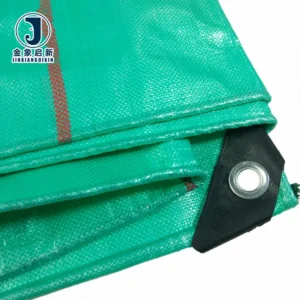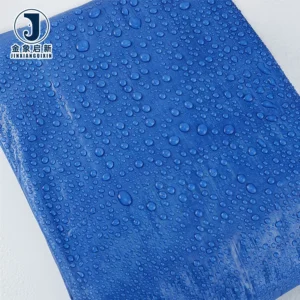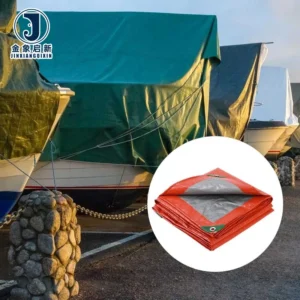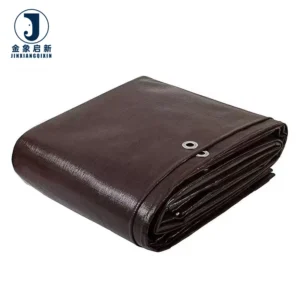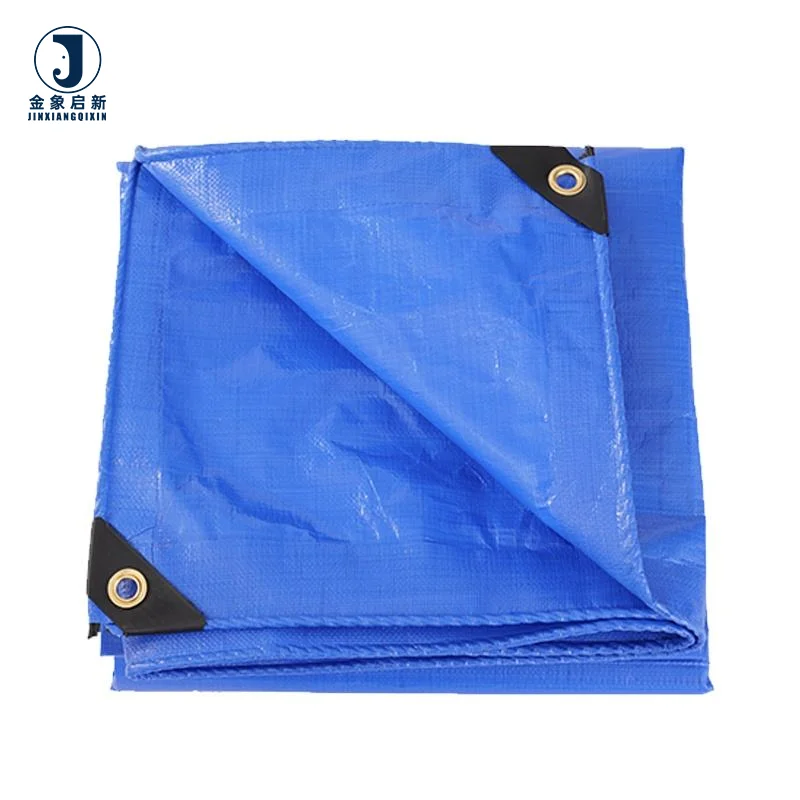
Roll-to-roll batch consistency — three full production lines running under controlled coating and weaving parameters ensure every PE tarpaulin roll in your shipment matches the confirmed GSM, mesh count and colour reference.
Technical Specifications
| Parameter | Value |
|---|---|
| Product Type | PE Tarpaulin |
| Coating Material | HDPE weaving with LDPE lamination on both sides |
| Weight (GSM) | 50 gr/m² ~ 220 gr/m² |
| Total Thickness | 0.18 mm ~ 0.35 mm |
| Mesh Count | 8×8 / 10×10 / 12×12 |
| Tensile Strength | Meridian 300–1200 N/5cm / Latitude 250–1000 N/5cm |
| Roll Width | 6ft, 8ft, 10ft, 12ft or 2m, 4m, 6m |
| Roll Length | 100 yards, 100 meters, or custom |
| Edge Reinforcement | PP rope in hem on all four edges |
| Eyelets | Galvanized eyelets every 3ft or 1 meter |
| Corner Reinforcement | Reinforced plastic corners |
| UV Treatment | Available — confirm the grade required for your market (test basis not stated) |
| Key Features | Waterproof, washable, tear resistant, mildew proof, anti-aging |
| Colour Options | Blue, Blue/Orange, Green, Grey, Black, Clear, Grey/Green, Orange, or custom |
Application Suitability
| Application | Exposure & Requirement |
|---|---|
| Flatbed and curtain-side trailer loads | Highway wind loading, constant flexing at tie-down points, road spray, UV exposure during multi-day transit |
| Construction site material covers | Rain and dust ingress, abrasion from stacked steel and timber, daily removal and re-draping |
| Warehouse and yard storage covers | Prolonged outdoor weather exposure, pooling water on flat surfaces, forklift contact at edges |
| Agricultural stockpile covers | Moisture protection for grain and feed, wind uplift on open ground, seasonal UV exposure |
Why Generic-Size Truck Covers Fail on the Road
A PE tarpaulin for truck and transport that arrives in a standard cut often leaves a gap at the trailer tail or bunches against the cab — exposing part of the load to rain and road spray while creating loose fabric that flaps and tears at speed.
Fleet operators who specify covers based on a generic size chart frequently discover on the first run that the hem does not align with the trailer’s tie-down rails. The result is a cover that either drags on the road surface or cannot be secured tightly enough to prevent wind getting underneath. Over a single season, loose-fitting covers develop abrasion damage at the contact points where the fabric rubs against the load edge during braking and cornering [NEED_CITE: fleet tarpaulin replacement frequency tied to fit accuracy]. Cutting PE tarpaulin to the exact vehicle model dimensions — including the overhang needed for the specific tailgate and headboard configuration — keeps the load fully enclosed and eliminates the stress concentrations that generic sizing creates.
HDPE Woven Base and LDPE Lamination Under Road Conditions
The HDPE woven base fabric provides the structural grid that carries tensile loads in both meridian and latitude directions, while the LDPE lamination on both sides seals the weave against water penetration. On a moving trailer, the PE tarpaulin for truck and transport flexes continuously as the load shifts under braking and cornering forces. The bond between the woven base and the laminated coating must hold through thousands of these flex cycles without delamination, particularly at the hem line where the PP rope reinforcement concentrates stress during tie-down.
Galvanized Eyelets and PP Rope Hems at Tie-Down Points
The PP rope running through the hem on all four edges distributes the ratchet strap load across a wider area of fabric rather than letting it concentrate at individual eyelet positions. Galvanized eyelets spaced every 3ft or 1 meter give fleet operators multiple attachment options along the trailer side rail, so the cover can be pulled down evenly without creating tension peaks that pull eyelets through the laminate. Reinforced plastic corners add an extra layer at the highest-stress grommet positions where diagonal strap tension meets the corner edge during transit.
How Mesh Count and GSM Interact to Determine Cover Strength
The relationship between mesh count and GSM is not linear — a 12×12 mesh with a lighter coating can weigh less than an 8×8 mesh with a heavier LDPE lamination, yet offer higher tear resistance because the denser weave arrests tear propagation more effectively. Tensile strength across the meridian and latitude directions depends on the HDPE yarn denier combined with the weave density, not on the lamination weight alone. When specifying a grade for truck and transport applications, both the mesh count and the confirmed GSM must be evaluated together to ensure the selected PE tarpaulin can handle the tie-down loads and wind forces the cover will encounter on the highway.
What Happens When Roll Consistency Breaks Down Mid-Order
When multiple rolls in the same shipment vary in colour or coating weight, the mismatch becomes visible once two sheets are installed side by side on adjacent trailers in the fleet. A lighter roll may also carry a lower tensile rating than the confirmed grade, meaning one trailer cover fails months before the others. Fleet operators then face the cost of replacing individual covers out of sequence, disrupting the planned maintenance rotation [NEED_CITE: batch colour and weight variance in PE tarpaulin shipments]. Consistent roll-to-roll GSM and colour across the entire order is what allows a transport fleet to standardise cover replacement intervals rather than reacting to random failures.
Sourcing PE Tarpaulin With Verified Roll Consistency
Three full production lines with 36 sets of professional equipment support bulk roll output while maintaining tight control over weaving tension and lamination weight across every production run. A 10-person R&D team develops custom widths, colours and eyelet spacing configurations and produces samples within days so buyers can verify the specification before committing to a full container order. Dedicated QA/QC at every production stage includes 100% inspection before shipment, with GSM and dimension checks recorded per roll on the pre-shipment inspection record. ISO and CE certified production processes back the documentation package that accompanies each dispatch, covering the customs and compliance requirements for cross-border shipment.
Documentation & Verification
- Material specification sheet confirming GSM, mesh count and LDPE coating weight per roll grade ordered
- Pre-shipment inspection record verifying finished dimensions and eyelet spacing match the specified truck model
- UV treatment test report where applicable, documenting the basis for outdoor exposure claims
- Roll packing list with individual roll weights and GSM for container loading verification
- ISO and CE certificates with certificate of origin for customs clearance in North America and Europe
Fabrication, Handling & Storage
- Heat-weld seams at a temperature matched to the LDPE lamination grade to prevent delamination at the weld line
- Position galvanized eyelets through the PP rope hem to spread strap load across the reinforced edge
- Store PE tarpaulin rolls upright on end cores to avoid flat-spotting the HDPE weave during warehouse holding
- Unfold laminated sheets in temperatures above freezing to prevent LDPE cracking at the crease lines
- Clean with mild detergent only — solvents can degrade the LDPE lamination surface over repeated washes
- Plan cut patterns around the standard roll widths to minimise off-cuts and seam joints on large covers
Before You Request a Quote
Share the truck or trailer model, the load type and the transit environment so we can match the correct GSM grade, mesh count and eyelet spacing to your fleet’s operating conditions. Specify the roll widths and lengths you need, the colour reference, and whether UV treatment is required for your market. Let us know if you need finished covers cut to vehicle dimensions or roll stock for your own fabrication line.
Frequently Asked Questions
Q: How is GSM verified on arrival to match the quoted PE tarpaulin grade?
A: Each roll is weighed and measured during the pre-shipment inspection, with the recorded GSM documented on the inspection record that accompanies the shipment. On arrival, buyers can cross-check the roll weight against the packing list figures to confirm the delivered grade matches the specification confirmed at order stage.
Q: Can the tarpaulin be cut to a specific truck or trailer model rather than a generic size?
A: Yes. Provide the vehicle model, body dimensions and any overhang requirements, and finished covers are cut and hemmed to those exact measurements. The PP rope reinforcement and galvanized eyelets are then positioned to align with the trailer’s tie-down rails and strap attachment points.
Q: What test basis supports the UV treatment claim for outdoor exposure?
A: UV treatment is available in grades suited to different exposure durations. The specific test standard and rating depend on the grade selected, so confirm the UV performance level required for your market and operating region when requesting a quotation and sample.
Q: How is colour consistency controlled across multiple rolls in the same fleet order?
A: Colour masterbatch is dosed into the HDPE yarn and LDPE lamination under controlled parameters across the production run. The pre-shipment inspection includes a visual colour check roll by roll, and any sheet falling outside the confirmed reference is held before dispatch to ensure uniform appearance across the entire order.
Q: What eyelet spacing and hem reinforcement options are available for heavy tie-down loads?
A: Standard galvanized eyelets are set every 3ft or 1 meter through the PP rope reinforced hem. For heavier tie-down loads, closer spacing or additional corner reinforcement can be specified. Share the strap tension and attachment method so the correct eyelet and hem configuration is matched to your application.