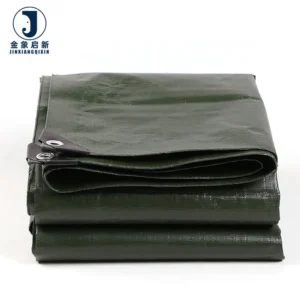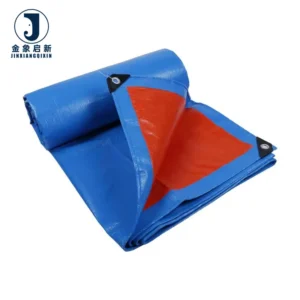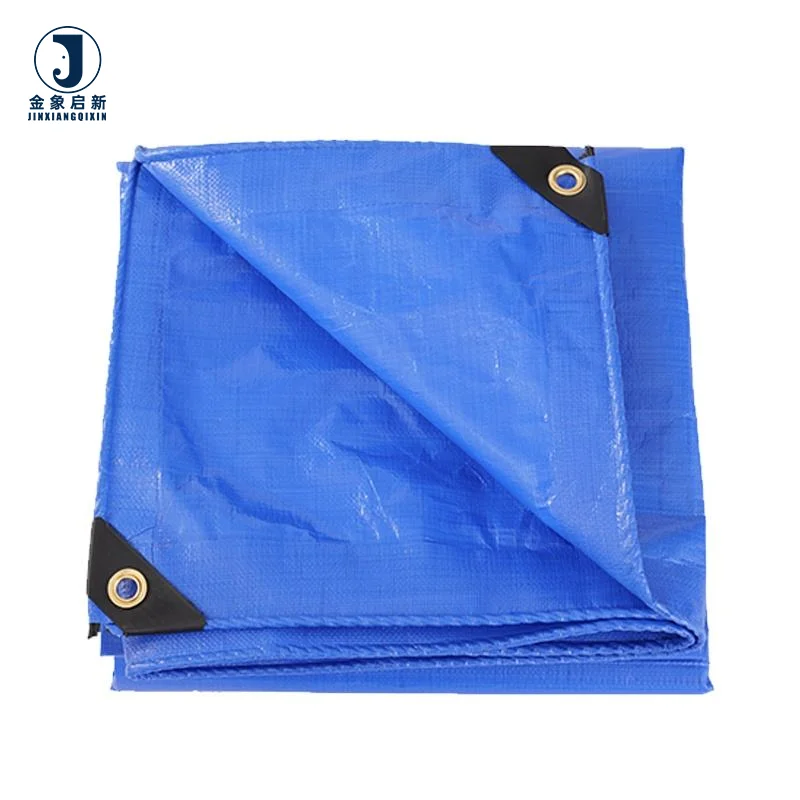
Verified Coating Weight Control — Every roll of PE tarpaulin passes 100% pre-shipment inspection to confirm GSM, mesh count, and edge finishing against the purchase order before leaving the factory.
Technical Specifications
| Parameter | Value |
|---|---|
| Product Type | PE Tarpaulin |
| Material | HDPE weaving with LDPE lamination on both sides |
| Weight Range | 50 g/m² ~ 220 g/m² (confirm grade for application) |
| Thickness | 0.2–0.4 mm / 8 mil–16 mil |
| Lightweight Grade | 80–110 g/m², 8×8 mesh, 0.18–0.22 mm |
| Medium Grade | 120–150 g/m², 10×10 mesh, 0.22–0.28 mm |
| Heavy-Duty Grade | 160–240 g/m², 12×12 mesh, 0.30–0.35 mm |
| Tensile Strength (Lightweight) | Meridian 300–500 / Latitude 250–450 N/5cm (test basis not stated) |
| Tensile Strength (Medium) | Meridian 500–800 / Latitude 400–700 N/5cm (test basis not stated) |
| Tensile Strength (Heavy-Duty) | Meridian 900–1200 / Latitude 700–1000 N/5cm (test basis not stated) |
| Edge Reinforcement | PP rope in hem on all four edges |
| Eyelets | Galvanized, every 3 ft or 1 meter interval |
| Corner Reinforcement | Reinforced plastic corners |
| Roll Width Options | 6 ft, 8 ft, 10 ft, 12 ft / 2 m, 4 m, 6 m |
| Roll Length Options | 100 yards, 100 meters, or custom |
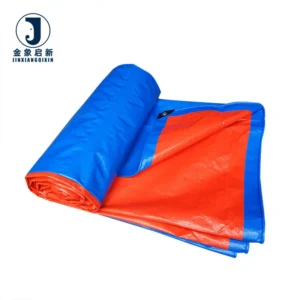
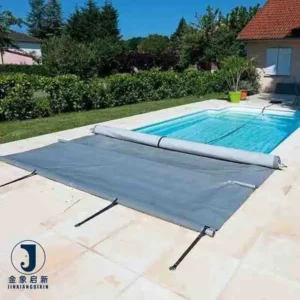
| Color Options | Blue, Blue/Orange, Green, Grey, Black, Clear, Grey/Green, Orange, or custom |
| Key Features | Waterproof, Washable, Tear Resistant, Mildew Proof, Anti-aging, UV treatment available (confirm grade for your market) |
| Standards | ISO, CE (product-level certificate not confirmed in source content) |
Application Suitability
| Application | Exposure & Requirement |
|---|---|
| Flatbed truck load covering | Constant road vibration, tie-down strap abrasion, wind uplift at highway speed, rain and spray exposure |
| Construction site material storage | Prolonged UV exposure, dust and debris, repeated handling by site workers, puncture risk from sharp aggregates |
| Agricultural stockpile protection | Moisture ingress, mildew formation, seasonal temperature fluctuation, moderate UV |
| Trailer side curtain fabric | Repeated flexing at fold points, friction against load edges, daily roll-up and release cycles |
| Equipment transport enclosure | Abrasion from metal surfaces, chemical splash from construction fluids, moderate tensile stress at grommet points |
When Generic Sizing Fails Your Fleet — How Custom-Cut PE Tarpaulin for Truck and Transport Solves It
A cover cut to a generic size that does not fit the specific trailer model is a recurring source of load exposure and strap failure — matching exact vehicle dimensions and reinforcing at stress points eliminates the gap.
Transport fleet operators frequently receive tarpaulin covers that are technically the right material but dimensionally wrong for the trailer. A cover that is too short leaves the rear load exposed during transit. A cover that is too wide bunches at the edges, creating pockets where water collects and wind catches, accelerating wear at the hem line. The result is not a material failure — it is a specification failure that compounds over every trip. Sourcing PE tarpaulin for truck and transport use means working from exact vehicle bed dimensions, including overhang allowance and tie-down point locations, so the cover sits flat and the eyelets align with the strap anchors on the trailer frame [NEED_CITE: dimensional tolerance standards for transport covers per ISO 1421].
Matching Weight Grade to the Actual Load Profile
The three-tier weight structure — lightweight at 80–110 g/m², medium at 120–150 g/m², and heavy-duty at 160–240 g/m² — exists because a cover for palletised goods on a short-haul route faces different demands than one protecting steel coils on a cross-country run. The HDPE woven base with dual-side LDPE lamination provides the waterproof barrier, but the mesh count (8×8, 10×10, or 12×12) determines how the fabric distributes load at the eyelet and hem points where tie-down straps concentrate force. Specifying PE tarpaulin for truck and transport without matching the mesh density to the load weight and route exposure is where early failures begin.
Reinforcement Detail That Survives the Tie-Down Cycle
Every finished cover in this range carries PP rope-reinforced hems on all four edges, galvanized eyelets spaced at 3 ft or 1 meter intervals, and reinforced plastic corners at the high-stress points. These are not cosmetic additions — they are structural. When a strap is tensioned across a loaded flatbed, the force transfers through the eyelet into the hem rope and then into the base fabric weave. If the hem is simply folded and heat-sealed without rope reinforcement, the fold line becomes a tear initiation point after repeated strap cycles [NEED_CITE: hem reinforcement test methods for coated fabrics per ISO 1421]. The corner reinforcement addresses the diagonal stress that occurs when a cover is pulled taut over an uneven load.
Reading the Specification Sheet Beyond the GSM Number
GSM tells you how much material is in the fabric, but it does not tell you how that material is distributed. A 150 g/m² PE tarpaulin with a 10×10 mesh and 0.25 mm thickness will behave differently under tensile load than a 150 g/m² sheet with a looser 8×8 mesh and thicker coating. The HDPE yarn denier and the LDPE lamination weight each contribute to the final GSM, and the balance between them determines whether the fabric tears at the weave or delaminates at the coating interface. For transport applications where the cover flexes constantly, the adhesion between the woven base and the lamination layers is as critical as the base fabric strength itself. Thickness values across the range (0.2–0.4 mm) correlate with lamination build, not necessarily with tear resistance — a thinner, tighter-weave fabric can outperform a thicker, loosely woven one in real-world tie-down scenarios.
The Hidden Cost of Batch-to-Batch Colour Drift
When a fleet orders multiple covers across several purchase orders, colour consistency between batches becomes a visible issue the moment two covers sit side by side on adjacent trailers. A blue cover from one production run can shift noticeably in hue against a blue cover from another, even when both are nominally the same colour reference. This is not just an aesthetic problem — it signals inconsistency in the LDPE lamination pigment dispersion, which can also correlate with variation in coating weight and UV stabiliser distribution. For transport operators who use colour coding to identify load types or fleet divisions, batch colour drift forces covers out of service not because they have failed mechanically, but because they no longer match the fleet standard [NEED_CITE: colour fastness testing for laminated PE fabrics].
Why Sourcing PE Tarpaulin Here Reduces Specification Risk
Nearly three decades of coated fabric production provides process control over lamination weight and adhesion that goes beyond simply meeting a GSM target. Three full production lines and 36 sets of professional equipment support bulk roll orders with consistent output, so a container load of rolls maintains the same mesh count and thickness from the first roll to the last. A 10-person R&D team handles custom sizing to specific truck and trailer model dimensions, pattern printing for fleet branding, and sample development within days so buyers can verify fit and finish before committing to a production run. Dedicated QA/QC inspection at every production stage, with 100% pre-shipment inspection, catches GSM deviation, eyelet spacing errors, and hem reinforcement gaps before the order leaves the factory.
Documentation & Verification
- Material specification sheet stating GSM, base fabric mesh count, lamination type, and colour reference per roll batch
- Weight verification per roll against the stated GSM value recorded before dispatch
- Pre-shipment inspection record confirming eyelet spacing, hem reinforcement, and corner detail on finished covers
- Roll packing list with roll count, individual roll weight, and dimensions for customs clearance
- Certificate of origin and customs documentation included with international shipments
- UV treatment test report available upon request — confirm the grade required for your market
Fabrication, Handling & Storage
- Heat-seal temperature must match the LDPE lamination grade — the dual-side coating on this PE tarpaulin responds to specific thermal windows for clean welds
- Galvanized eyelets at 3 ft or 1 m intervals distribute tie-down load across the PP rope hem, reducing point stress on the HDPE weave
- Store rolls vertically on pallets to prevent flat-spot creases that become visible after the LDPE lamination sets in the folded position
- Clean with mild detergent only — aggressive solvents can degrade the LDPE lamination surface on lighter 80–110 g/m² grades
- Custom-cut finished sizes should be folded along the hem reinforcement lines to avoid creasing through the reinforced plastic corners
- Allow material to acclimate to ambient temperature before unrolling in cold conditions, as LDPE lamination stiffens below standard workshop temperatures
What We Need to Quote Accurately
To provide a specification that matches your operation, share the truck or trailer model dimensions including bed length, width, and any overhang allowance required. Confirm the load type and typical route exposure so the correct weight tier and mesh count can be recommended. Specify whether roll stock or finished cut-to-size covers are needed, along with eyelet spacing preference and any colour or brand printing requirements for fleet identification.
Frequently Asked Questions
Q: Can PE tarpaulin be cut to fit specific truck and trailer model dimensions?
A: Yes. Finished covers are produced to exact vehicle bed dimensions, including overhang and tie-down point alignment. The R&D team develops a sample from the specified GSM grade and mesh count for fit verification before bulk production begins, ensuring the PP rope hems and galvanized eyelets align with the trailer strap anchors.
Q: How is GSM verified on arrival and what happens if the weight is below the quoted value?
A: Every roll undergoes weight verification against the stated GSM before dispatch, with results recorded in the pre-shipment inspection report. This document ships with the order. If a discrepancy is found on receipt, the inspection record provides the baseline for resolution against the original specification.
Q: How is batch-to-batch colour consistency controlled when ordering multiple rolls or covers?
A: Colour reference standards are set at the sample approval stage and applied to each production run. The LDPE lamination pigment is matched against this reference, and the pre-shipment inspection includes a visual colour check roll to roll before dispatch to flag any visible drift.
Q: What UV treatment is applied and is there a test report to confirm outdoor service life?
A: UV treatment is available across the weight range. The specific grade and test basis should be confirmed for your market’s requirements. Request the UV test report during the inquiry stage so the treatment level matches your expected outdoor exposure conditions.
Q: What is the lead time and minimum order for custom sizes and branded printing?
A: Lead times and minimums depend on the roll width, finished size complexity, and print specification required. These are confirmed at the quotation stage after sample approval. Custom colour and branded printing options are available on both roll stock and finished cover orders.