Deep Process Control Over Lamination Weight — HDPE woven base with double-side LDPE lamination, checked at every production stage to maintain waterproof integrity across the full roll length.
Technical Specifications
| Parameter | Value |
|---|---|
| Product Type | PE Tarpaulin Roll / Finished PE Tarpaulin |
| Material | HDPE weaving with LDPE lamination on both sides |
| Base Fabric | HDPE woven |
| Coating Material | LDPE lamination |
| Weight (GSM) | 50gr/m2 ~ 220gr/m2 available (range covers product family — confirm the grade for this item) |
| Total Thickness | 0.2-0.4mm / 8 mil-16 mil / Custom |
| Roll Width | 6ft, 8ft, 10ft, 12ft or 2m, 4m, 6m |
| Roll Length | 100 yards, 100 meters, or custom |
| Finished Regular Sizes | 2x2m, 3x3m, 3x5m, 4x4m, 4x5m, 4x6m, 4x8m, 4x10m, 5x5m, 5x6m, 5x8m, 5x10m, 6x6m, 6x8m, 6x10m, 8x10m (and corresponding ft sizes) |
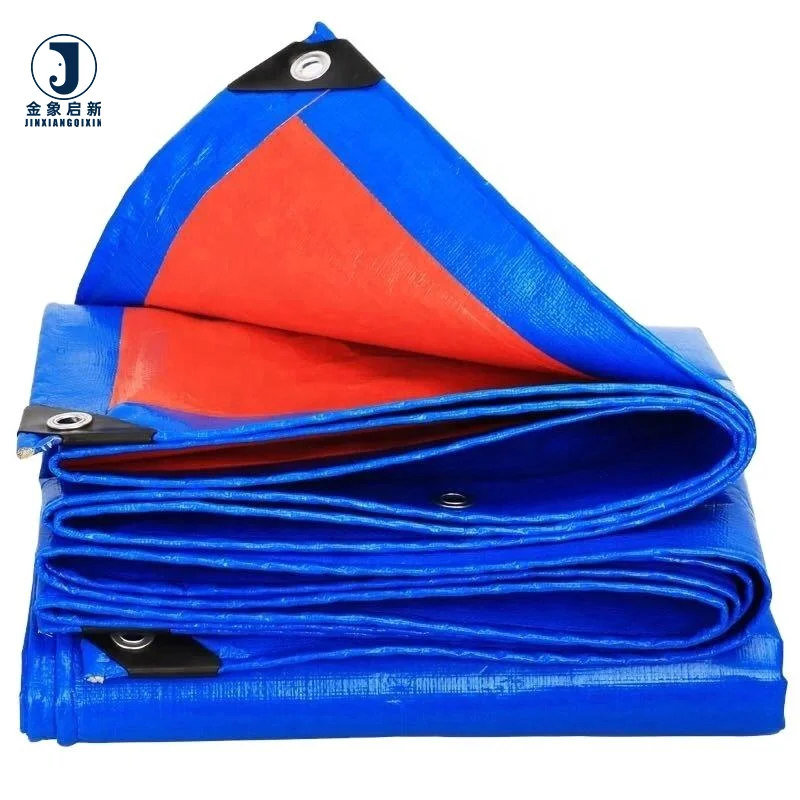
| Edge Reinforcement | All four edges reinforced with PP rope in hem |
| Eyelets | Galvanized eyelets every 3ft or 1 meter interval |
| Corners | Reinforced plastic corners |
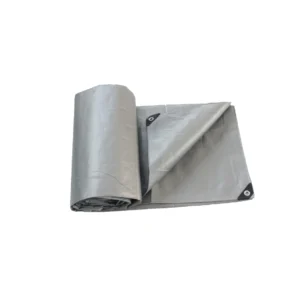
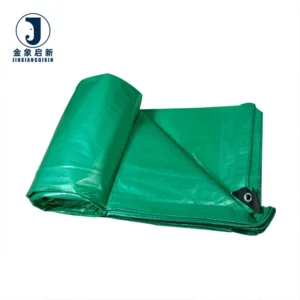
| Color | Blue, Blue/Orange, Green, Grey, Black, Clear, Grey/Green, Orange, or any other color |
| Waterproof | Yes |
| UV Treatment | Available (test basis not stated in source) |
| Anti-Mildew | Mildew proof stated (standard not stated in source) |
| Anti-Aging | Anti-oxidants added, anti-exposure, anti-aging stated (test basis not stated in source) |
| Corrosion Resistance | Acid and alkali resistance stated (test basis not stated in source) |
| Tear Resistance | High density weaving, tensile resistance stated (test standard not stated in source) |
| Printing Option | Custom brand printing available |
| Standards | ISO, CE |
Application Suitability
| Application | Exposure & Requirement |
|---|---|
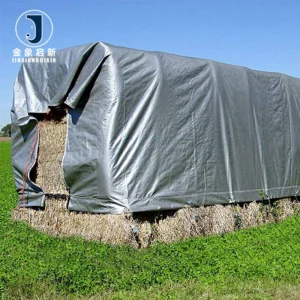
| Truck and trailer load covering | Constant road vibration, wind flex at high speed, UV and rain exposure, abrasion at tie-down contact points |
| Scaffolding enclosure on construction sites | Wind load on large vertical panels, scaffold tube abrasion, prolonged weather exposure across seasons |
| Camping and outdoor equipment cover | Ground moisture, folding and packing stress, UV degradation from direct sunlight, mildew in humid storage |
| Flatbed and open-top cargo protection | Highway-speed wind uplift, water pooling on horizontal surfaces, friction against load edges during braking |
| Side curtain fabric for transport equipment | Repeated rolling and unrolling, lateral tension from curtain track systems, road debris impact |
Why Generic-Size Covers Fail Fleet Operators
A PE Tarpaulin for Truck and Transport Cover cut to a generic dimension rarely matches the exact profile of a specific trailer model, leaving gaps at the corners or excess fabric that flaps and abrades during transit.
Fleet managers routinely order covers based on nominal trailer lengths, only to discover that the actual cargo profile sits higher than the side rails, creating tension points that standard grommet spacing cannot handle. The result is premature eyelet pull-through, water ingress at the overlap zones, and cargo damage claims that far exceed the cost of a properly sized cover [NEED_CITE: common failure modes in transport tarpaulin tie-down systems]. When a cover is too short, operators improvise with secondary sheets that shift in crosswinds. When it is too long, the loose material beats against the load and accelerates wear at the hem line. Custom sizing matched to vehicle dimensions eliminates both failure modes and reduces the total number of covers a fleet needs to carry.
Covering a Moving Load at Highway Speed
A truck load cover faces a fundamentally different stress profile than a static pond liner or scaffolding wrap. At highway speed, wind creates sustained uplift pressure across the entire panel while turbulence at the leading edge concentrates force on the front hem and eyelets. The HDPE woven base fabric provides the tensile backbone to resist this uplift, while the LDPE lamination on both sides seals the weave against driven rain. Galvanized eyelets spaced at 3ft or 1 meter intervals distribute tie-down rope loads across the hem, and the PP rope reinforcement inside the hem prevents the eyelet from tearing through the fabric under lateral pull.
Colour Consistency Across a Multi-Vehicle Fleet Order
When a logistics company orders covers for an entire fleet, even slight colour variation between rolls becomes visible once the covers are deployed side by side at a loading dock or customer site. Batch consistency in LDPE lamination pigment is controlled during the compounding stage before extrusion. This ensures that every roll within a single production run matches the specified colour reference. For fleet operators who use colour-coded covers to differentiate load types or customer accounts, consistent pigmentation across the full order quantity is a non-negotiable procurement requirement.
Reading the Specification Sheet Beyond the GSM Number
The stated GSM of a PE tarpaulin reflects total weight per square metre but does not isolate how that weight is distributed between the HDPE base fabric and the LDPE lamination layers. Two covers rated at the same GSM can behave very differently: one may carry a denser base weave with thinner lamination for higher tear resistance, while the other relies on heavier coating to reach the target weight with a lighter, less tear-resistant base. The base fabric denier and weave density determine how the material resists puncture and tear propagation, particularly at stress points around eyelets and corners [NEED_CITE: relationship between base fabric denier and tear propagation in woven PE fabrics]. The lamination thickness governs waterproof integrity and surface abrasion resistance. Specifying GSM alone is insufficient — buyers should confirm the base fabric construction and lamination weight separately to ensure the cover matches the mechanical demands of their application.
The Hidden Cost of Underspecified Edge Reinforcement
Edge and eyelet failures account for a disproportionate share of tarpaulin warranty claims in transport applications. A cover with standard edge finishing may perform adequately in static storage use, but the cyclic loading from highway wind and braking forces exposes any weakness in the hem construction. Without PP rope reinforcement inside the hem, the folded fabric edge gradually frays under rope tension, and eyelets begin to pull free from the laminate. Reinforced plastic corners add a secondary load path at the points where tie-down straps concentrate the highest force [NEED_CITE: tie-down load distribution at corner eyelets under dynamic transit conditions]. Skipping these reinforcement features to save on unit cost leads to covers that require replacement multiple times per year rather than lasting through extended service cycles.
Production Capability Matched to Fleet and Transport Requirements
Three full production lines with 36 sets of professional equipment allow roll stock and finished cut sizes to be scheduled simultaneously without one product type blocking the other. The 10-person R&D team develops samples within days when a fleet operator needs a cover dimensioned to a specific trailer model, including eyelet spacing and corner reinforcement matched to the vehicle’s tie-down rail configuration. Dedicated QA/QC at every production stage means GSM, colour, and lamination adhesion are checked before the roll leaves the line, not only at final packing. Pre-shipment inspection covers 100% of the order quantity, so the material arriving at the dock matches the quotation in weight, dimension, and finish.
Documentation & Verification
- Material specification sheet stating GSM, HDPE base fabric construction, LDPE lamination weight, and colour reference for each roll
- UV treatment test report supplied where applicable — confirm the test basis required for your market
- Pre-shipment inspection record verifying finished dimensions, eyelet spacing, and PP rope hem integrity
- Roll packing list with individual roll weights and dimensions for container load reconciliation
- Certificate of origin and customs documentation included with each dispatch
Fabrication, Handling & Storage
- Heat sealing temperature should be calibrated to the LDPE lamination layer — test on a sample offcut before production runs
- Galvanized eyelets at 3ft intervals require consistent punch pressure to avoid crushing the surrounding PP rope hem
- Store rolls horizontally on pallets to prevent permanent creasing in the HDPE woven base fabric
- Unroll finished tarpaulins fully before folding for transport to avoid trapping moisture between LDPE laminate layers
- Clean with mild detergent only; solvents may degrade the LDPE lamination surface and reduce waterproof integrity
- When cutting to custom trailer dimensions, add hem allowance for PP rope insertion on all four edges
What to Include in Your Enquiry
Provide the exact trailer model or cargo dimensions so finished sizes can be matched to vehicle profiles rather than cut to generic measurements. Specify whether you require roll stock for in-house fabrication or finished tarpaulins with eyelets and reinforced hems ready for immediate deployment. Indicate the colour reference or Pantone code for your fleet, and confirm whether UV treatment is needed for your operating climate.
Frequently Asked Questions
Q: How is GSM verified on arrival to match the quotation weight?
A: Every roll undergoes weight verification during pre-shipment inspection, with results recorded on the inspection report included in your documentation pack. The material specification sheet states the target GSM alongside the base fabric and LDPE lamination breakdown, so you can confirm the product received matches the product quoted.
Q: Can finished tarpaulin sizes be cut to match a specific trailer model?
A: Yes. Provide the vehicle make, model, and cargo profile dimensions, and samples are developed to confirm fit before full production. Eyelet spacing and corner reinforcement can be adjusted to align with the trailer’s tie-down rail system for secure load covering.
Q: How is colour consistency maintained across rolls in the same fleet order?
A: Pigment is compounded into the LDPE lamination at the extrusion stage under controlled conditions, and colour reference is checked against the specified standard during in-process QA. The pre-shipment inspection record includes colour verification across the full order batch.
Q: What eyelet spacing and hem reinforcement options are available for tie-down systems?
A: Standard configuration uses galvanized eyelets every 3ft or 1 meter with PP rope reinforced hems on all four edges and reinforced plastic corners. Spacing and corner reinforcement can be modified to match specific tie-down hardware and fleet operating requirements.
Q: What UV test basis supports the anti-UV treatment for road exposure?
A: UV treatment is available for extended outdoor and road weather exposure. Confirm the specific test standard required by your market or application, and the corresponding test report will be supplied with the shipment documentation where applicable.