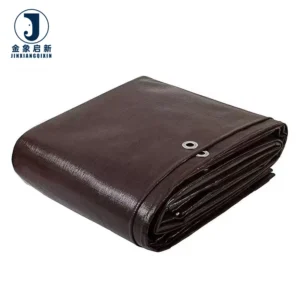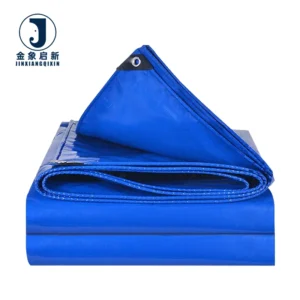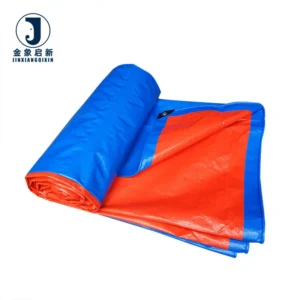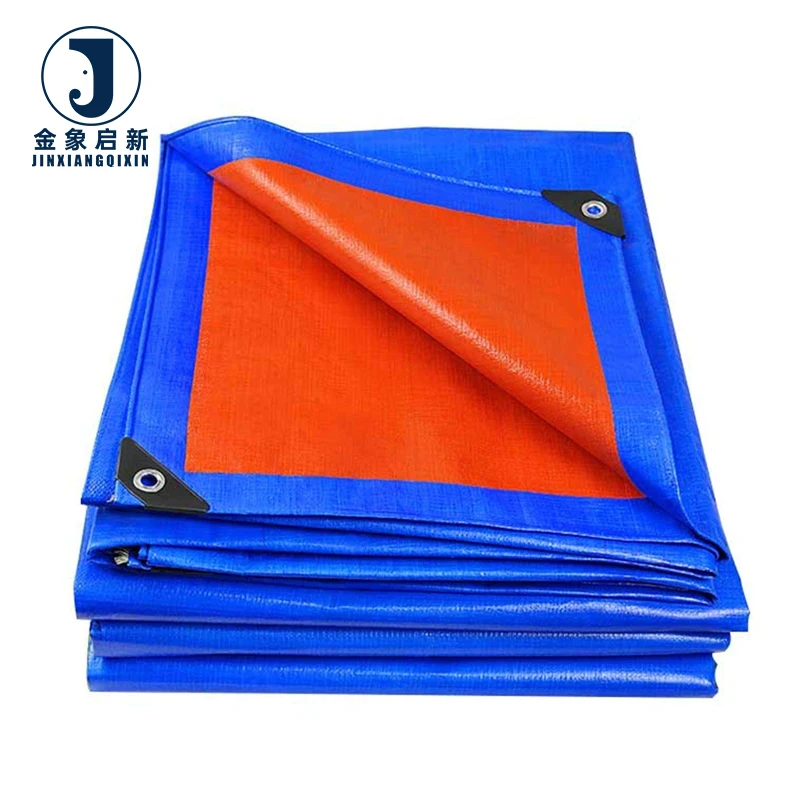
Deep process control over coating weight and adhesion — Every PE tarpaulin truck covering roll is produced on dedicated lines with in-process QA checkpoints that verify LDPE coating uniformity across the HDPE woven base before it leaves the facility.
Technical Specifications
| Parameter | Value |
|---|---|
| Product Type | PE Tarpaulin |
| Material | HDPE woven fabric with LDPE coating on both sides |
| Mesh Density | 6×6 to 16×16 |
| Weight Range | 50 g/m² to 300 g/m² (confirm required grade) |
| Colour Options | Blue, Orange, White, Black, Grey, Yellow, Green, Red, or custom |
| Sheet Sizes | 2×3, 3×4, 3×5, 4×5, 5×6, 6×8, 10×10, 10×12, 12×14 m or custom trailer dimensions |
| Roll Length | 100 m per roll or custom |
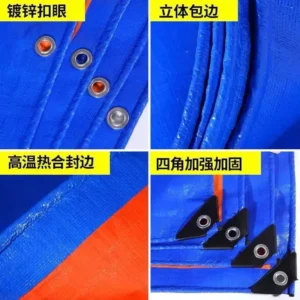
| Edge Construction | PP rope hem on all edges |
| Corner Reinforcement | Black plastic triangle at all corners |
| Eyelets | Rustproof aluminum, spaced every 1 m or 1.5 m or custom interval |
| Printing | Custom logos or company information available |
| Special Treatment | Fire resistant / UV protection available in specific grades — confirm the grade required for your market |
| Anti-Aging | Anti-oxidants added (test basis not stated) |
| Corrosion Resistance | Acid and alkali resistance claimed (test basis not stated) |
| Certification | ISO, CE |
Application Suitability
| Application | Exposure & Requirement |
|---|---|
| Flatbed trailer load covering | Highway speed wind load, rain ingress, strap tension at eyelet points, repeated folding and unfolding |
| Curtain-side truck top covers | Constant flex at roll mechanism, road grit abrasion, UV exposure on horizontal surfaces |
| Construction equipment wraps on trucks | Puncture from sharp edges, diesel and hydraulic fluid contact, vibration during transit |
| Palletised cargo protection in transit | Stacking compression, condensation under the cover, edge abrasion against trailer walls |
Why a PE Tarpaulin for Truck and Transport Fails Before the Fabric Does
The eyelet pulls through before the sheet tears — because the reinforcement was specified for static loads, not highway flex.
Fleet operators who have replaced truck covers mid-route know that the failure rarely starts in the middle of the fabric. It begins at the hem where strap tension concentrates, or at a corner where the trailer frame rubs on every cornering manoeuvre. I have seen covers returned with intact centre panels but shredded hems and popped eyelets. The HDPE woven base with LDPE coating may be fully adequate for water protection, but if the PP rope hem and aluminum eyelet spacing are not matched to the actual tie-down pattern of a specific trailer, the PE tarpaulin for truck and transport will fail at its weakest engineered point [NEED_CITE: tensile and tear test methods for coated fabrics per ISO 1421].
Hem and Eyelet Engineering for Highway Tie-Down Loads
Every edge of this PE tarpaulin truck covering is hemmed with a PP rope that distributes strap tension across a wider fabric area rather than concentrating it at a single thread line. Rustproof aluminum eyelets are set at intervals that can be specified to match the D-ring or lashing rail spacing on your trailer model — whether that is 1 m, 1.5 m, or a custom distance. Corner reinforcement uses black plastic triangles bonded over the hem intersection, which is the point where two rope-hemmed edges meet and where diagonal strap loads generate the highest peel force.
Custom Sizing to Trailer Model Dimensions
Generic-cut covers leave excess fabric that flaps in the slipstream and abrades against itself, or they fall short and leave cargo exposed at the tailgate. This PE tarpaulin for truck and transport is cut to the exact deck length, width and drop of your trailer model — flatbed, curtain-side or tipper. When you provide the vehicle make, model and year, the sheet is produced to match the actual tie-down geometry, reducing the number of unused eyelets and eliminating the slack zones where water pools.
Density and Coating Weight as an Integrated System
Mesh density — available from 6×6 to 16×16 — determines how many HDPE tapes per inch carry the tensile load in both warp and weft directions. A 6×6 weave provides an economical cover for short-haul palletised goods where exposure is measured in days. A 16×16 weave increases the tape count substantially, producing a denser substrate for the LDPE coating to bond into, which matters when the cover is dragged over rough cargo surfaces or exposed to sustained highway wind lift. The LDPE coating on both sides seals the weave intersections, and the combined weight of base fabric plus coating gives the final g/m² figure [NEED_CITE: relationship between mesh density and coating adhesion in woven PE fabrics].
Reading the g/m² Figure Correctly
A quotation that states a single g/m² number without breaking it into base fabric weight and coating weight leaves room for a lighter base cloth hidden under a thicker coat. The HDPE tape denier and mesh count set the structural strength; the LDPE coating provides waterproofing and surface abrasion resistance. Two covers can share the same total g/m² but behave very differently under strap tension — one tears at the eyelet because the base cloth is thin, the other holds because the HDPE tapes are heavier and the coat is thinner but better bonded. Always request the base fabric weight and coating weight listed separately before approving a production run.
What Happens When Colour Drifts Across Rolls in One Fleet Order
When a transport company orders multiple rolls to cover a fleet of identical trailers, visible colour variation between adjacent panels looks unprofessional to the client receiving the delivery. This drift typically traces back to masterbatch dosing inconsistency during the HDPE tape extrusion stage, or to LDPE coating batches mixed at slightly different temperatures. Consistent colour across the full order requires that all rolls are coated from the same masterbatch lot and that the production run is scheduled as a single continuous batch. Verify batch colour consistency against a physical swatch before the rolls are loaded [NEED_CITE: colour fastness standards for outdoor polyethylene fabrics].
Why Procurement Checks Matter Before the Rolls Ship
Confirming that the g/m² on the pre-shipment inspection record matches the quoted figure prevents the situation where a cover feels noticeably lighter when the driver unfolds it at the depot. Checking eyelet spacing against the specification sheet ensures that every lashing point on the trailer has a corresponding eyelet — an extra half-metre gap between eyelets can mean a strap passes through fabric instead of metal. Reviewing the roll packing list for batch numbers allows you to trace any future failure back to the specific production run and request documentation.
Why Sourcing Here Supports Your Fleet Specification Process
Three full production lines with 36 sets of professional equipment allow custom-width PE tarpaulin truck covering rolls to run without waiting for a stock-width changeover. The 10-person R&D team develops samples within days, so you can test hem reinforcement and eyelet pull-out on your actual trailer before committing to bulk. Dedicated QA and QC at every stage — from tape extrusion through weaving, coating and finishing — means the pre-shipment inspection record reflects measured values, not assumed ones. ISO and CE certified production supports documentation requirements for fleet procurement tenders across multiple markets.
Documentation & Verification
- Material specification sheet listing base fabric mesh, coating weight and total g/m² per roll
- Pre-shipment inspection record confirming eyelet spacing and hem reinforcement against your drawing
- UV and fire resistant test reports supplied when specific treatment grades are requested
- Roll packing list with batch numbers for traceability across your fleet
- Certificate of origin and customs documentation for cross-border shipment
- ISO and CE certificates included with each dispatch
Fabrication, Handling & Storage
- Heat-seal the LDPE-coated edges at temperatures matched to the coating thickness to avoid delamination
- Punch aluminum eyelets through the PP rope hem, not through uncoated weave, for maximum pull-out resistance
- Store rolls upright on pallets to prevent flat-spot compression marks on the outer LDPE surface
- Unroll in temperatures above freezing to avoid cracking the LDPE coat at the fold lines
- Clean with mild detergent only — solvents can soften the LDPE coating and reduce abrasion resistance
- Match cutting layouts to the 100 m roll length to minimise off-cuts when producing multiple sheet sizes
Request a Quotation with Your Trailer Details
Provide the trailer make, model, deck dimensions and tie-down rail spacing so that sheet sizes and eyelet intervals can be matched precisely. Specify the target g/m² grade and whether UV or fire resistant treatment is required for your operating region. Confirm the colour reference and whether all rolls must come from a single masterbatch lot. Indicate the annual roll or sheet quantity so that production scheduling and lead time can be aligned to your fleet maintenance cycle.
Frequently Asked Questions
Q: How do I verify the g/m² on arrival matches the quoted specification?
A: Request the pre-shipment inspection record that lists the measured base fabric weight and coating weight for each roll. On receipt, cut a measured sample from the roll edge and weigh it on a calibrated scale. Compare the result against the specification sheet supplied with the documentation package.
Q: Can you produce custom sheet sizes for my specific trailer model?
A: Yes. Provide the trailer make, model, deck length, width and drop height. The sheet is cut to those exact dimensions with PP rope hems and aluminum eyelets positioned to match your lashing points. A sample can be produced for fit-check before bulk production begins.
Q: What eyelet spacing options are available for high-flex tie-down areas?
A: Rustproof aluminum eyelets can be set at 1 m, 1.5 m or a custom interval. At high-stress zones such as corners and mid-span strap positions, additional eyelets can be added. Black plastic triangle reinforcement is applied at every corner to resist diagonal peel forces.
Q: How is colour consistency maintained across multiple rolls in one order?
A: All rolls in a single order are scheduled as one continuous production run using the same HDPE masterbatch lot and LDPE coating batch. A physical colour swatch is approved before production, and each roll is checked against it during pre-shipment inspection.
Q: What documentation is included with each shipment?
A: Each dispatch includes a material specification sheet, pre-shipment inspection record, roll packing list with batch numbers, certificate of origin and ISO and CE certificates. UV or fire resistant test reports are added when those specific treatments have been applied and requested.