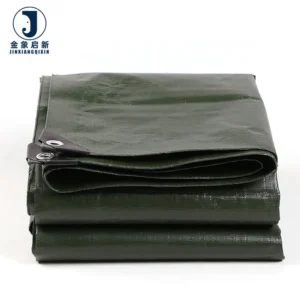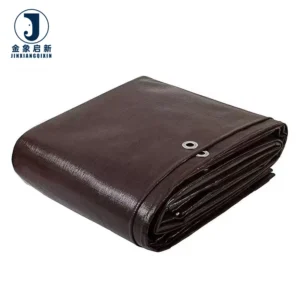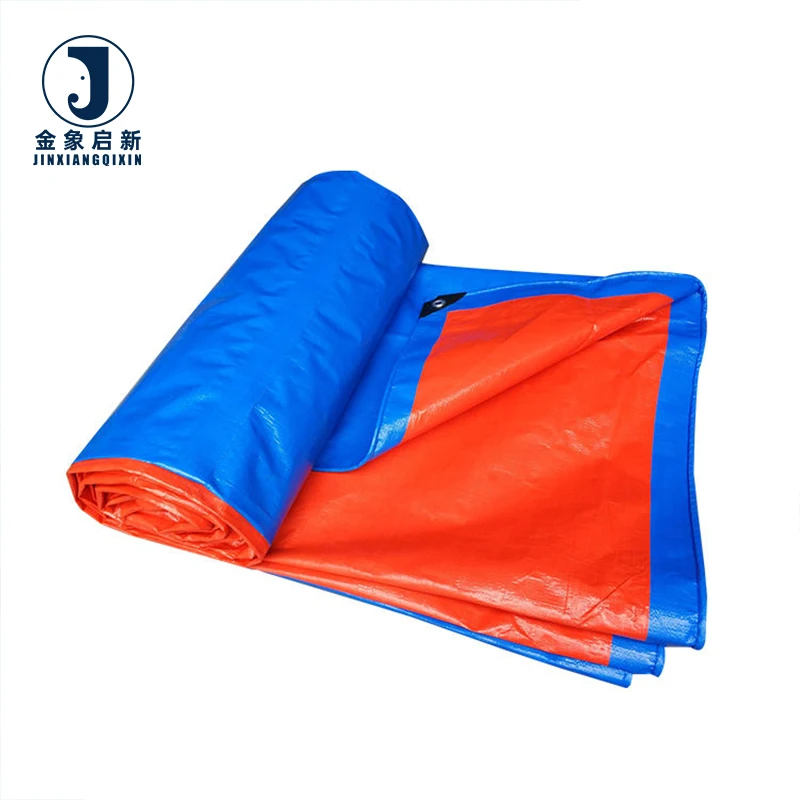
Proven Coating Control — Decades of HDPE woven and LDPE coating process mastery ensure every PE Tarpaulin for truck and trailer sheet meets stated mesh density and weight without deviation.
Technical Specifications
| Parameter | Value |
|---|---|
| Product Type | PE Tarpaulin |
| Material | HDPE woven fabric with LDPE coat on both sides |
| Mesh Density | 6×6 to 16×16 |
| Weight Range | From 50 g/m² up to 300 g/m² — confirm the grade for this item |
| Colour Options | Blue, Orange, White, Black, Grey, Yellow, Green, Red, or any custom colour |
| Sheet Sizes | 2×3, 3×4, 3×5, 4×5, 5×6, 6×8, 10×10, 10×12, 12×14, or custom dimensions |
| Roll Size | 100 m per roll or as required |
| Edge Construction | PP rope hem on all edges |
| Corner Reinforcement | Black plastic triangle at all corners |
| Eyelet Specification | Rustproof aluminum eyelets every 1 m or 1.5 m, or per requirement |
| Printing | Logos or company information; reinforced strip available |
| Special Treatment | Fire resistant / UV protection available — confirm the grade required for your market |
| Certification | ISO, CE |
Application Suitability
| Application | Exposure & Requirement |
|---|---|
| Flatbed trailer load cover | Road vibration, wind flap, tie-down stress at eyelets, rain and debris |
| Curtain-side truck enclosure | Constant flexing at curtain runners, abrasion against trailer frame, UV exposure |
| Box trailer roof and rear sheet | Standing water pooling, thermal expansion cycles, forklift contact during loading |
| Transport equipment OEM fitment | Model-specific cut accuracy, batch colour consistency across production run |
| Fleet replacement cover | Dimensional match to existing tie-down hardware, rustproof eyelet compatibility |
Generic-Sized Covers Cost Fleets More Than They Save
A truck cover that does not match the trailer model exposes cargo, flaps at highway speed, and tears first at the eyelet line.
Fleet operators who source generic-sized sheets often find the fabric sits too loose across the load or pulls too tight at the corners. Both conditions shift stress away from the reinforced hem and onto the eyelet ring, where the HDPE weave begins to tear within weeks of regular use. [NEED_CITE: tensile and tear test methods for coated fabrics per ISO 1421] When the cover flaps under wind load, the repeated flexing fatigues the LDPE coating at the fold line, leading to micro-cracks that let water reach the cargo underneath. Colour mismatch between replacement sheets and the rest of the fleet also creates a visible patchwork effect across the trailer park — a detail that matters when the fleet serves brand-conscious shippers.
Model-Specific Fitment Eliminates the Flap-and-Tear Cycle
Every PE Tarpaulin for truck and trailer in this range is cut to the exact dimensions of the target trailer model, not to a generic size chart. The PP rope hem runs the full perimeter, distributing tie-down tension across the woven edge rather than concentrating it at a single eyelet. Black plastic triangle reinforcements at each corner add a second load path, so when the ratchet strap pulls at an angle, the corner holds without deforming the aluminum eyelet.
Eyelet Spacing and Pull-Out Resistance on the Road
Rustproof aluminum eyelets are punched at 1 m or 1.5 m intervals depending on the trailer’s tie-down rail configuration. Closer spacing suits flatbed loads where straps cross at steep angles and the fabric sees high point-loads. Wider spacing works on curtain-side runners where the cover slides rather than straps down. Each eyelet sits within the PP rope hem zone, meaning the rope absorbs the initial pull and the woven HDPE base fabric carries the sustained load. [NEED_CITE: eyelet pull-out testing standards for transport covers]
Reading Mesh Density and Weight Together
Mesh density — from 6×6 to 16×16 — defines how many HDPE tapes cross per square inch in each direction. A higher count creates a tighter weave that resists tear propagation, because a tear must break more tapes to spread. Weight alone, measured in g/m², reflects the combined mass of the woven base and the LDPE coating on both sides. Two sheets at the same weight can have very different tear performance if one uses a lighter base with a heavier coating. For fleet covers, the mesh density matters more than coating weight, because the mechanical load at the eyelet and hem is carried by the woven structure, not the coating film.
When the Wrong Specification Reaches the Loading Bay
A cover specified by weight alone, without checking mesh density, may pass the GSM check on arrival yet tear at the first ratchet strap. Colour variation between rolls in the same shipment becomes visible the moment two sheets hang side by side on adjacent trailers — a problem that forces the fleet to reject the batch and wait for replacements. [NEED_CITE: batch colour consistency standards in coated fabric production] If the fire-resistant or UV treatment is claimed but not backed by a test report, the cover may fail a site safety audit or degrade prematurely in high-UV corridors, leaving the fleet exposed to cargo claims and compliance penalties.
Why Source This PE Tarpaulin Here
Nearly 30 years of coated fabric production gives this line deep process control over HDPE tape extrusion, weave density, and LDPE coating adhesion. Three full production lines with 36 sets of professional equipment support fleet-scale orders with consistent on-time dispatch. The 10-person R&D team develops model-specific patterns, ensuring each PE Tarpaulin for truck and trailer is cut to fit rather than trimmed from a generic blank. A dedicated QA/QC team runs 100 percent pre-shipment inspection, checking sheet dimensions, eyelet pull-out, and hem reinforcement against the purchase order. Samples for custom colour and print are developed within days, letting the fleet approve the exact finish before bulk production starts.
Documentation & Verification
- Material specification sheet confirming mesh density, base fabric, and LDPE coating weight per roll
- Pre-shipment inspection record showing sheet dimensions matched to the specified trailer model
- UV and fire-resistant test reports provided where the treatment grade is confirmed at inquiry
- Roll packing list with individual sheet labels and colour batch reference
- Certificate of origin and customs documentation for cross-border fleet shipments
Fabrication, Handling & Storage
- Heat-weld seams at moderate temperature to avoid melting the LDPE coating on the HDPE base
- Punch eyelets within the PP rope hem zone to maximise pull-out resistance under strap load
- Store rolls upright on pallets to prevent flat-spot creases across the 100 m roll length
- Fold finished sheets with the LDPE-coated face inward to protect the surface during transit
- Clean with mild detergent only; solvents can soften the LDPE coat and reduce waterproofing
- Allow custom-printed logos to cure fully before folding to prevent ink transfer onto the reverse face
What We Need to Quote Accurately
Provide the trailer make, model, and year so the sheet is cut to the correct dimensions and the eyelet spacing aligns with the existing tie-down rail. State the required colour and whether fleet branding or hazard markings need to be printed on the face. Confirm the mesh density and weight grade your operating conditions demand, and indicate if fire-resistant or UV treatment is required for your market’s compliance framework.
Frequently Asked Questions
Q: How do you ensure the tarpaulin fits my specific truck or trailer model?
A: We request the trailer make, model, and year, then develop a cut pattern matched to that vehicle’s dimensions and tie-down rail layout. A pre-shipment inspection record confirms the finished sheet matches the pattern before dispatch, so the cover seats correctly on arrival without field trimming.
Q: What eyelet spacing and hem reinforcement options are available for heavy tie-down loads?
A: Rustproof aluminum eyelets are set at 1 m or 1.5 m intervals, placed within the PP rope hem for load distribution. Black plastic triangle reinforcements at every corner add a secondary load path. For high-stress routes, closer eyelet spacing and additional reinforced strips can be specified.
Q: How is colour consistency maintained across multiple sheets in one fleet order?
A: All sheets in a single fleet order are produced from the same LDPE coating batch. A colour batch reference is recorded on the packing list, and visual inspection under controlled lighting is part of the 100 percent pre-shipment check to flag any roll-to-roll variation before dispatch.
Q: Can the tarpaulin be custom-printed with fleet branding or hazard markings?
A: Yes. Logos, company information, and hazard markings can be printed on the LDPE-coated face. A print proof is prepared for approval before production, and the ink formulation is selected to bond with the PE surface without affecting the sheet’s waterproofing or flexibility.
Q: What is the process for replacing a damaged truck cover under warranty?
A: Report the issue with photographs showing the failure point and the sheet label. We review the pre-shipment inspection record against the claim, and if the defect is manufacturing-related, a replacement sheet cut to the same trailer model pattern is produced and dispatched with the next available shipment.