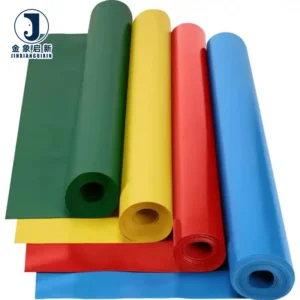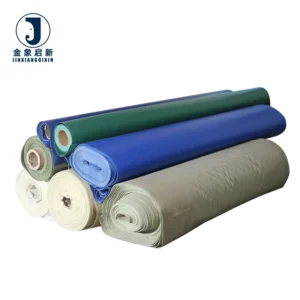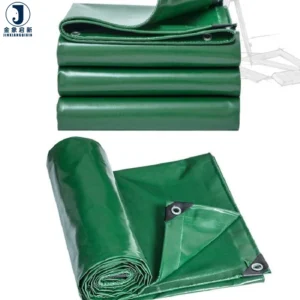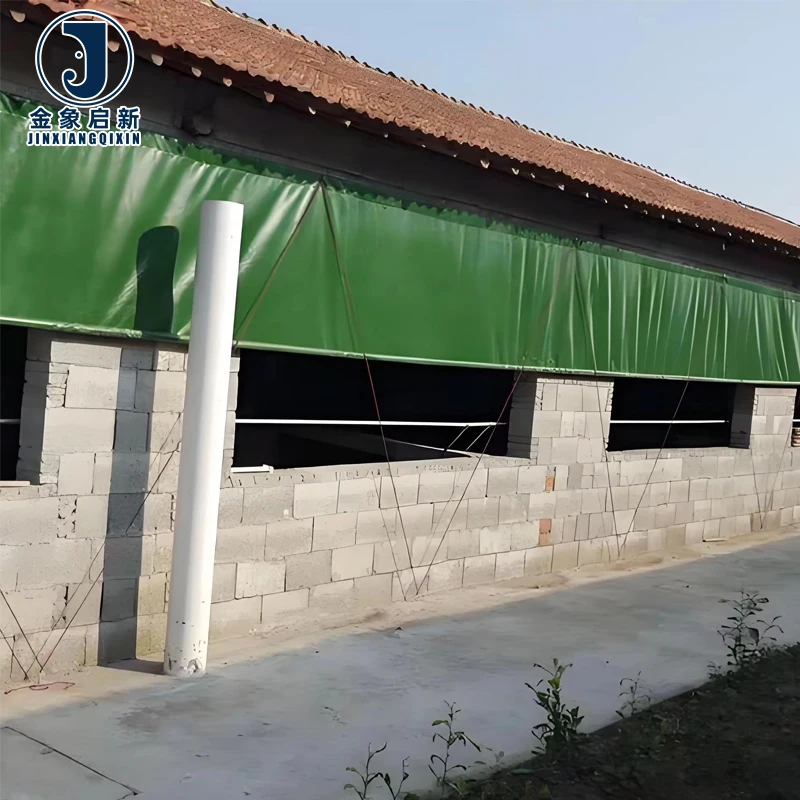
Warp Knitted Base Stability — 36 sets of coating and laminating equipment maintain consistent PVC adhesion across every roll of farm tarpaulin, preventing delamination at fold and tie-down points during transport.
Technical Specifications
| Parameter | Value |
|---|---|
| Product Type | PVC Coated Tarpaulin Roll |
| Coating Material | PVC |
| Base Fabric | Warp knitted polyester |
| Weave Style | Plain |
| Waterproof | Yes |
| Anti-Static | Claimed (test basis not stated) |
| Tear Resistant | Claimed (test basis not stated) |
| Color | Customizable |
| Finish | Glossy or matte available |
| Application Grade | Industrial / Heavy-duty |
Application Suitability
| Application | Exposure & Requirement |
|---|---|
| Poultry and broiler house side curtains | Wind-driven rain, ammonia atmosphere, repeated roll-up stress at hem |
| Pig and sheep shelter enclosures | Constant moisture, animal contact abrasion, tie-down flex at frame joints |
| Livestock trailer covers for transit | Road vibration, load shift at tie-downs, UV and weather exposure |
| Agricultural tent and storage structures | Long-term weathering, wind uplift on seams, dust and debris accumulation |
| Farm equipment and feed stockpile covers | Static load compression, UV exposure, repeated deployment and folding |
Why Tarpaulin Weight Alone Cannot Predict Farm Cover Longevity
Coating adhesion and base fabric construction determine field performance far more than GSM.
When sourcing PVC Coated Tarpaulin for Poultry Farm covers, buyers often anchor decisions on a single number: the grams per square metre stated on the quotation. I have watched heavy-grade rolls delaminate at the weld line after one season on a broiler house, while lighter rolls with superior coating penetration held firm through multiple winters. GSM measures total mass — it does not separate base fabric denier from coating weight, and it says nothing about how well the PVC bonds to the warp knitted substrate under repeated flex and tension [NEED_CITE: coating adhesion test methods for PVC tarpaulin per ISO 1421]. A cover that fails at the seam on a livestock trailer does not fail because it was too light. It fails because the coating peeled from the base fabric at the exact point where tie-down straps concentrate load.
Tear Resistance at Tie-Down and Flex Points
Farm transport and livestock shelter covers experience concentrated stress at every attachment point. The warp knitted polyester base fabric in this PVC Coated Tarpaulin for Poultry Farm applications provides dimensional stability under tension, resisting the progressive tear propagation that woven fabrics can suffer when a single yarn breaks. This matters most on livestock trailer side curtains where wind load and road vibration cycle thousands of times per trip, and on broiler house roll-up curtains where the bottom hem bears the full curtain weight during daily operation.
Waterproof Integrity Under Farm Moisture Conditions
Poultry and pig operations generate moisture from both weather and internal humidity. The PVC coating on this tarpaulin roll forms a continuous barrier across the warp knitted base, preventing water ingress that would otherwise degrade stored feed or compromise livestock health. The coating process controls weight distribution evenly across the fabric surface, which is critical because thin spots in the coating layer become the first entry points for moisture and the first locations where delamination begins under UV exposure and flex cycling [NEED_CITE: PVC coating weight uniformity and waterproof performance correlation].
How Base Fabric, Coating Method and Weight Interact in Farm Tarpaulin
The warp knitted construction of the base fabric creates a multi-axial yarn structure that distributes load across adjacent yarns rather than along a single warp or weft line. This is fundamentally different from standard woven fabrics and explains why warp knitted PVC tarpaulins resist tear propagation differently under field conditions. The PVC coating is applied to both faces of this base, and the total GSM combines base fabric weight with coating weight on each side. A higher coating weight improves waterproofing and UV shielding but adds stiffness, which can reduce drape and make roll-up curtain operation harder on poultry house side walls. The balance between base denier and coating thickness determines whether the fabric flexes at a tie-down without cracking or resists abrasion against a trailer frame without wearing through. Coating adhesion — how deeply the PVC penetrates the warp knitted structure — governs whether the coating stays bonded after months of ammonia exposure inside a livestock shelter [NEED_CITE: PVC coating adhesion to knitted polyester substrates].
The Hidden Cost of Wrong Specification on Farm Covers
A tarpaulin roll that arrives lighter than the quoted GSM is not just a commercial problem — it is a structural one. When coating weight is reduced to hit a price point, the fabric loses waterproof depth at the surface and becomes more susceptible to UV degradation and physical abrasion at contact points. On livestock trailers, under-specified fabric wears through at the frame rails within months rather than seasons. On poultry farm curtains, inadequate coating adhesion leads to delamination that starts at the hem and spreads across the panel, requiring full replacement instead of a simple repair. Color inconsistency between rolls in the same order becomes visible once covers are installed side by side on adjacent shelters, creating a patchwork appearance that signals poor quality control to anyone visiting the farm [NEED_CITE: batch color consistency standards in PVC coated fabric production].
Sourcing Confidence Through Process Control
Nearly 30 years focused on coated fabric production has built deep process control over coating weight accuracy and adhesion quality, which directly affects how this PVC tarpaulin performs at the tie-down and flex points on farm trailers and shelters. Three full production lines and 36 sets of professional equipment support bulk roll output with reliable on-time delivery for large farm cover projects. The 10-person R&D team handles material selection, custom color matching and sample development so you can verify fabric hand and performance before committing to a full order. Dedicated quality inspection at every production stage, with 100% pre-shipment inspection, catches coating defects and color variance before rolls leave the factory. Sample turnaround within days lets farm operators and transport fleet managers test fitment and welding parameters on their own equipment before the main production run begins.
Documentation & Verification
- Material specification sheet stating GSM, base fabric denier, and PVC coating weight per roll
- Waterproof performance verification documented through coating process records
- Color reference and batch consistency report across all rolls in the order
- Anti-static and tear resistance test documentation available upon confirmation of required grade
- Pre-shipment inspection record covering coating adhesion and surface quality
- Roll packing list with individual roll dimensions and weights for receiving verification
Fabrication, Handling & Storage
- Heat welding parameters must be adjusted to the specific PVC coating thickness to ensure seam strength matches the base fabric tear resistance
- Reinforced hem construction should distribute tie-down load across the warp knitted structure to prevent tear initiation at grommet points
- Store rolls upright on a flat surface to prevent compression marks on the PVC coating surface
- Unroll in moderate temperatures to avoid stiffness-related cracking of the PVC coating in cold conditions
- Clean with mild detergent only; solvents can degrade the PVC coating and compromise waterproof integrity
- Allow for material stretch characteristics of warp knitted base fabric when cutting panels to final farm cover dimensions
Preparing Your Inquiry for Farm Tarpaulin Roll
To get an accurate specification recommendation, share your intended application — whether livestock trailer side curtain, poultry house roll-up panel, or static shelter cover — along with the environmental exposure conditions and any regulatory requirements for your market. Specify the roll width and length you need, along with color requirements and whether you need fabricated panels or roll stock only. If your project involves non-standard trailer dimensions or custom branding, confirm these details at inquiry stage so samples can be developed to match.
Frequently Asked Questions
Q: How do I verify the GSM of PVC Coated Tarpaulin for Poultry Farm covers on arrival matches the quotation?
A: Request a material specification sheet that separates base fabric weight from PVC coating weight. On receipt, cut a measured sample from the roll and weigh it to cross-check against the stated total GSM. Any variance should be flagged before fabrication begins, as coating weight directly affects waterproof and tear performance on farm covers.
Q: What eyelet and hem reinforcement options work best for livestock trailer tie-downs?
A: Reinforced hems with heat-welded webbing distribute tie-down strap load across the warp knitted base fabric, preventing tear initiation at individual grommet points. Eyelet spacing should match your trailer’s tie-down rail configuration to avoid unsupported spans that flex excessively under road vibration.
Q: How is color consistency maintained across multiple rolls for large farm cover orders?
A: Each production batch is matched to a confirmed color reference, and rolls from the same order are inspected side by side before dispatch. Request a batch color consistency report with your shipment documentation to verify that all panels will match once installed on adjacent shelters or trailer units.
Q: What welded seam performance should I expect at flex points on farm transport covers?
A: Seam strength depends on coating adhesion to the warp knitted base and correct heat welding temperature for the PVC thickness. A properly welded seam on this tarpaulin should resist delamination under load flex, but welding parameters must be tested on sample material first to match your specific fabrication equipment.
Q: Can I order custom widths for non-standard farm trailer and shelter frame sizes?
A: Custom width and length options are available and should be confirmed at inquiry stage along with your color and any printed branding requirements. Sample development within days allows you to verify fitment on your specific trailer model or shelter frame before full production commences.