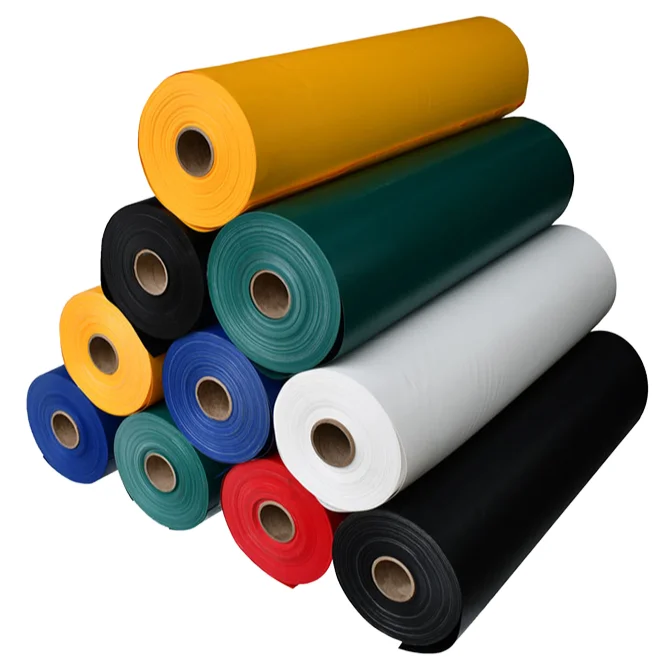
Coating adhesion control — Hot-melt and laminated coating processes produce consistent PVC-to-base-fabric bonding, verified through 100% pre-shipment inspection on every roll before dispatch.
Technical Specifications
| Parameter | Value |
|---|---|
| Product Type | PVC Coated Tarpaulin |
| Material | PVC + High-strength polyester mesh fabric |
| Weight (GSM) | 350gsm / 420gsm / 500gsm / 550gsm / 600gsm / 750gsm |
| Total Thickness | 0.32mm / 0.35mm / 0.4mm / 0.45mm / 0.5mm / 0.65mm |
| Coating Method | Laminated technology & Hot-melt Coating technology |
| Roll Size | 2m width × 75m length / 2.1m width × 50m length |
| Finish Product Size | Custom items as per customer’s needs or sold by inventory |
| Color Options | Blue / Red / Yellow / Light blue / Grey (Customized) |
| Key Features | Waterproof, cold crack resistance, anti-mildew, anti-static treatment (grade not stated), flame retardant (grade not stated), best color fastness, outstanding tearing strength for welding |
| Service Life | 3–7 years under normal circumstances |
| Standards | ISO, CE |
Application Suitability
| Application | Exposure & Requirement |
|---|---|
| Truck side curtain | Constant flexing at load points, road debris abrasion, wind-driven rain, UV exposure during transit |
| Trailer flatbed cover | Tie-down strap friction, repeated folding at edges, standing water pooling during stops |
| Transport awning | Deployment and retraction stress, sun exposure at rest stops, colour consistency across fleet branding |
| Cargo ship cover | Salt spray, heavy weather, prolonged UV, securing against shifting deck loads |
What Happens When the Cover Does Not Fit the Trailer
PVC coated tarpaulin for truck and trailer use must be cut and reinforced against the actual trailer dimensions, not a generic template.
Fleet operators who source covers sized to a standard rectangle often discover that the hem sits too short of the rear latch or the side curtain drags on the chassis rail. Every excess fold becomes a water channel; every gap becomes a cargo exposure point. I have reviewed return logs where the primary complaint was not fabric quality but simply that the cover did not match the trailer profile. [NEED_CITE: trailer dimension variance across European and North American OEM chassis specifications]
Matching Cover Geometry to Your Fleet Configuration
A PVC coated tarpaulin for truck and trailer application requires more than width and length measurements. The position of tie-down rails, the radius of the rear corner, and the clearance between curtain runners and the load deck all determine where reinforcement patches and eyelets must sit. Each trailer model in your fleet may need its own pattern file, and those patterns must be retained for repeat orders so that replacement covers arrive ready to install.
Weld Seam Behaviour Under Load Flexing
The flex points on a moving trailer — where the side curtain bends around the rear corner or where the cover folds over the tailgate — concentrate mechanical stress on welded seams. Hot-melt coating technology produces a PVC layer that bonds into the base fabric rather than sitting on top of it, which means the weld zone carries tearing load through both the coating and the yarn structure simultaneously. [NEED_CITE: weld seam peel strength testing methods for PVC coated polyester per ISO 1421]
Reading the GSM Range Against Actual Load Conditions
The available weight grades from 350gsm to 750gsm span applications from light transport awnings to heavy-duty side curtains carrying sustained wind load. A higher GSM does not automatically translate to higher tear resistance — the denier of the polyester yarn and the weave density of the base fabric determine how a tear propagates once initiated. Choosing the correct grade requires matching the trailer’s operating environment: a long-haul curtain exposed to highway speeds needs different base fabric construction than a yard cover that only sees handling during loading and unloading.
The Hidden Cost of Colour Variance Across Rolls
When a fleet orders side curtains or awnings in a brand colour, rolls pulled from different production batches can show visible shade differences once installed side by side on adjacent vehicles. This forces the operator to either accept the mismatch or return entire panels for replacement, delaying fleet deployment and adding freight cost. Colour consistency is a coating-line control issue — the pigment dispersion ratio and oven temperature profile must remain locked across every roll in the order. [NEED_CITE: color measurement tolerance standards for industrial coated textiles]
Why Source PVC Coated Tarpaulin Through This Process
Nearly 30 years of coated fabric production means the coating weight and adhesion parameters for each GSM grade are established from historical run data, not guessed on the first trial. Three full production lines with 36 sets of professional equipment allow simultaneous roll runs so that multi-container orders ship on schedule. The 10-person R&D team develops sample panels against your exact trailer dimensions within days, not weeks. Dedicated QA/QC runs at every production stage, and 100% pre-shipment inspection catches GSM drift and colour shade variation before the rolls reach the packing area. Each shipment includes a pre-shipment inspection record and a material specification sheet tied to that specific production batch.
Documentation & Verification
- Material specification sheet stating GSM, base fabric, coating method, and colour reference per roll
- Pre-shipment inspection record confirming verified weight against quoted GSM before dispatch
- Roll packing list with individual roll weights and dimensions for container loading verification
- Certificate of origin and customs documentation prepared per destination market requirements
- Test reports for flame retardant and anti-static grades supplied where applicable to order specification
Fabrication, Handling & Storage
- Hot-melt coated rolls respond well to high-frequency welding; set power to match the 0.32mm–0.65mm thickness range
- Reinforce eyelet zones with additional PVC patches at tie-down points specified on your trailer pattern
- Store rolls vertically on pallets to prevent permanent creasing through the polyester mesh base fabric
- Allow cold-stored rolls to reach ambient temperature before unrolling to avoid coating crack at the fold line
- Cut panels from 2m or 2.1m roll widths to minimise off-cuts against your specific trailer panel dimensions
Preparing Your Enquiry
Provide the make and model of each trailer in your fleet, along with photographs of the existing cover or curtain runner system. Specify your target market so that any flame retardant or anti-static grade requirements can be matched to local compliance standards. Confirm whether you need finished covers with eyelets and reinforced hems or roll stock for your own fabrication line, and indicate your annual volume to align production scheduling.
Frequently Asked Questions
Q: How is truck cover sizing matched to specific trailer models?
A: We request the trailer make, model, and year along with photographs of the existing cover and its attachment points. Our R&D team builds a pattern file from these dimensions and produces a sample panel for fitment confirmation before the full production run begins. The pattern is retained on file so that repeat orders match the original geometry exactly.
Q: What eyelet spacing and hem reinforcement options are available?
A: Eyelet spacing and hem reinforcement are set according to the tie-down load and the trailer’s securing rail configuration. We reinforce high-stress zones with additional PVC patches welded over the base fabric. The spacing, diameter, and backing plate specification are confirmed during the sample approval stage before production.
Q: How is color consistency controlled across rolls in the same fleet order?
A: Every roll in a single order runs from the same pigment batch with locked oven temperature and coating weight parameters. Shade readings are taken at the start, middle, and end of the run. Rolls that fall outside the agreed tolerance are rejected at the pre-shipment inspection stage and do not enter the packing area.
Q: How does the fabric perform at weld seams under repeated load flexing?
A: The hot-melt and laminated coating technology bonds PVC into the polyester mesh rather than sitting on the surface, so welded seams carry tearing load through both layers. This construction is designed to resist delamination at flex points such as trailer rear corners where the curtain bends during transit and loading operations.
Q: What documentation is provided to verify material specs on arrival?
A: Each shipment includes a material specification sheet stating the GSM, base fabric construction, coating method, and colour reference for every roll. A pre-shipment inspection record confirms the verified weight, and a roll packing list details individual roll weights and dimensions. Flame retardant or anti-static test reports are included where applicable to your order specification.