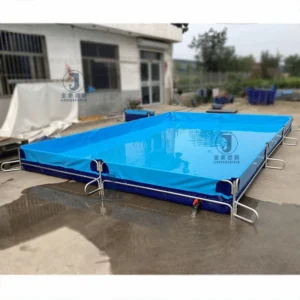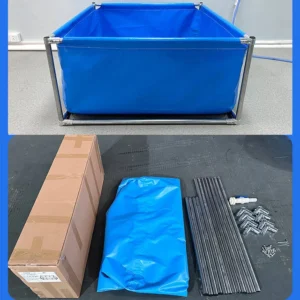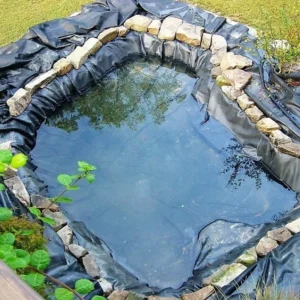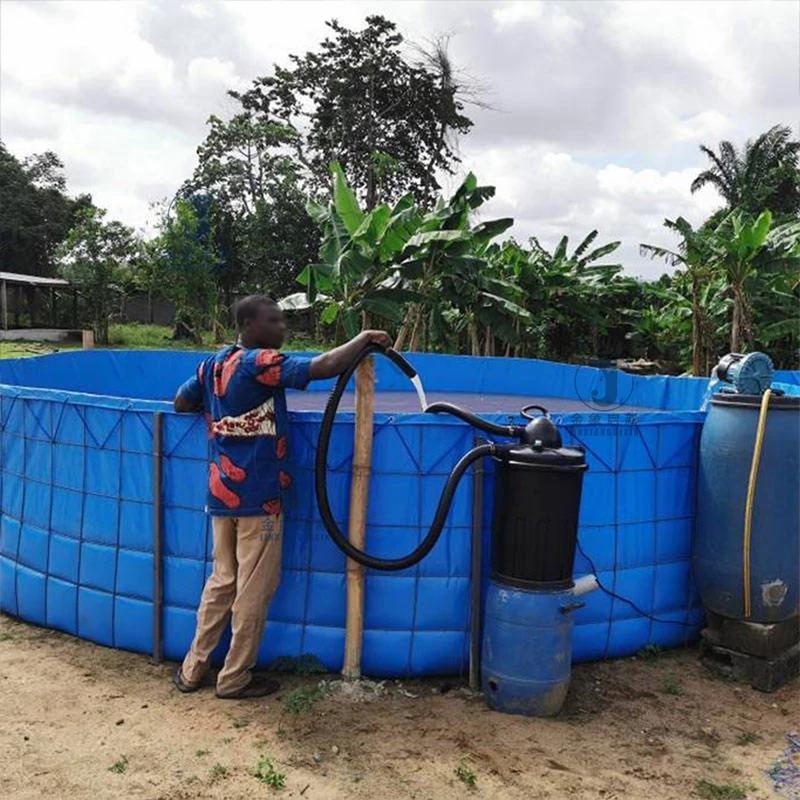
Deep Process Control Over Coating — every roll of PVC tarpaulin for fish pond is verified for coating weight and adhesion at each production stage before dispatch.
Technical Specifications
| Parameter | Value |
|---|---|
| Product Type | PVC Coated Tarpaulin |
| Material | PVC & Polyester |
| Yarn Count Options | 500D×840D / 500D×1000D / 1000D×1000D / 1000D×1300D / 1300D×1300D / 1000D×2000D |
| Density Options | 30×19 / 20×20 / 30×15 |
| Thickness Range | 0.29mm to 0.65mm |
| GSM Range | 350 to 900 g/m² |
| Tensile Strength (Warp) | 1650 N to 3900 N |
| Tensile Strength (Weft) | 1600 N to 3500 N |
| Key Features | Water Resistant, Waterproof, Flame Retardant (grade not stated in source), Anti-UV (test basis not stated in source) |
| Surface | Smooth, leather-like texture |
| Repairability | Hot air welding |
| Certification | ISO, CE |
Application Suitability
| Application | Exposure & Requirement |
|---|---|
| Fish pond liner | Permanent water contact, soil chemistry, puncture risk from substrate |
| Shrimp pond containment | Saline water exposure, UV degradation from continuous outdoor sunlight |
| Agricultural water reservoir | Hydrostatic pressure, seasonal temperature fluctuation, mechanical abrasion |
| Decorative and commercial pool | Chlorinated or treated water, foot traffic stress, prolonged UV exposure |
| Water storage tank lining | Constant water pressure at seams, flexing during fill and drain cycles |
Why Quoted GSM Alone Cannot Guarantee Pond Liner Integrity
The number on the quotation only matters if it matches what arrives on the pallet.
I have seen coated fabric orders arrive at aquaculture sites where the rolls measured lighter than the stated GSM — sometimes by a margin large enough to compromise hydrostatic resistance. For a pond liner holding thousands of litres of water, that shortfall is not an abstract quality issue. It shows up as seepage at welded seams within the first fill cycle, or as tearing when the liner shifts against the pond bed under load. [NEED_CITE: tensile and tear test methods for coated fabrics per ISO 1421]
How Polyester Base Fabric Defines Long-Term Containment
The PVC tarpaulin for fish pond applications relies on its polyester base fabric to carry the structural load once water fills the pond. A 1000D×2000D weave delivers warp and weft tensile values that resist the outward pressure exerted by deep water columns. Lower denier constructions — such as 500D×840D — suit lighter-duty tank linings where hydrostatic forces remain modest. Selecting the correct base fabric grade prevents the liner from stretching or deforming at stress concentration points, particularly at corners and along welded joints where the material transitions from floor to sidewall.
Coating Weight and the Waterproof Seal at Every Seam
Double-sided PVC coating creates a continuous barrier that blocks water migration through the fabric body and, critically, through thermally welded seams. When the coating thickness is consistent across the roll surface, hot air welding produces a uniform bond that matches the parent material in waterproof integrity. Rolls with uneven coating layers tend to produce welds that fail under sustained water pressure — a failure mode that often appears weeks after installation rather than during initial testing. [NEED_CITE: coating adhesion and peel strength testing for PVC tarpaulin fabrics]
Reading GSM, Denier and Density Together
A high GSM value without a correspondingly dense base fabric can mean heavy coating over a weak substrate — a construction that may resist puncture but tears easily once a small cut propagates. The mesh count, expressed as warp and weft yarns per unit area, determines how far a tear travels before encountering the next yarn intersection. For pond liner use, the combination of 30×15 density with 1000D×2000D yarns produces a fabric where tear propagation is arrested within a short distance, limiting damage from sharp stones or root intrusion beneath the liner.
The Hidden Cost of Specifying on Price Per Square Metre
Choosing pond liner fabric primarily on cost per unit area often leads to receiving material where the coating has been applied thinner than the sample approved during quotation. The base fabric may match the stated denier, but reduced PVC coating weight leaves welded seams vulnerable to pinhole leakage under hydrostatic pressure. I have observed entire pond installations requiring partial drainage and re-welding because the liner material could not hold a consistent seam under sustained water load. [NEED_CITE: common failure modes in PVC pond liner installations]
Why Procurement Teams Source This Fabric Here
- Coating weight verified at every production stage through dedicated QA/QC checkpoints, not only at final inspection.
- Ten-person R&D team develops samples within days when custom GSM, width or colour is required for a specific pond geometry.
- Three full production lines and 36 sets of professional equipment support volume orders with consistent roll-to-roll output.
- One hundred percent pre-shipment inspection confirms thickness, GSM and surface quality against the approved specification before dispatch.
- ISO and CE certified production with full documentation packages tailored to the importing market’s customs and compliance requirements.
Documentation & Verification
- Material specification sheet listing exact GSM, base denier, mesh count and coating weight per roll
- Pre-shipment inspection record confirming thickness and weight against the purchase order
- UV test documentation available — confirm the standard required for your market
- Roll packing list with batch identification for field traceability
- Certificate of origin and customs support documentation included with each shipment
Fabrication, Handling & Storage
- Hot air welding at temperatures suited to the PVC coating thickness — test weld parameters on offcuts before joining full panels
- Store rolls upright on pallets to prevent flat-spot deformation that affects unrolling and weld alignment on site
- Avoid dragging heavy-grade rolls across abrasive ground during deployment to protect the smooth coating surface
- Clean with mild detergent and soft brush; solvent-based cleaners may degrade the PVC coating layer
- Repair field punctures using compatible PVC patches and hot air welding for a permanent, waterproof bond
- Plan panel cuts to minimise the number of welded seams crossing the pond floor where hydrostatic pressure is highest
What to Include in Your Enquiry
Provide the pond or tank dimensions, water depth and substrate type so the correct GSM and base fabric denier can be recommended. Specify whether the liner will be exposed to direct sunlight continuously, as this determines whether anti-UV treatment with supporting test documentation should be included. Indicate the roll width and length required, or whether custom-cut panels with factory-welded seams are preferred over field fabrication.
Frequently Asked Questions
Q: How do I verify GSM and thickness on arrival to ensure the pond liner matches the specification?
A: Each shipment includes a pre-shipment inspection record that documents measured GSM and thickness values per roll. On receipt, you can cross-check these figures using a calibrated scale and thickness gauge against the material specification sheet provided with your order. Any discrepancy should be flagged immediately with the inspection documentation as reference.
Q: What UV test basis supports the anti-UV claim for continuous outdoor pond exposure?
A: Anti-UV treatment is available across the PVC tarpaulin for fish pond range. The specific test standard and exposure duration vary by market requirement. Request the UV test report during the enquiry stage and confirm which standard — such as ISO 4892 or equivalent — your local regulations or project specifications mandate before approving production.
Q: Can the tarpaulin be custom-cut to fit irregular pond shapes, and what are the minimum order requirements?
A: Custom-cut panels are available alongside standard roll supply. The R&D team develops samples within days based on your pond geometry drawings, including corner radii and inlet or outlet penetrations. Minimum order quantities depend on the selected GSM grade and colour. Confirm dimensions and annual volume during the enquiry to receive a specific production schedule.
Q: How are welded seams tested to prevent water leakage at pond joints and corners?
A: Welded seams are inspected as part of the 100% pre-shipment quality check. Peel strength and visual inspection confirm bond integrity across the full seam length. For on-site fabrication, test welds on material offcuts establish the correct hot air temperature and speed before joining full panels, ensuring seams match the parent PVC coating in waterproof performance.
Q: What is the recommended cleaning, maintenance and hot-air welding repair procedure for pond liners?
A: Drain the affected area and clean the liner surface with mild detergent before any repair work. Apply a compatible PVC patch using hot air welding at parameters matched to the coating thickness. After repair, refill gradually and inspect the patched zone under partial hydrostatic load before returning the pond to full capacity.