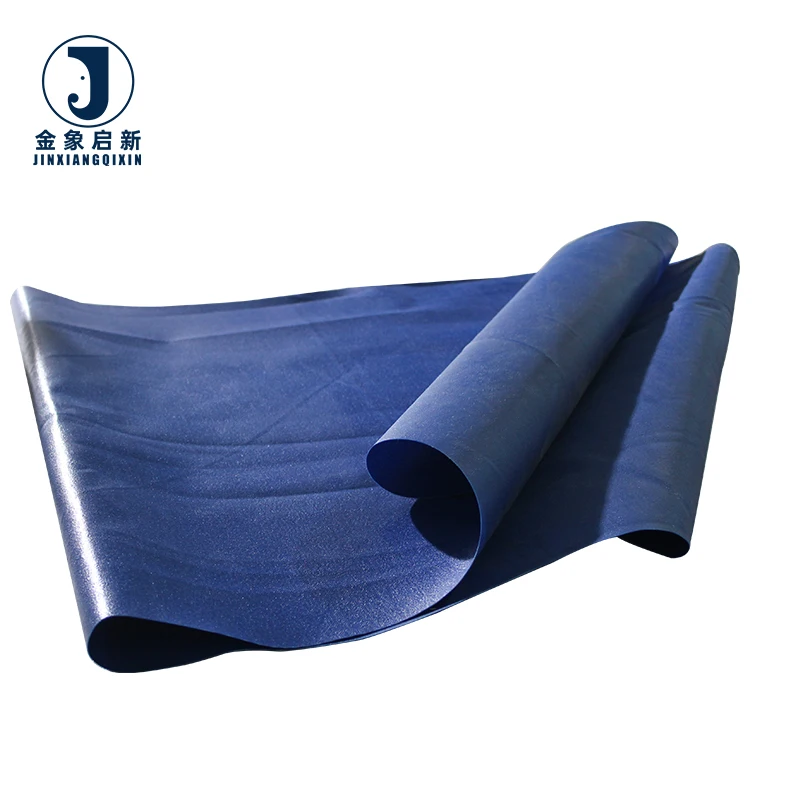
Precision-Fit Fabrication — rolls cut and reinforced to match your specific trailer model rather than generic stock sizes, backed by 36 sets of professional cutting and welding equipment.
Technical Specifications
| Parameter | Value |
|---|---|
| Product Type | PVC Tarpaulin Roll |
| Coating Material | PVC |
| Weight (GSM) | 550g, 600g, 650g, 900 GSM |
| Thickness | 0.2-0.4mm / 8 mil-16 mil |
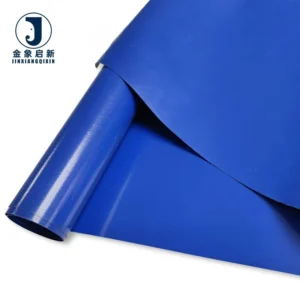
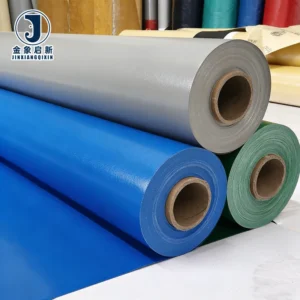
| Color Options | Blue, Blue/Orange, Green, Grey, Black, Clear, Grey/Green, Orange, or custom color |
| UV Treatment | Available (test basis not stated) |
| Waterproof | Yes |
| Key Features | Tear resistant, weather proof, sunproof, mildew proof, anti-aging, washable |
| Certification | ISO and CE (company level) |
Application Suitability
| Application | Exposure & Requirement |
|---|---|
| Truck and trailer side curtains | Constant flexing at load shift points, road spray abrasion, daily UV exposure, wind loading at speed |
| Flatbed and load covers | Tie-down strap abrasion at eyelets, water pooling, forklift contact during loading |
| Transport fleet replacement fabric | Batch-to-batch colour consistency for panel replacement, welded seam integrity under tension |
| Roof tent outer shells | Rain and condensation exposure, repeated folding and unfolding, UV degradation at high altitude |
Why Generic-Sized Truck Covers Fail at the Flex Points
Your trailer is not a rectangle, and neither is the fabric that covers it.
Fleet operators routinely replace truck covers not because the PVC coated fabric itself wore through, but because the welded seams split at the exact points where the load flexes during transit. Generic-cut tarps leave seam lines positioned by default rather than by design, placing the weakest structural element — the heat-welded joint — directly in the highest-stress zone. When you source PVC Tarpaulin Roll for Truck Cover aftermarket replacement, the cut dimensions and seam placement matter as much as the GSM weight [NEED_CITE: tensile and tear test methods for coated fabrics per ISO 1421].
I have seen heavy-grade coated rolls perform worse than lighter ones simply because the seam layout ignored the trailer articulation pattern. The fabric survived; the weld did not.
Reinforcement Layout Matched to Trailer Articulation
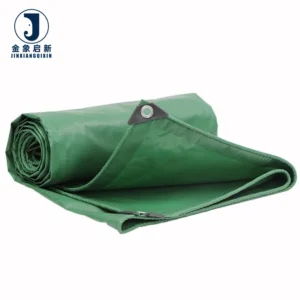
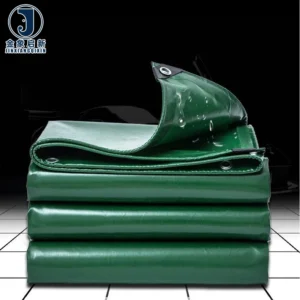
Every trailer model flexes differently depending on axle spacing, load distribution, and suspension travel. A PVC Tarpaulin Roll for Truck Cover application requires reinforcement strips and double-layer patches positioned at known stress concentrations — not evenly spaced across the panel. Our R&D team maps reinforcement zones based on the specific trailer model you supply, so the eyelet line, hem fold, and internal patches align with where the fabric actually moves.
Welded Seam Integrity Under Dynamic Load
Static tensile strength tells you what the fabric holds on a test frame. It does not tell you what happens at 90 km/h with a crosswind and a shifting pallet load. The heat-welded seam on this PVC coated tarpaulin roll is constructed to exceed the base fabric tear resistance at the joint line, meaning the fabric will yield before the weld separates under normal dynamic conditions [NEED_CITE: welded seam peel strength testing for PVC coated polyester].
How GSM, Coating Method, and Base Fabric Interact
The weight in GSM is a starting point, not a complete specification. A 650 GSM roll with a loosely woven base fabric and heavy coating may feel thick but tear easily along the weave. A 550 GSM roll with a high-denier, tightly woven polyester base and balanced PVC coating on both sides can outperform it in both tensile and tear resistance. The coating method — whether knife-over-roll, dip, or calender — determines how deeply the PVC penetrates the base weave, which directly affects the bond strength between coating and yarn. Deeper penetration means the coating will not delaminate at the fold line after repeated flexing cycles. This is why specifying only GSM on your purchase order leaves too much room for interpretation [NEED_CITE: coating adhesion and delamination test standards for PVC tarpaulin].
Thickness at 0.2-0.4mm across the 550g to 900 GSM range reflects the coating weight applied to each side of the base fabric. Heavier coating builds thickness but does not automatically improve tear resistance if the base yarn denier remains unchanged. For truck side curtain applications, the base fabric weave density is the primary driver of longevity, while the coating thickness governs waterproofing and surface abrasion resistance.
The Hidden Cost of Specifying GSM Without Verification
Quoting by GSM is standard practice, but arrival weight frequently deviates from the stated specification. A roll ordered at 650 GSM that arrives at 580 GSM has had its coating weight reduced somewhere in production — thinner PVC on each face, less penetration into the base weave, lower bond strength. The shortage is not visible on the roll and not detectable by hand feel. It becomes visible only when the cover fails months earlier than expected, and by then the supplier conversation has already closed [NEED_CITE: GSM deviation and its effect on coated fabric service life].
Colour variation between rolls in the same order is a separate but equally costly problem. When two rolls from one shipment show a visible shade difference once installed side by side on a trailer fleet, the only remedy is full replacement of the mismatched panels. Consistent pigment dosing and coating temperature control across the production run are what prevent this, and both require in-process checks rather than end-of-line sampling alone.
Why Fleet Operators Source This PVC Tarpaulin Roll Here
Three full production lines with 36 sets of professional equipment give us the capacity to run your fleet replacement order as a single batch, keeping colour and coating weight consistent across every roll. A 10-person R&D team handles trailer-specific cut patterns and reinforcement layouts, not just standard roll dispatch. Every roll undergoes dedicated QA/QC at each production stage with 100% inspection before shipment — the pre-shipment inspection record you receive documents actual GSM per roll, not a batch average. Samples for custom widths, colours, or reinforcement patterns are developed within days so you can verify fit and weld behaviour before committing to the full order. ISO and CE certification underpins the production system, and documentation packages ship with every dispatch for customs clearance at destination.
Documentation & Verification
- Material specification sheet stating GSM, base fabric construction, and coating weight per roll
- Pre-shipment inspection record with actual measured weight against the quoted GSM
- UV treatment test report included where UV stabilised grades are specified
- Roll packing list with individual roll dimensions and weight for container loading
- Certificate of origin and customs documentation matched to destination port requirements
Fabrication, Handling & Storage
- Heat-weld at recommended temperature and speed for 0.2-0.4mm PVC coating to avoid scorching or weak bonds
- Position eyelet reinforcement patches based on tie-down strap angle, not evenly spaced intervals
- Store rolls upright on pallets to prevent flat-spot deformation of the PVC coating surface
- Allow rolls to reach ambient temperature before unrolling in cold conditions to avoid coating crack
- Use neutral pH cleaners on the PVC surface to preserve anti-aging treatment integrity
- Plan cut layout from roll width to minimise off-cuts and reduce the number of welded seams per cover
What to Include in Your Enquiry
Specify the trailer model or exact cover dimensions so the roll width and reinforcement layout can be matched to your fleet. Confirm whether you require UV treatment or flame-retardant grades and which standard applies in your operating region. State your colour requirement by RAL or Pantone reference and indicate the annual volume to determine production scheduling and batch consistency grouping.
Frequently Asked Questions
Q: Can you cut PVC Tarpaulin Roll for Truck Cover to fit my specific trailer model dimensions?
A: Yes. Provide the trailer make, model, and year, or supply exact panel dimensions with eyelet and reinforcement positions marked. Our R&D team develops a cut pattern and sample for your approval before the production run begins, ensuring the cover fits without field modification.
Q: How do I verify the GSM matches what I ordered?
A: Every roll is weighed and measured during our 100% pre-shipment inspection. You receive an inspection record documenting the actual GSM per roll alongside the quoted specification. This record travels with your shipment documentation so you can cross-check on arrival.
Q: What certifications come with flame-retardant or anti-UV PVC tarpaulin fabric?
A: Where flame-retardant or UV-treated grades are specified, a test report documenting the applicable standard ships with your order. Confirm the grade required for your market at enquiry stage so the correct treatment and documentation are prepared during production.
Q: How do you ensure colour consistency across multiple rolls in one order?
A: Your full order runs as a single batch on one production line with in-process colour checks at each coating stage. Pigment dosing and coating temperature are controlled continuously, and rolls showing shade deviation are pulled before the 100% pre-shipment inspection.
Q: What documentation ships with my order for customs clearance?
A: Each dispatch includes a material specification sheet, pre-shipment inspection record, roll packing list with individual weights and dimensions, certificate of origin, and any applicable test reports. All documents are matched to your destination port requirements.