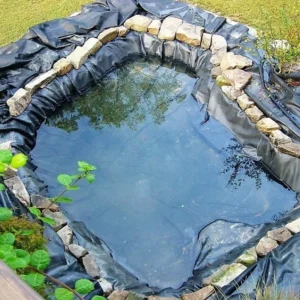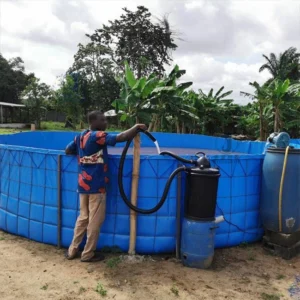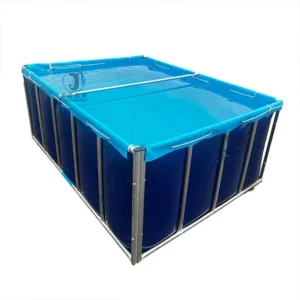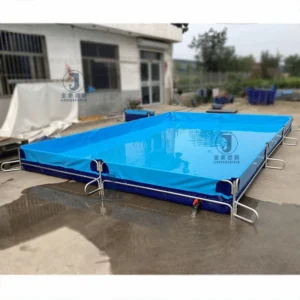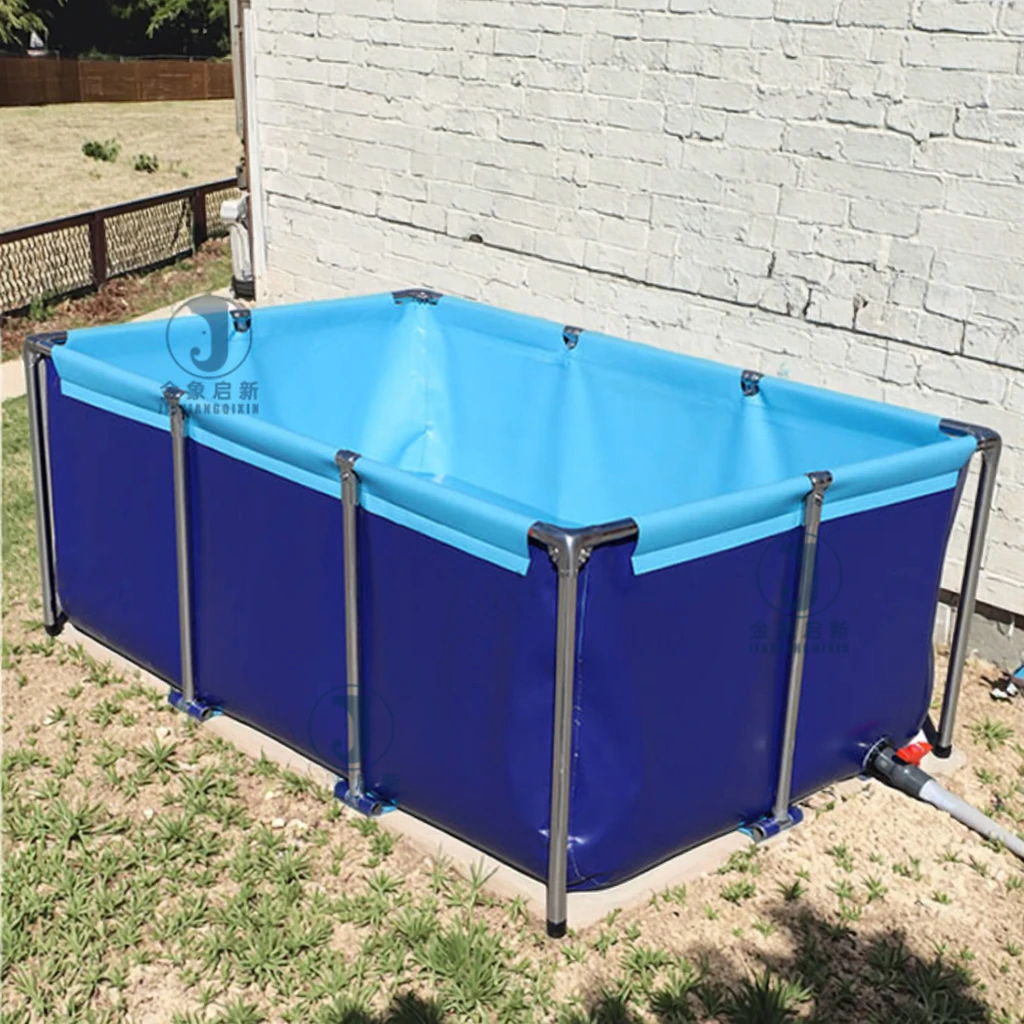
Precision Weight Control — Every roll of PVC Tarpaulin Roll for Fish Pond Lining & Aquaculture Tanks is inspected against the quoted GSM before dispatch, eliminating the risk of under-weight delivery that compromises containment integrity.
Technical Specifications
| Parameter | Value |
|---|---|
| Product Type | PVC Tarpaulin Roll for Fish Pond Lining & Aquaculture Tanks |
| Material Composition | High-tenacity polyester base fabric with double-sided PVC coating |
| Base Fabric Denier Options | 500D840D, 500D1000D, 1000D1000D, 1000D1300D, 1300D1300D, 1000D2000D |
| Weight (GSM) Range | 350 / 400 / 420 / 500 / 600 / 650 / 750 / 900 g/m² |
| Thickness Range | 0.29mm (350 GSM) to 0.65mm (900 GSM) |
| Weave Density Options | 3019, 2020, 30*15 |
| Tensile Strength (Warp) | 1650 N (350 GSM) to 3900 N (900 GSM) |
| Tensile Strength (Weft) | 1600 N (350 GSM) to 3500 N (900 GSM) |
| Key Features | Waterproof, abrasion-resistant, anti-bacteria treatment available, UV and flame retardant grades available — confirm the grade required for your market |
| Surface Finish | Smooth, leather-like texture |
| Repairability | Hot air weldable |
| Colour | Customizable |
| Printing | Custom brand printing available |
| Certifications | ISO, CE |
Application Suitability
| Application | Exposure & Requirement |
|---|---|
| Commercial fish and shrimp pond lining | Permanent water immersion, soil chemistry contact, puncture risk from substrate, UV exposure at water line |
| Hatchery and nursery tank construction | Continuous water contact, anti-bacteria requirement, frequent cleaning and disinfection cycles |
| Agricultural water reservoir lining | Long-term water containment, UV exposure, thermal expansion and contraction |
| Aquaculture site equipment and feed covers | Weather exposure, mechanical abrasion from handling, need for waterproof seal |
Why GSM Verification Matters More Than Quoted Weight for Pond Liners
A quoted GSM only protects your project if the delivered roll actually matches it on the scale.
When aquaculture operators receive pond liner rolls that are lighter than specified, the shortfall is rarely obvious until the material is deployed. A liner that is supposed to be 650 GSM but arrives at 580 GSM will have proportionally lower tensile and tear values. In a pond environment, this translates to higher vulnerability to puncture during installation and greater risk of seam failure under hydrostatic pressure. The cost of replacing a failed liner — draining the pond, removing livestock, and re-lining — far exceeds the initial material saving [NEED_CITE: cost impact of pond liner failure in commercial aquaculture operations]. Specifying a PVC pond liner for aquaculture without a pre-shipment weight verification protocol leaves this exposure entirely on the buyer.
Double-Sided Coating for Continuous Water Immersion
A PVC coated tarpaulin roll for fish pond service must maintain waterproof integrity on both faces. The base fabric is encapsulated between two PVC layers, preventing water ingress into the polyester weave that would otherwise lead to biological growth and fabric degradation. This encapsulation also protects the yarn structure from chemical interaction with pond water treatments and soil minerals, preserving tensile properties throughout the service period.
Welded Seams That Match the Fabric Strength
Pond liners fail most often at the joints. The PVC coating on this material is formulated for hot air welding, allowing fabricators to create seams where the coating layers fuse into a continuous bond. Unlike mechanically joined or adhesively bonded alternatives, a correctly welded seam on a PVC pond liner for aquaculture maintains flexibility and waterproof performance that matches the body of the fabric itself [NEED_CITE: hot air weld strength testing for PVC coated polyester fabrics].
Reading the Specifications Beyond GSM
Selecting the correct grade requires understanding how denier, density, and coating weight interact. A 500 GSM liner built on a 500D1000D base with 2020 density will behave differently under load than one on a 1000D*1000D base at the same weight — the higher denier yarns provide greater individual yarn strength, while the denser weave distributes stress across more intersection points. Coating thickness, reflected in the overall GSM and total thickness figures, determines puncture resistance and the depth of the weldable layer. For shallow hatchery tanks, a lighter grade with a smooth surface facilitates cleaning. For deep commercial ponds with rocky substrates, a heavier grade with higher warp tensile values provides the necessary margin against installation damage and long-term hydrostatic load.
The Hidden Cost of Incorrect Liner Specification
Choosing a PVC coated tarpaulin roll based on price per kilogram without verifying the relationship between base fabric denier and coating weight leads to predictable field failures. An under-specified liner installed over an uneven substrate will puncture at stress concentrations. A liner with insufficient anti-UV treatment at the exposed waterline will become brittle and crack, while the submerged portion remains intact — a failure pattern that is often misdiagnosed as a material defect rather than a specification error [NEED_CITE: UV degradation patterns in partially submerged PVC coated fabrics]. Batch-to-batch colour inconsistency across a multi-roll order can also force rejection of an entire installation when the lined pond is visible to clients or inspectors.
Why Procurement Teams Choose This Supply Chain
Three full production lines and 36 sets of professional equipment allow bulk orders to be fulfilled without splitting production across external workshops, maintaining consistent coating weight and colour across the entire order. A dedicated 10-person R&D team develops samples within days for custom widths, colours, and printed branding, enabling specification confirmation before the full production run. Every roll undergoes 100% inspection at the coating stage and again before shipment, with GSM verified against the purchase order. Nearly 30 years of focused production on coated fabrics has produced a process control system that manages adhesion strength and coating uniformity at every stage. ISO and CE certified production provides the documentation trail required by aquaculture certification schemes and import regulations.
Documentation & Verification
- Material specification sheet listing exact GSM, base fabric denier, weave density, and coating type per roll
- UV and anti-bacteria test reports provided for treated grades to validate performance claims
- Pre-shipment inspection record confirming roll weight, width, and surface condition before dispatch
- ISO and CE certificates included with every shipment for customs and compliance clearance
- Certificate of origin and customs documentation prepared to match destination country requirements
Fabrication, Handling & Storage
- Hot air welding temperature and speed should be adjusted to the specific GSM and total thickness of the roll
- Store rolls upright on pallets in shaded conditions to prevent surface flattening and coating adhesion loss
- Unroll in ambient temperatures above 10°C to avoid creasing or cracking in heavier grades such as 750 or 900 GSM
- Use neutral pH cleaners on the smooth PVC surface to preserve the anti-bacteria treatment integrity
- Damaged sections can be repaired on-site using hot air welding with compatible PVC patch material
- Plan cutting layout to minimise off-cuts, particularly on custom width rolls where lead times apply for re-order
What We Need to Quote Your Liner Project
To provide an accurate specification and lead time, share the intended application — whether pond lining, reservoir containment, or aquaculture tank construction — along with the required GSM range and any treatment requirements such as anti-bacteria or flame retardant grades. Confirm the roll width, colour, and whether custom printing is needed. Let us know if you require finished cut sizes with welded hems or full rolls for your own fabrication.
Frequently Asked Questions
Q: What GSM is recommended for fish pond lining versus reservoir covers?
A: Lighter grades in the 350 to 500 GSM range suit shallow hatchery tanks and temporary covers where flexibility and ease of handling are priorities. Heavier grades from 600 to 900 GSM are specified for deep commercial ponds and large reservoirs where puncture resistance and higher tensile values are needed to withstand hydrostatic pressure and substrate irregularities.
Q: Can I get test reports for UV resistance and anti-bacteria treatment?
A: Yes. When you specify anti-UV or anti-bacteria treatment, test reports validating those claims are included with the shipment documentation. We recommend requesting these reports at the inquiry stage so you can confirm the treatment meets your local aquaculture certification or environmental compliance requirements before production begins.
Q: How do PVC pond liners compare to PE liners for longevity and seam integrity?
A: PVC coated polyester liners offer hot air welded seams that fuse the coating into a continuous bond, whereas PE liners typically rely on heat fusion or mechanical joining that can create rigid points prone to cracking. The polyester base fabric in PVC liners also provides substantially higher tensile and tear resistance than PE film of comparable thickness.
Q: What is the minimum order for custom width or colour?
A: Custom widths and colours are produced on dedicated runs, and minimum order quantities vary depending on the specific GSM grade and the complexity of the colour match. Contact us with your required specification and target quantity, and we will confirm the applicable minimum along with the sample development timeline and production lead time.
Q: Can damaged sections be repaired on-site, and what equipment is needed?
A: Yes, the PVC coating is repairable by hot air welding using compatible PVC patch material and a standard hot air gun. This allows aquaculture operators to carry out on-site repairs to punctures or seam damage without draining the pond or replacing entire sections, minimising operational downtime and stock disturbance.