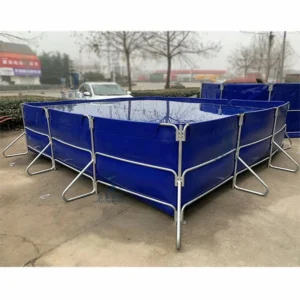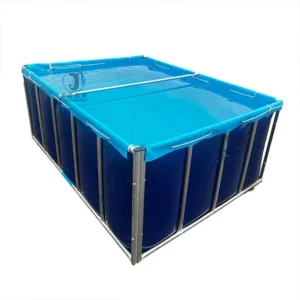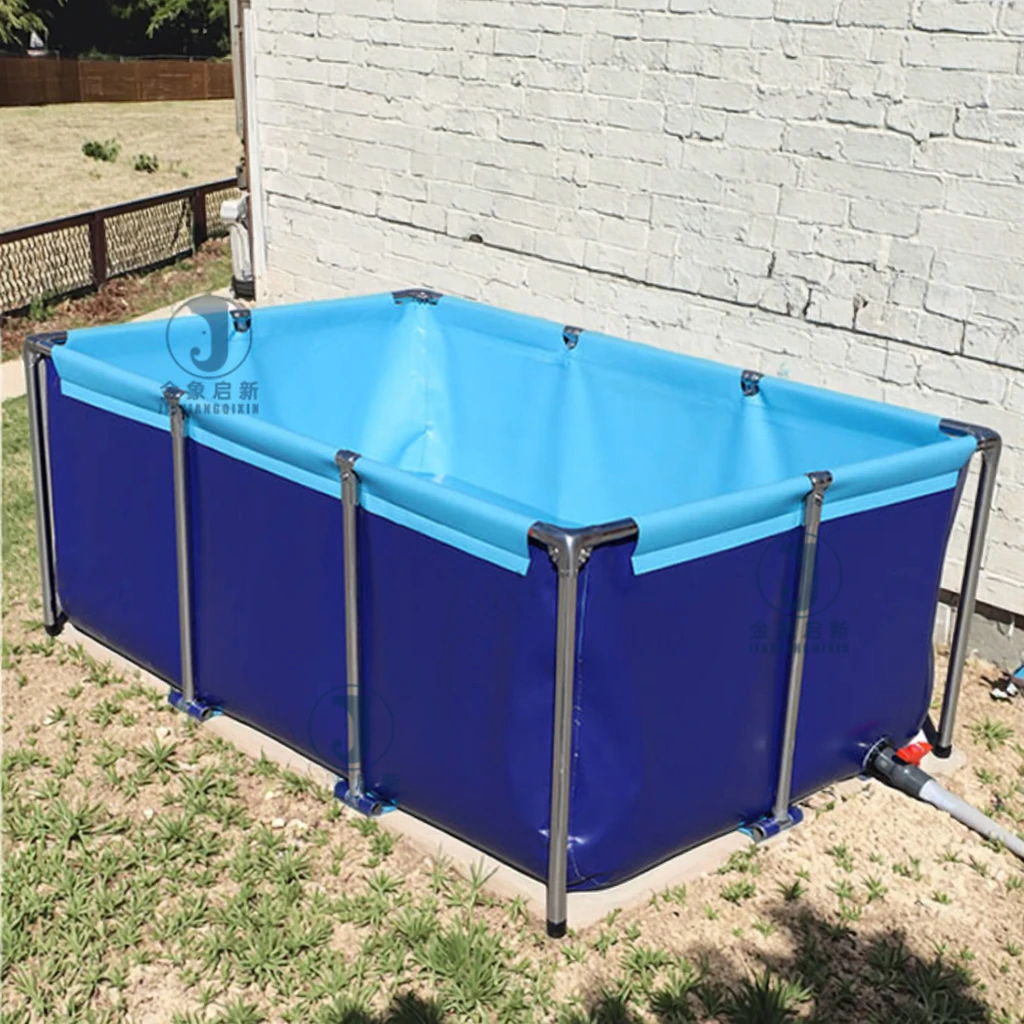
Coated Fabric Process Control — Nearly 30 years of PVC coating expertise applied to pond liner production, with dedicated QA/QC at every stage ensuring the GSM on the roll matches the GSM on your specification sheet.
Technical Specifications
| Parameter | Value |
|---|---|
| Product Type | PVC Tarpaulin Roll for Fish Pond Lining & Aquaculture Tanks |
| Material | Polyester Base Fabric with Double-Sided PVC Coating |
| Yarn Count Options | 500D×840D / 500D×1000D / 1000D×1000D / 1000D×1300D / 1300D×1300D / 1000D×2000D |
| Density Options | 30×19 / 20×20 / 30×15 |
| Weight Range | 350 / 400 / 420 / 500 / 600 / 650 / 750 / 900 GSM |
| Thickness Range | 0.29 / 0.32 / 0.38 / 0.44 / 0.46 / 0.55 / 0.65 mm |
| Tensile Strength (Warp) | 1650 – 3900 N (test basis not stated in source) |
| Tensile Strength (Weft) | 1600 – 3500 N (test basis not stated in source) |
| Surface | Smooth, leather-like texture |
| Waterproof Performance | Fully coated, overall sealing |
| Flame Retardancy | Available in flame retardant grades — confirm the grade required for your market |
| Anti-UV Treatment | Available with UV stabilisation — confirm test basis at inquiry |
| Repairability | Hot air weldable |
| Custom Colour | Supported |
| Custom Printing | Supported (brand customisation) |
| Standards | ISO, CE |
Application Suitability
| Application | Exposure & Requirement |
|---|---|
| Fish pond lining | Permanent water immersion, soil chemistry contact, puncture risk from substrate and stock movement |
| Aquaculture tanks and shrimp ponds | Continuous water containment, abrasion from aeration equipment, cleaning and disinfecting cycles |
| Agricultural water reservoirs | UV exposure on uncovered sections, temperature fluctuation, sediment load |
| Hatchery and nursery containment | Fish-safe membrane integrity, frequent draining and refilling, biosecurity washing |
Why the GSM on the Quote Does Not Guarantee the Liner You Receive
A specification sheet without verified coating weight is just a promise — we ship documentation that proves what is on the roll.
For aquaculture operators, a PVC Pond Liner for aquaculture that arrives lighter than quoted means thinner coating, reduced puncture resistance, and a liner that fails before the stock cycle ends. Buyers have reported receiving rolls that pass visual inspection but fall short when weighed per square metre, with the deficit hidden inside the core [NEED_CITE: GSM verification methods for coated fabrics per ISO 2286]. When lining a pond that holds live stock, the consequence is not a return — it is lost production and emergency replacement under time pressure.
Coating Weight and Waterproof Integrity for Pond Environments
The double-sided PVC coating on this PVC Pond Liner for aquaculture provides continuous waterproof sealing across the entire fabric surface. Unlike laminated constructions where the coating can separate at the edges, the overall coating process encases the polyester base fabric on both faces, eliminating pathways for water ingress at cut edges and weld lines. This matters for pond installations where the liner sits in permanent contact with water and any coating gap becomes a leak point within the first filling cycle.
Weld Line Performance Under Pond Stress Conditions
Pond liners flex at the base-to-wall transition and at any point where substrate settlement creates an unsupported span. Hot-air welded seams on this fabric are designed to outlast the base material at these stress concentrations. The PVC coating formulation allows consistent heat activation across the weld zone, producing a joint that maintains flexibility after cooling rather than becoming a rigid failure point [NEED_CITE: hot air welding parameters for PVC coated polyester]. For operators installing liners in excavated ponds with uneven subgrades, weld integrity determines whether the liner survives the first season or requires patching before stock is introduced.
Reading the Specification Sheet Beyond the GSM Number
GSM tells you the total weight per square metre, but it does not tell you how that weight is distributed between base fabric and coating. Two rolls at 650 GSM can perform very differently if one carries a heavier base fabric with a thinner coating while the other reverses that ratio. The base fabric denier and weave density — available here in options from 500D×840D through 1000D×2000D — govern tensile and tear strength, while the coating weight determines waterproof integrity and weld behaviour. For a pond liner that must resist puncture from rocky subgrades while maintaining seal integrity, both values must be specified and verified independently. The thickness range from 0.29 mm to 0.65 mm correlates with the combined construction, and buyers should request the material specification sheet that breaks down each component rather than relying on total weight alone [NEED_CITE: relationship between coating weight and base fabric contribution to total GSM].
What Happens When the Liner Grade Does Not Match the Pond
Selecting a lighter grade for a pond with abrasive substrate or heavy stock loading leads to puncture failures that appear within the first weeks of operation. Colour variation between rolls in the same order becomes visible once the liner is installed and filled, particularly in shallow ponds where the material is seen through the water. Rolls that arrive with inconsistent coating weight across the width produce weak zones that fail under hydrostatic pressure, and by the time the leak is found, the pond has already lost volume and stock is stressed [NEED_CITE: common failure modes in aquaculture pond liner installations]. These are not material defects — they are specification and inspection gaps that compound once the liner is in the ground.
What Jinan Jinxiang Brings to Your Pond Liner Order
Three full production lines and 36 sets of professional equipment support bulk roll output with consistent coating weight across the production run, so every roll in a container-load order carries the same GSM and thickness. The 10-person R&D team handles material selection for specific pond conditions — recommending denier, density, and coating weight combinations based on your depth, substrate, and stock type. Every roll undergoes 100% inspection before dispatch, with pre-shipment records documenting the actual weight and visual condition. Custom widths are available to match your pond dimensions, reducing on-site welding and the number of seams in the finished installation. Samples are developed within days for custom colour or weight requirements, allowing you to verify the material before committing to a full production run.
Documentation & Verification
- Material specification sheet stating GSM, base fabric denier, and coating weight per roll
- Pre-shipment inspection record with weight verification against the quoted grade
- Roll packing list with individual roll weight and count for container loading
- UV and flame retardant test reports where applicable to the specified grade
- Certificate of origin and customs documentation for international shipment
- Batch consistency record confirming colour and weight across all rolls in the order
Fabrication, Handling & Storage
- Hot-air weld temperature and speed should be calibrated to the specific GSM grade before field seaming begins
- Rolls should be stored on their cores in a covered area to prevent flat-spot deformation of the PVC coating surface
- Cut panels should be laid on a smoothed subgrade free of sharp protrusions to protect the coating integrity
- Field repairs use hot-air welding compatible with the double-sided PVC coating construction
- Unfolding in cold conditions requires care as PVC stiffens at low temperatures and may crack if forced
- Custom width rolls reduce the number of transverse welds needed to cover the full pond footprint
What We Need to Quote Your Pond Liner Project
Provide the pond dimensions, water depth, and substrate description so we can recommend the appropriate denier, density, and GSM combination. Specify whether you need rolls in standard widths or custom widths cut to your pond layout, and indicate the total linear metres required. If your market requires flame retardant or UV-stabilised grades, confirm the standard or test method applicable in your region so we can match the correct formulation.
Frequently Asked Questions
Q: How is the GSM verified before the pond liner rolls are shipped?
A: Each roll is weighed and measured during the pre-shipment inspection to confirm the actual GSM matches the grade on your purchase order. The inspection record documents the verified weight per square metre alongside the base fabric denier and coating specification, so you receive proof of what is on the roll before it leaves the factory.
Q: How do I choose the right roll width and length for my pond dimensions?
A: Provide your pond length, width, and depth so we can calculate the panel layout that minimises on-site welding. Custom widths are available to reduce transverse seams, and roll lengths can be matched to your longest continuous run, cutting the number of field joints and reducing installation time.
Q: What is the correct method for joining pond liner panels on site?
A: Hot-air welding is the recommended method for this PVC coated polyester fabric, producing a flexible seam that bonds the coating layers together. Weld temperature and travel speed must be calibrated to the specific GSM grade, and we provide welding guidance matched to the material you receive.
Q: How is colour consistency controlled across multiple rolls in one order?
A: All rolls in a single production run are manufactured from the same coating batch to minimise colour variation. The pre-shipment inspection includes a visual comparison across rolls, and the batch consistency record documents that the colour reference was maintained throughout the run.
Q: What UV protection is available for pond liners exposed to direct sunlight?
A: UV-stabilised grades are available for installations where the liner is exposed above the waterline or in shallow ponds with high solar exposure. Confirm the test standard required in your market at the inquiry stage so we can supply the appropriate treatment level with supporting documentation.