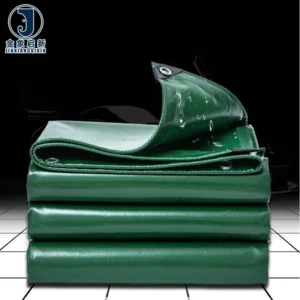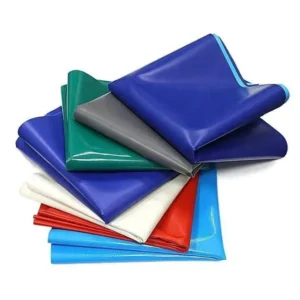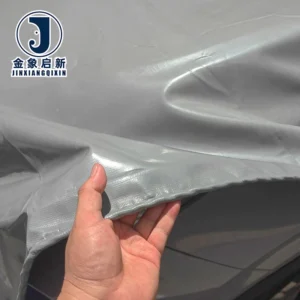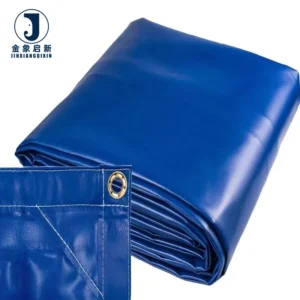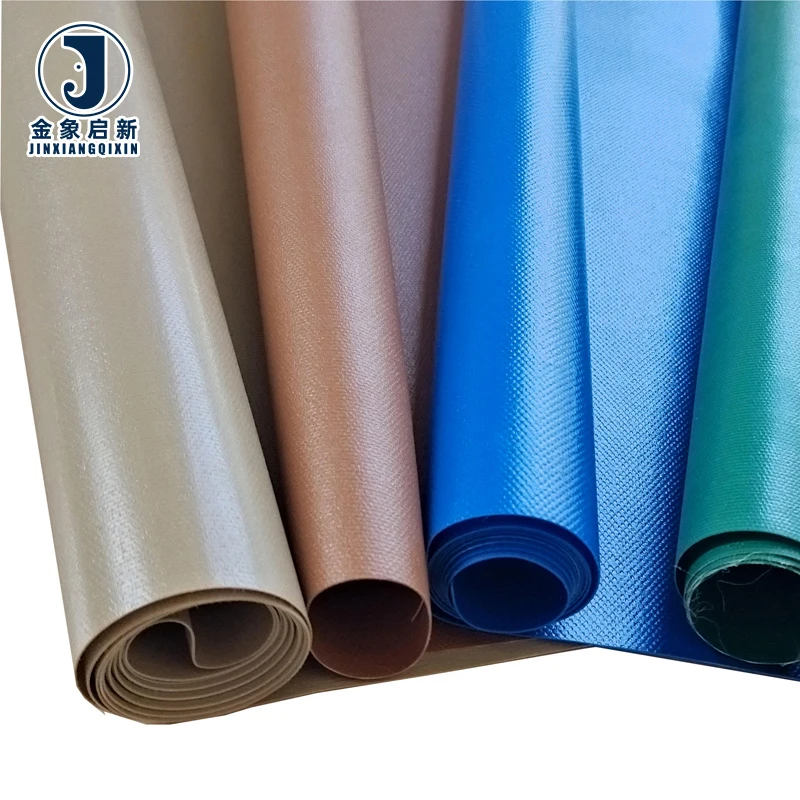
Deep process control over coating weight — coating weight and GSM controlled in-house across three production lines, ensuring the PVC tarpaulin roll you order matches the roll you receive.
Technical Specifications
| Parameter | Value |
|---|---|
| Product Type | PVC Coated Tarpaulin Roll |
| Base Fabric | 1000 Denier |
| Weight | 500 g/m² |
| Waterproof Rating | Anti-permeable ≥20 KPa |
| Flame Retardant | ≤10 seconds (grade not stated) |
| Low-Temperature Flexibility | Not fractured at -30°C |
| Heat Seaming | High-frequency welded |
| Corrosion Resistance | Acid, alkali, brine |
| Water Absorption | Almost none, quick-drying |
| Surface Finish | Matte / Glossy (customizable) |
| Color | Blackout / Grey / Custom |
| Width & Length | Custom |
| Certification | ISO, CE |
Application Suitability
| Application | Exposure & Requirement |
|---|---|
| Truck & Trailer Side Curtain | Constant flexing, road spray, load abrasion at tie-down points, high-frequency welding for curtain tracks |
| Flatbed Top Cover | Tension from ratchet straps, UV and weather exposure, wind flap fatigue during highway transit |
| Shipping & Logistics Load Wrap | Puncture risk from sharp cargo edges, moisture ingress during open-yard storage, forklift handling |
| Boat & Marine Cover | Saltwater exposure, tight folding for winter storage, mildew resistance required in humid conditions |
| Large Awning & Carport Fabric | Long-span tension, pooling water load, colour consistency visible across adjoining panels |
Why Seam Strength Decides the Lifespan of a PVC Coated Tarpaulin for Truck Cover
The weld line fails before the fabric does — this is where most transport covers actually die.
Fleet operators and transport builders see the same failure pattern repeatedly: the PVC coated tarpaulin for truck cover fabric itself holds, but the seam splits at the point of maximum flex. When a truck rounds a corner or hits a bump, the load shifts and the curtain fabric bends sharply at the weld. If the heat-seaming temperature, pressure, or dwell time was not matched to the specific 500 g/m² weight and coating chemistry of this 1000D base, the bond peels apart under cyclic stress [NEED_CITE: tensile and tear test methods for coated fabrics per ISO 1421]. Generic welding settings applied across different GSM grades produce weak joints on some and burnt-through joints on others. High-frequency welding, as used on this material, targets the molecular structure of the PVC coating itself, producing a bond that matches the tear resistance of the parent fabric rather than sitting as a separate, weaker layer on top.
Curtain Track Compatibility and Flex Fatigue
Side curtain systems demand fabric that slides smoothly into aluminium tracks and folds tightly at the buckles without cracking. This 500 g/m² PVC coated tarpaulin with a 1000D base fabric balances pliability with dimensional stability — thick enough to resist load shift abrasion, yet flexible enough to fold repeatedly at the buckle points along a trailer side. The low-temperature flexibility rating to -30°C means the material remains workable on cold-climate routes where cheaper plastisol coatings turn brittle and fracture at the fold line within a single winter season.
High-Frequency Welding at the Seam Boundary
High-frequency welding energises the PVC molecules at the joint interface, fusing coating to coating rather than relying on adhesive bonding. For fleet operators running trailers through automated wash systems and constant road spray, this distinction matters: adhesive seams wick moisture at the overlap edge and delaminate over repeated wet-dry cycles. A high-frequency weld on this 500 g/m² roll produces a homogeneous joint zone that resists water penetration and maintains integrity under the ratchet strap tension points where most load-bearing stress concentrates [NEED_CITE: high-frequency welding parameters for PVC coated polyester fabrics].
Reading the 1000D Base and 500 g/m² Weight Together
A 1000 denier base fabric provides the structural backbone — the yarn thickness determines how well the weave resists tear propagation once a puncture starts. However, denier alone does not guarantee performance. The 500 g/m² total weight reflects both the base fabric mass and the PVC coating applied to each face. The coating method — heat combined with high-frequency — influences how deeply the PVC penetrates the weave versus sitting on the surface. Deeper penetration yields higher peel strength at the weld seam and better adhesion under flexing, while surface-heavy coating can feel stiff and crack along fold lines. For truck cover applications, the balance between base denier and coating penetration determines whether the PVC coated tarpaulin for truck cover survives strap tension, load shift, and highway vibration over extended service periods.
The Hidden Cost of Unverified Roll Specifications
Quotations often state a target GSM, but the roll arriving at the dock weighs lighter — and the fabric tears at strap points far earlier than expected. When two rolls from the same order show visible colour variation once unrolled side by side on a trailer, the entire installation looks unprofessional and the client demands a redo. Flame-retardant grades claimed without a supporting test report create compliance risk at the inspection stage, where transport safety authorities require documented classification. High-frequency welds applied to a material with inconsistent coating thickness fail unpredictably, with some seams holding and adjacent ones peeling under identical stress [NEED_CITE: batch-to-batch GSM and coating weight variance in PVC tarpaulin production]. These are not theoretical failures — they are the most common reasons fleet operators switch suppliers mid-contract.
Production Control You Can Trace
Three full production lines with 36 sets of professional equipment handle this 500 g/m² roll stock, providing volume capacity without subcontracting coating to external mills. A 10-person R&D team manages colour matching, custom width development, and sample runs for specific trailer model fitments before full production begins. Every roll undergoes 100% pre-shipment inspection with documented GSM verification, coating weight check, and visual review for colour consistency across the batch. ISO and CE certification underpins the quality system, with test reports for flame-retardant and UV grades available to match specific transport compliance requirements in your destination market. Samples for custom widths, colours, or pattern printing are developed within days, allowing you to verify the material on your own welding equipment before committing to a container load.
Documentation & Verification
- Material specification sheet stating 500 g/m² GSM, 1000D base fabric, and coating type per roll
- Flame-retardant test report citing the grade achieved, available before shipment confirmation
- Pre-shipment inspection record with GSM weight verification per roll against the quoted value
- Roll packing list detailing width, length, colour reference, and batch number per unit
- ISO and CE certificates supplied with every dispatch for customs and compliance filing
Fabrication, Handling & Storage
- Set high-frequency welder dwell time and pressure to match 500 g/m² coating thickness for full seam fusion
- Reinforce eyelet zones with additional PVC patches at ratchet strap tie-down points on 1000D base
- Store rolls upright on end cores to prevent flat-spot creases in the 500 g/m² coated surface
- Allow rolls to acclimate to workshop temperature before unrolling to avoid low-temperature coating stiffness
- Use mild detergent only on matte or glossy finish surfaces to preserve the coating top layer
- Plan cutting layout to minimise cross-grain seams on trailer side curtain panels for flex durability
What to Include in Your Inquiry
Specify the truck or trailer model you are covering, including side curtain track type and buckle spacing. Note your target market’s fire safety or transport compliance requirements so the correct flame-retardant grade can be confirmed with a test report. Indicate required roll widths, annual volume, and whether you need finished panels cut to vehicle dimensions or roll stock only. If colour matching to an existing fleet or custom pattern printing is required, provide a reference sample or Pantone code for R&D sample development.
Frequently Asked Questions
Q: Can you guarantee GSM on arrival matches the quotation?
A: Every roll is weighed and inspected during the pre-shipment QA process. The inspection record documents actual GSM per roll against the quoted 500 g/m² specification. This record travels with the shipment documentation so you can verify on arrival at your dock. Any deviation is flagged before dispatch, not discovered after the container is opened.
Q: Do flame-retardant and UV grades come with a test report?
A: Yes. Where flame-retardant or UV treatment is specified, a test report citing the achieved grade and test method is included in the shipment documentation. The standard grade for this material achieves ≤10 seconds burn time. If your market requires a specific classification, confirm the grade needed so the appropriate formulation and report can be prepared.
Q: What is the minimum order for a custom width or colour?
A: Custom widths and colours are developed through the in-house R&D team, with samples produced for your approval before full production runs. Minimum order quantities depend on the specific width and colour requested. Provide your target dimensions and annual volume in your inquiry for a precise minimum and lead time assessment.
Q: How do you ensure colour consistency across multiple rolls in one order?
A: Colour matching is controlled at the coating formulation stage with reference to a defined colour standard. Rolls within a single production batch are inspected side by side during pre-shipment QA for visible shade variation. Batch numbers are recorded on the packing list, enabling traceability and ensuring all rolls for one project come from the same coating run.