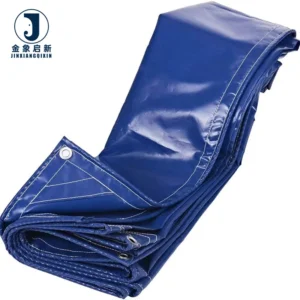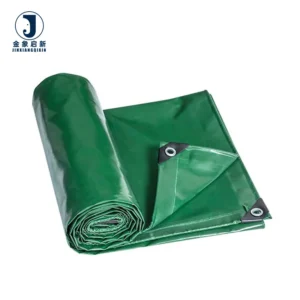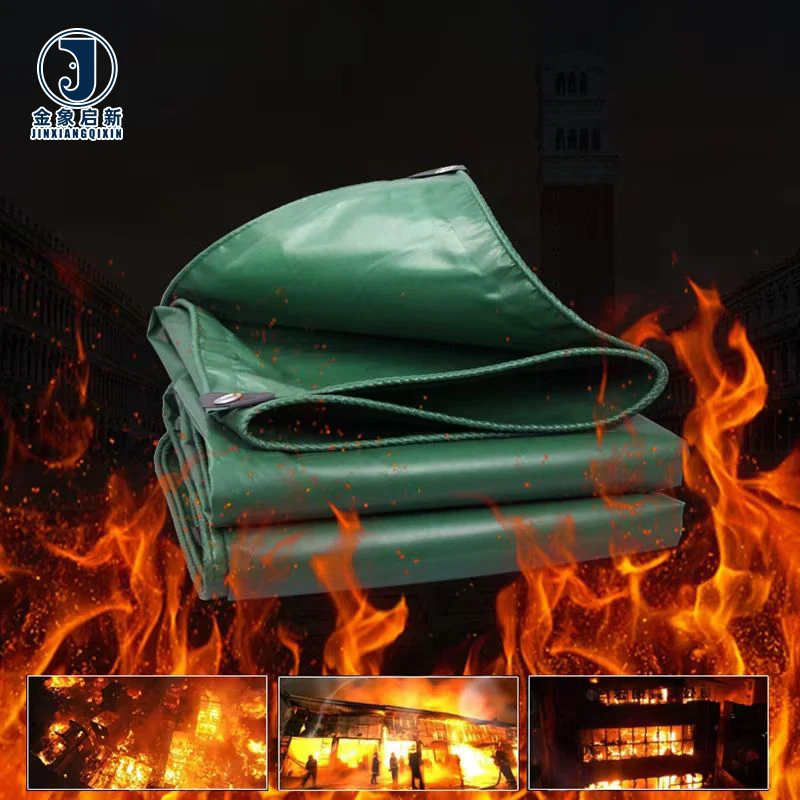
Deep Process Control Over Coating Weight — Every roll of this PVC coated truck tarpaulin fabric is inspected at each production stage, with coating weight verified against the stated GSM before dispatch to fleet and transport equipment operators.
Technical Specifications
| Parameter | Value |
|---|---|
| Product Type | PVC Coated Tarpaulin |
| Base Fabric | 500D-500D Polyester |
| Material Structure | Polyester Base Fabric + Double-Sided PVC Coating |
| Weight Range | 450-900 g/m² (grade dependent — confirm required GSM) |
| Surface Characteristics | Smooth and soft surface with a leather-like texture |
| Waterproof Performance | Fully waterproof coated construction with overall sealing |
| Abrasion Resistance | Very strong |
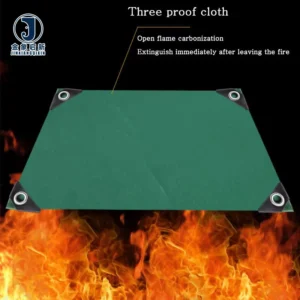
| Key Features | Water Resistant, Flame Retardant (grade not stated in source), Anti-UV (test basis not stated in source), Waterproof |
| Flame Retardancy | Available in flame retardant grades — confirm the grade required for your market |
| UV Resistance | Available in anti-UV grades — confirm test basis required for your application |
| Repairability | Repairable by hot air welding |
| Package | Roll packing, bale packing, carton |
| Standards | ISO, CE |
Application Suitability
| Application | Exposure & Requirement |
|---|---|
| Truck side curtain fabric | Constant flexing at load points, road abrasion, UV exposure, weather cycling |
| Trailer load cover | Tie-down strap pressure, wind lift forces, rain and road spray ingress |
| Machine and equipment cover | Outdoor storage, dust and moisture protection, occasional handling abrasion |
| Flatbed load enclosure | High-speed airflow stress, solar degradation, cargo shift friction |
| Custom-fitted vehicle cover | Model-specific panel geometry, reinforcement at stress concentration points |
Why Generic-Size Truck Covers Fail on Specific Trailer Models
PVC coated tarpaulin for truck and transport must be cut to the exact trailer geometry, not a generic rectangle.
Fleet operators routinely receive covers that claim to fit a trailer class but leave gaps at the rear roller door or pull tight across the side curtain runners. The result is fabric stress concentrated at the wrong points, leading to premature tearing at the hem or weld line. When a PVC coated tarpaulin truck cover is patterned to the specific vehicle model, the eyelet spacing, reinforcement patches, and panel joins all align with the actual tie-down and curtain track positions [NEED_CITE: vehicle-specific fitment reduces stress concentration at hem and weld points].
Side Curtain Fabric for Moving Loads
Transport fleets expose side curtain fabric to continuous mechanical stress. Each load cycle flexes the material at the curtain track interface and along the tie-down edge. This PVC coated tarpaulin for truck and transport applications uses a 500D-500D polyester base fabric that provides the tensile foundation needed to resist deformation under repeated load shift and road vibration. The double-sided PVC coating bonds to the base fabric and seals the weave completely, preventing water ingress even when the curtain is under tension from crosswinds.
Weld Integrity at Flex Points
Where truck covers flex most — typically around the load bulge and at the curtain track attachment — the welded seam must hold as long as the fabric itself. The PVC coating formulation on this material supports hot air welding, allowing fabricators to create seams that fuse the coating layers into a continuous bond. On-site or depot repairs follow the same hot air welding process, meaning a torn panel does not require full cover replacement [NEED_CITE: hot air welding parameters for PVC coated polyester at varying GSM grades].
Reading the GSM and Base Fabric Together
Buyers often focus on GSM as the single indicator of fabric quality, but weight alone does not determine how a truck cover performs under load. The 500D-500D polyester base provides the structural skeleton: the denier count defines individual yarn thickness, while the weave density determines how load distributes across the fabric plane. Two materials at the same GSM can behave very differently if one uses a heavier coating over a lighter base fabric. The coating adds waterproofing and surface durability, but the base fabric carries the tensile and tear loads. This PVC coated tarpaulin for truck and transport use balances base fabric denier with coating weight across the 450-900 g/m² range, with each grade matched to a specific duty cycle. Fleet operators replacing side curtains on long-haul trailers typically specify toward the upper end of this range, while lighter covers for short-distance flatbed runs sit lower [NEED_CITE: relationship between base fabric denier, coating weight, and tensile performance in PVC coated fabrics per ISO 1421].
What Happens When Specification Is Wrong
Selecting a grade too light for the actual duty cycle leads to coating wear at the tie-down contact zones within the first season. Colour variation between rolls in the same shipment becomes visible once installed side by side across a fleet, forcing a full re-order to restore uniform appearance. Flame retardant claims unsupported by a test report can result in rejected deliveries at sites with enforced fire safety compliance. And weld seams that fail before the fabric does leave operators patching covers in the yard instead of running scheduled routes [NEED_CITE: coating adhesion failure modes in PVC coated fabric under cyclic loading].
Why Source This PVC Coated Tarpaulin for Truck and Transport Here
Three full production lines and 36 sets of professional equipment support bulk roll output with reliable dispatch scheduling for fleet-scale orders. A 10-person R&D team handles pattern development, custom sizing to specific truck and trailer models, and sample turnaround within days. Dedicated QA/QC runs at every production stage with full pre-shipment inspection before any roll leaves the facility. Coating weight and adhesion are controlled through established process parameters built over nearly 30 years of focused coated fabric production. Samples are developed for custom width, colour, and treatment requirements so buyers can verify fit and finish before committing to production volume.
Documentation & Verification
- Material specification sheet stating exact GSM, base fabric denier, and coating type for the ordered grade
- UV and flame retardant test reports provided where applicable to support the claimed treatment grade
- Pre-shipment inspection record confirming weight, colour, and dimensional checks across all rolls in the order
- ISO and CE certificates included in dispatch documentation
- Roll packing list with individual roll weights and dimensions for receiving verification
- Certificate of origin and customs documentation for international transport shipments
Fabrication, Handling & Storage
- Hot air welding temperature and speed must match the specific GSM grade of this double-sided PVC coated fabric
- Eyelet and hem reinforcement patches should be welded to the smooth coating surface for maximum bond area
- Store rolls horizontally on pallets to prevent permanent creasing in the polyester base fabric
- Allow cold-stored rolls to reach ambient temperature before unrolling to avoid coating crack at low temperature
- Clean the leather-like surface with mild detergent; avoid solvent-based cleaners that degrade the PVC coating
- Field repairs use hot air welding on the PVC coating — patch material must match the base fabric denier
Request a Specification Match for Your Fleet
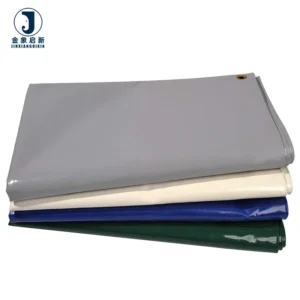
Share the truck or trailer model designation, the panel dimensions required, and whether the covers will serve as side curtains or full load enclosures. Specify any flame retardant grade or anti-UV treatment mandated by your operating region. Indicate the colour reference and whether you need rolls for in-house cutting or finished covers with eyelets and reinforcement. If batch colour consistency across multiple rolls is critical for fleet-wide installation, note this in your inquiry so production sequencing can be planned accordingly.
Frequently Asked Questions
Q: How is GSM verified on arrival and what documentation supports the quoted weight?
A: Each roll is weighed during pre-shipment inspection and the results are recorded on the inspection report that ships with the order. The material specification sheet states the exact GSM for the grade supplied. On receipt, buyers can cross-check roll weight against the packing list. Any discrepancy is addressed through the after-sales support process before installation begins.
Q: What flame retardant grades are available and do they meet transport sector fire safety standards?
A: This PVC coated tarpaulin is available in flame retardant grades — the specific grade must be confirmed against your market requirements. Test reports are supplied where applicable to document the grade achieved. Buyers should specify the fire safety standard relevant to their operating region at inquiry stage so the correct treatment is applied during production.
Q: How is custom sizing handled for specific truck and trailer models?
A: The R&D team develops samples based on the vehicle model designation and panel dimensions provided by the buyer. This includes eyelet positioning, hem reinforcement layout, and weld seam placement matched to the trailer geometry. Approved samples become the production template, ensuring every cover in the order fits the intended vehicle without field modification.
Q: How is batch colour consistency maintained across multiple rolls for fleet-wide replacement?
A: Production planning sequences all rolls for a single order through the coating line consecutively to minimise batch variation. The pre-shipment inspection includes a visual colour check across rolls. If the order is installed side by side across a fleet, buyers should flag this requirement at inquiry so additional consistency controls are applied during production.
Q: What are the hot air welding and seam reinforcement options for high-flex areas?
A: The double-sided PVC coating supports hot air welding at seams and reinforcement patches. For areas subject to repeated flexing — such as curtain track attachments and tie-down zones — additional coating patches can be welded over the base seam. Welding parameters must be matched to the specific GSM grade to ensure the seam holds as long as the surrounding fabric.