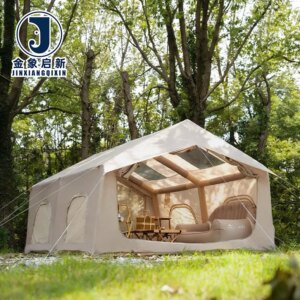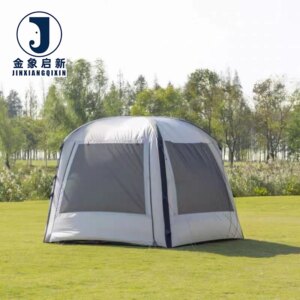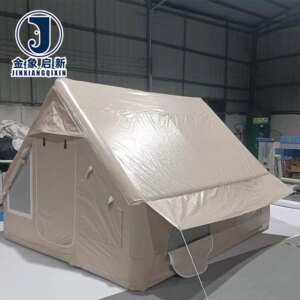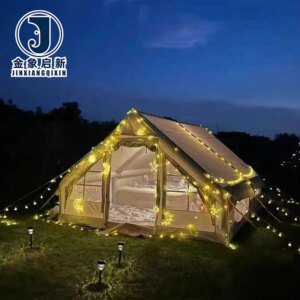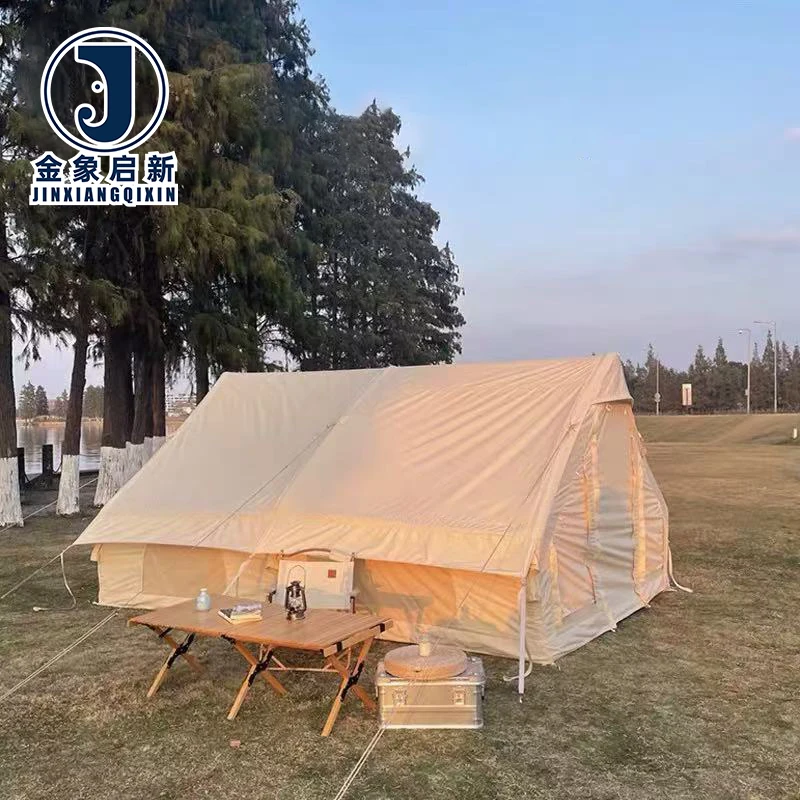
Coating Process Mastery — Nearly three decades of focused PVC coating experience ensures reliable adhesion and consistent weight control across every inflatable tent production run.
Technical Specifications
| Parameter | Value |
|---|---|
| Product Type | Inflatable Tent Fabric / PVC Glamping Tent |
| Core Material | PVC Tarpaulin |
| Key Performance | Waterproof, Quick Automatic Opening, Four-Season Design, Single Layer Construction |
| Production Facility Area | 9180 square meters |
| Production Lines | 3 full production lines |
| Processing Equipment | 36 sets of professional processing equipment |
| R&D Team Scale | 10 technicians |
| Customization Service | OEM & ODM (sample customization, pattern printing) |
| Product Forms | Outdoor Camping Tent |
| Standards | ISO9001, ISO14001, ISO45001, CE |
Application Suitability
| Application | Exposure & Requirement |
|---|---|
| Fleet depot temporary shelter | Wind loading, rain ingress, repeated deployment cycles, rapid setup |
| Event management covered space | Public occupancy compliance, weather protection, branding visibility |
| Expedition base camp | Extended outdoor exposure, temperature fluctuation, high moisture contact |
| Industrial equipment protection | Abrasion from handling, dust and debris, UV exposure on open sites |
Why Quick Setup Matters More Than Tent Weight Alone
Deployment speed determines whether your temporary covered space is operational before weather turns.
When fleet operators stage equipment at remote depots or event managers face incoming storms, the time between unloading and having a sealed shelter upright defines operational continuity. Conventional pole-and-canvas assemblies require multiple personnel and significant time to erect. The quick automatic opening mechanism on this PVC glamping tent for transport and fleet outdoor operations collapses that timeline, allowing a single operator to achieve full deployment. [NEED_CITE: comparative setup times for inflatable versus pole-frame temporary structures]. The cost of delayed deployment is not measured in tent price — it is measured in equipment exposure, schedule slippage, and crew idle time on site.
Rapid Inflation and Structural Rigidity
The inflatable frame system integrated into this PVC glamping tent replaces rigid poles with air-filled chambers that achieve structural form within minutes of inflation. This eliminates the risk of bent poles, lost components, or mismatched fittings that plague conventional frame tents during repeated transport and storage. The PVC tarpaulin skin works in tension with the inflated beams to maintain shape under wind loading, a critical factor when the tent serves as a roadside staging shelter or remote depot workspace.
Four-Season Performance Without Material Rotation
Single layer PVC construction in this inflatable tent avoids the trapped-moisture problems common in multi-layer fabric assemblies where condensation builds between laminations during cold-weather use. The four-season design means the same unit deployed in summer heat remains functional through winter conditions without swapping to a heavier or differently rated shelter. [NEED_CITE: thermal performance parameters for single-layer coated fabric structures across seasonal temperature ranges]. For operators managing multiple sites, this removes the logistical burden of maintaining separate summer and winter tent inventories.
Understanding How Coating Weight and Base Fabric Interact
The waterproof performance of a PVC glamping tent depends on the relationship between the base fabric weave density and the coating weight applied to it. A heavier coating on a loosely woven base may achieve high GSM figures but will exhibit poor peel strength at the weld lines where panels join — the coating cracks and separates before the fabric itself fails. Conversely, a tightly woven high-denier base with adequate coating penetration produces a composite where the seam is as strong as the field of the material. The coating method — whether knife-over-roll, dip, or calender — determines how thoroughly the PVC fills the interstices of the weave, directly affecting both water ingress resistance and the thermal welding behaviour during fabrication. Surface finish, whether glossy or matte, influences how the material sheds dirt and accepts printed branding, which matters when the tent carries operator logos or safety signage visible at distance.
What Specification Misalignment Costs on Site
Specifying a PVC glamping tent without confirming the coating adhesion strength relative to the base fabric leads to seam failures that appear after the first few deployment cycles — typically at the points where the structure flexes most during inflation and deflation. [NEED_CITE: common failure modes in inflatable fabric structures at welded seams]. Operators who selected on GSM alone have found the material performing adequately in flat, static applications but failing at the stress concentrations inherent in an inflatable frame geometry. Batch-to-batch colour variation across multiple units deployed side by side at an event site creates a visibly inconsistent appearance that undermines professional presentation.
Why Procurement Through This Facility Works
Three full production lines and 36 sets of professional processing equipment provide the capacity to fulfil multi-unit orders for fleet operators standardising their temporary shelter inventory across regional depots. The 10-person R&D team handles dimensional customisation and pattern printing directly, so a transport company can order PVC glamping tents cut to match specific vehicle footprints or branded to fleet livery without outsourcing to a third-party printer. Dedicated QA and QC staff conduct inspection at every production stage, with 100% pre-shipment verification against the material specification sheet — meaning the waterproof performance and dimensional accuracy stated on the quotation are confirmed before dispatch, not assumed. ISO9001, ISO14001, ISO45001, and CE certification underpin the quality management and compliance documentation required for commercial procurement in regulated markets.
Documentation & Verification
- Material specification sheet stating base fabric denier, coating type, and waterproof performance parameters
- Pre-shipment inspection record confirming dimensional accuracy and waterproof integrity per unit
- ISO9001, ISO14001, ISO45001, and CE certificates for procurement compliance
- Roll packing list detailing unit count, dimensions, and net weight per shipment
- Certificate of origin and customs documentation supporting international dispatch
Fabrication, Handling & Storage
- Heat welding parameters must match the PVC coating thickness to ensure seam strength equals field strength
- Store rolled units horizontally on pallets to prevent permanent creasing in the single layer PVC tarpaulin
- Avoid dragging deflated units across abrasive surfaces during pack-down to protect the PVC coating face
- Use mild detergent and soft brush for cleaning; solvents may degrade the waterproof PVC coating surface
- Allow full inflation and air circulation before long-term storage to prevent mildew on interior surfaces
What We Need to Quote Accurately
To specify the correct PVC glamping tent for your operation, provide the deployment footprint dimensions, the climatic conditions the unit will face, and whether branding or pattern printing is required on the outer surface. Confirm whether you need individual units or container-volume quantities, and whether pre-production samples are required for fit validation before the full order enters production. Share any compliance or fire-retardant grade requirements your destination market mandates.
Frequently Asked Questions
Q: How is the waterproof performance of the PVC tarpaulin verified before shipment?
A: Each inflatable tent undergoes inspection by dedicated QA and QC staff before dispatch. The waterproof integrity of the PVC tarpaulin panels and welded seams is checked against the material specification sheet. A pre-shipment inspection record documenting the results accompanies every batch, providing traceable confirmation that performance matches the stated specification.
Q: What customization options are available for dimensions, pattern printing, and material specifications?
A: The R&D team develops custom samples based on your exact dimensional requirements, branding artwork, and material preferences. OEM and ODM services cover size configuration, pattern printing for fleet livery or event branding, and material selection. Sample approval is required before mass production begins, ensuring the final PVC glamping tent matches your operational needs.
Q: How does the quick automatic opening mechanism perform under repeated deployment cycles?
A: The inflatable frame system is engineered for commercial deployment frequency, with PVC tarpaulin chambers that maintain structural integrity through repeated inflation and deflation. The single layer construction minimises material fatigue points compared to multi-layer assemblies. Performance consistency is verified during pre-shipment inspection across the production batch.
Q: What certifications and documentation accompany each batch for commercial procurement compliance?
A: Every shipment includes ISO9001, ISO14001, ISO45001, and CE certificates alongside the material specification sheet, pre-shipment inspection record, packing list, and certificate of origin. This documentation package supports compliance requirements for commercial outdoor operations, event management procurement, and industrial temporary shelter contracts in regulated markets.
Q: How is batch-to-batch consistency maintained across large-volume orders?
A: Three full production lines with 36 sets of professional equipment and in-process QA at every stage ensure uniform coating weight, colour, and dimensional accuracy across units. The 100% pre-shipment inspection protocol catches deviations before dispatch. Buyers ordering multiple PVC glamping tents for fleet-wide deployment receive units with consistent appearance and performance.