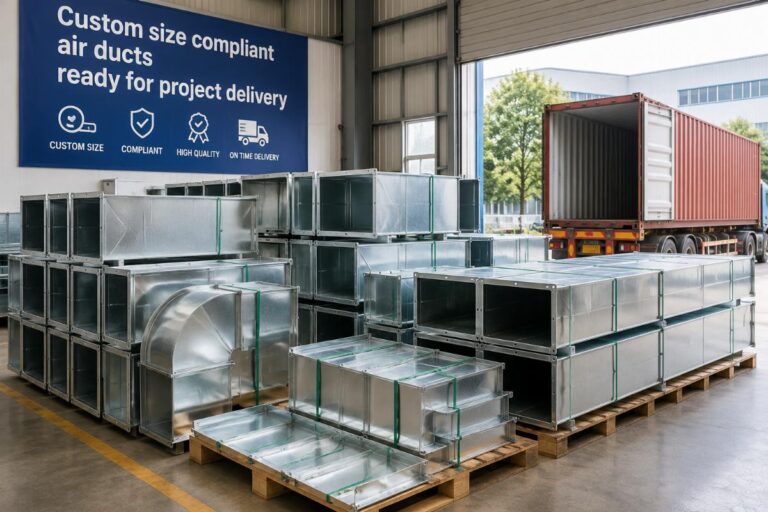
Buy Mining Ventilation Duct OEM Manufacturing
Thicker coating does not mean longer service life — the weave strength and coating formula decide tear resistance, not GSM alone.
When sourcing OEM mining ventilation ducts, the first step is never comparing prices. It is confirming that the flame retardant and anti-static ratings match the destination country’s mine safety regulations. Only after that alignment is locked can you move on to GSM, diameter, and lead time.
I grew up in Linyi, surrounded by tarpaulin factories. My early career was spent on the hot-air welding floor, then I moved into export follow-up for coated fabrics. Over the years, the situation I dread most is a buyer handing over a drawing and saying “just make it like this,” only for the goods to get stuck at the destination port because the flame retardant class does not match local legislation. On one shipment of PVC ducts bound for a copper mine in Chile, the anti-static reading fell short by a fraction of one order of magnitude. The entire container was held at San Antonio port, and replacement pieces had to be sent by air freight — a cost that dwarfed the original production savings. Since then, my first questions are always: how deep is the shaft, what is the gas classification, and which standard does your local inspector enforce? Parameters on a spec sheet are not paperwork — they are a matter of survival underground. [NEED_CITE: correlation between anti-static surface resistance values and methane ignition risk in coal mines]
Getting these parameters right from the start is what separates a smooth deployment from a costly port hold-up. Let us walk through the critical checkpoints.
What Specs Must You Confirm Before Ordering OEM Mining Ventilation Ducts?
Flame retardant class and anti-static surface resistance come first; GSM, diameter, and length come second.
Too many procurement teams open the conversation with “what GSM do you need?” when the real question should be “which safety standard must this duct pass?” The sequence matters because the standard dictates the coating chemistry, which in turn limits the achievable GSM range and affects the base fabric selection.
Here is a typical parameter matrix buyers should complete before requesting a quote on a mining ventilation duct OEM manufacturing order:
| Parameter | Why It Matters | Typical Range / Options | Verification |
|---|---|---|---|
| Flame retardant class | Determines whether the duct can be used in gassy or non-gassy mines | Oxygen index classes, vertical burn ratings | Third-party lab report |
| Anti-static surface resistance | Critical in methane-prone shafts to prevent spark ignition | Surface resistance categories | Lab test per relevant standard |
| Base fabric weave | Controls tear strength independent of coating thickness | Polyester scrim densities | Mill test certificate |
| Coating GSM | Affects weight, flexibility, and abrasion resistance | Lightweight to heavy-duty ranges | Weight-per-unit-area test |
| Diameter and length | Must match existing shaft bracket spacing | Custom diameters, standard or custom lengths | Field measurement |
| Flange ring type and hole pitch | Determines compatibility with existing connector systems | Steel ring, reinforced ring, spacing tolerance | Drawing cross-check |
[NEED_CITE: mapping of flame retardant test methods to major international mining safety standards]
A gold mining operation in Central Asia once ordered a full container of ventilation ducts based on a drawing that specified diameter and length but omitted any reference to the local fire safety code. The ducts arrived on site, the inspector asked for the anti-static test report, and the paperwork did not exist. The entire batch had to be re-evaluated, and a supplementary order with the correct certification was rushed in — at a premium that erased any initial price advantage.
The lesson is straightforward: lock the regulatory standard first, then build the spec sheet around it.
PVC vs PE Mining Ducts — Which Material Fits Your Mine Condition?
Gassy coal mines require anti-static PVC; non-gassy hard-rock mines can use PE to reduce cost.
This is one of the most common areas of confusion. Buyers often assume “flame retardant equals safe” and do not distinguish between the two hazard modes: fire propagation and electrostatic spark ignition. In a coal shaft where methane accumulation is a real risk, the anti-static property is what prevents an explosion. A duct can pass every vertical burn test and still be lethal if static charge builds up on its inner surface and discharges near a gas pocket. [NEED_CITE: mechanism of electrostatic discharge ignition in underground coal mine ventilation systems]
PVC-coated ducts, when formulated with anti-static additives, keep surface resistance within the safe threshold required for gassy environments. The coating also bonds well with polyester scrim, giving a balanced combination of flexibility and tear strength. PE-coated ducts, on the other hand, are lighter and cheaper to produce, and they perform well in hard-rock mines — gold, copper, iron ore — where methane is not a concern and the primary requirement is abrasion resistance and moisture protection.
| Condition | Recommended Material | Key Property | Cost Position |
|---|---|---|---|
| Gassy coal mine, deep shaft | Anti-static PVC | Surface resistance control, flame retardancy | Higher |
| Non-gassy hard-rock mine | PE or standard PVC | Abrasion resistance, moisture barrier | Lower |
| Surface ventilation, temporary use | Lightweight PVC or PE | UV resistance, ease of handling | Lowest |
A deep-shaft coal operation in West Africa initially specified a standard PVC duct without the anti-static requirement, because the original drawing came from a contractor who had only worked in open-pit environments. Once the ducts were underground and the gas monitoring system flagged the surface resistance gap, the installation was halted. The replacement order — this time with the correct anti-static PVC formulation — took weeks to produce and ship, during which the affected section of the mine could not advance.
The takeaway: material selection is not a cost decision. It is a hazard-matching decision.
How to Verify an OEM Factory’s Capability for Mining Ducts?
Ask for original test reports, check the coating line type, confirm MOQ flexibility, and review export document completeness.
Not every tarpaulin factory can produce mining-grade ventilation ducts. The coating process itself is different — mining ducts require uniform impregnation of the base fabric with a formulation that includes flame retardant and anti-static agents, and this demands specific coating equipment and process control. A factory that only does calendar coating may struggle to achieve consistent additive distribution across the full width of the fabric. [NEED_CITE: difference between knife-over-roll and calendar coating methods for technical coated fabrics]
Here is what a serious buyer should verify when evaluating a mining ventilation duct OEM manufacturing partner:
- Original third-party test reports — not photocopies, not self-declared certificates. The report should come from a recognized lab and reference the specific production batch or coating formulation.
- Coating line type and width — this determines whether the factory can handle the full GSM range needed for your duct spec, and whether the fabric width matches your diameter requirement without excessive seaming.
- MOQ structure — mining projects often need a mix of standard and custom diameters in one order. A factory that insists on container-level MOQ per diameter will force you into overstock on some sizes and shortages on others.
- Export document readiness — mine safety equipment entering regulated markets often requires specific certificates of conformity, test reports translated into the destination language, and material traceability records. The factory should be able to produce these as a standard part of the shipment package.
Jinxiang, based in Shandong Province, operates as a PVC and PE coated fabric and finished-product manufacturer with in-house coating lines covering the full GSM range relevant to mining ducts. The factory handles OEM manufacturing for mining ventilation ducts from parameter confirmation through third-party testing to mass production and export documentation, giving buyers a single point of accountability for the technical and paperwork chain.
A copper mine procurement team in South America learned this the hard way when their original supplier — a general-purpose tarpaulin workshop — could not provide a valid anti-static test report at shipment time. The goods were already at the port. The buyer had to qualify a new factory, re-order, and absorb both the delay and the cost of idle equipment waiting underground.
What Are the Common Pitfalls in OEM Mining Duct Procurement?
Missing standard references on drawings, ignoring flange compatibility, and skipping pre-shipment inspection are the three most frequent mistakes.
Even experienced procurement teams fall into these traps, usually because the mine site engineers and the purchasing department operate in separate information loops. The engineer draws the duct to fit the shaft bracket; purchasing sends the drawing to the factory without flagging the regulatory environment; the factory produces exactly what is on the drawing — which is technically correct but operationally useless.
Here is a breakdown of the three pitfalls and how to avoid them:
| Pitfall | Root Cause | Consequence | Prevention |
|---|---|---|---|
| Drawing lacks standard reference | Engineer assumes factory knows destination regulations | Duct passes production but fails port inspection | Specify the applicable safety standard on the drawing |
| Flange hole pitch mismatch | Site bracket spacing not communicated to factory | Ducts cannot be connected on site, rework required | Confirm bracket spacing and flange tolerance before production |
| No pre-shipment inspection | Buyer trusts factory self-check | Defects or wrong specs discovered only at destination | Arrange independent inspection or request video verification |
[NEED_CITE: common non-conformities found in imported mining ventilation equipment at destination ports]
A mid-depth coal operation in East Africa ordered ducts with a flange ring spacing that matched the supplier’s standard catalog. When the ducts arrived, the site’s existing bracket system used a non-standard pitch. The ducts could not be hung. The fix involved cutting and re-welding flange rings on every single duct segment at the mine site — a task that required bringing in a specialized hot-air welding team and cost several times the original duct price.
The pattern is clear: most procurement failures in this category are not manufacturing failures. They are specification and communication failures. The factory built what it was told to build. The problem was that what it was told to build did not match what the mine actually needed.
Conclusion
OEM mining ventilation duct procurement succeeds when regulatory alignment leads the specification, not follows it.
Confirm the flame retardant and anti-static standard required by the destination mine authority before discussing GSM or diameter. Match the material — PVC or PE — to the actual gas hazard level of the shaft, not to a generic cost comparison. Verify the factory’s coating capability, test report authenticity, and export document readiness. And close the loop with a pre-shipment inspection that checks flange compatibility against the site’s actual bracket spacing. Get these steps right, and the mining ventilation duct OEM manufacturing order will arrive on site ready to hang, certify, and ventilate.