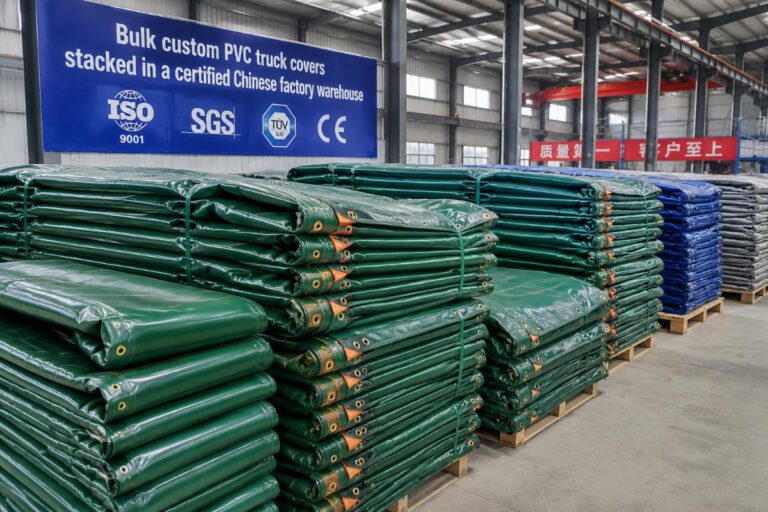
Compare China Ground Sheet Suppliers: PVC PE Tarp Wholesale for Greenhouses
The lowest unit price often results in the highest total cost of ownership.
To successfully compare ground sheet suppliers in China, you must prioritize verifiable technical certifications for UV and fire retardancy alongside export compliance capabilities, rather than focusing solely on base material costs. A reliable supplier provides transparent documentation for raw material sources, consistent GSM tolerance within industry standards, and proven experience with customs clearance requirements in target markets like Africa and MENA.
I still remember the humidity in Lagos during that particular dry season. The air was thick, not just with heat, but with the frustration of a client watching his container sit idle at the port. We had shipped a batch of agricultural covers that looked perfect in the factory warehouse in Shandong. They were smooth, uniformly colored, and packed tightly. But when they arrived, the local customs authority flagged them for missing specific fire-retardant certification details required for agricultural imports in that region. The cargo sat for weeks. The demurrage charges alone eclipsed the margin we had fought so hard to secure by choosing a cheaper production run. That silence on the phone line taught me more about supply chain risk than any textbook ever could. It shifted my focus from merely finding a manufacturer to auditing a partner’s ability to navigate the invisible barriers of international trade.
This reality is why many importers stumble. They see a spreadsheet of prices and assume comparability. They are not comparing apples to apples; they are comparing compliant, durable products against those that may fail under solar stress or regulatory scrutiny. When you set out to compare ground sheet suppliers in China, you are really evaluating their engineering consistency and administrative rigor.
Why Do Most Importers Fail at Supplier Verification?
Lack of pre-shipment certification checks is the primary driver of costly customs delays and product rejection.
Many buyers assume that if a factory can produce the physical item, it can handle the paperwork. This is a dangerous misconception. The physical product is only half the transaction. The other half is the legal and technical documentation that allows that product to enter your country without penalty. I have seen shipments held because the certificate of origin did not match the harmonized system code exactly, or because the fire-retardant test report was from an unrecognized laboratory.
When you begin to compare ground sheet suppliers in China, ask for their export history to your specific region. A supplier who regularly ships to the Middle East will understand the specific certification nuances required there, just as one focused on Europe will be well-versed in REACH compliance. It is not enough to have a certificate; you need the right certificate, issued by the right body, for the right market. [NEED_CITE: common customs clearance failure reasons for agricultural textiles]
Consider the case of a distributor in North Africa who sourced greenhouse films based on price. The supplier provided a general quality certificate, but not the specific UV stabilization data sheet required by local agricultural standards. The film degraded within months, far earlier than the promised lifespan. The cost of replacing the crop coverage, plus the labor, far exceeded the initial savings. This is not just a quality issue; it is a verification failure.
What Technical Specs Define Quality Ground Sheets?
GSM accuracy, UV resistance levels, and tear strength are the critical metrics that determine product longevity beyond basic waterproofing.
It is easy to look at a piece of PVC or PE tarpaulin and say it looks thick. But "thick" is subjective. Grams per square meter (GSM) is objective. However, even GSM can be manipulated if you do not know how to verify it. Some suppliers might quote a high GSM but use a higher percentage of recycled material, which affects tensile strength and clarity. Others might rely on standard labels without actual batch testing.
When you compare ground sheet suppliers in China, request the method they use for GSM verification. Do they cut and weigh samples from every batch? Or do they rely on machine settings? The difference is significant. A variance of even a few percent can mean the difference between a cover that lasts five years and one that tears during the first storm. [NEED_CITE: industry standards for GSM tolerance in coated fabrics]
Furthermore, UV resistance is not a binary feature. It is a spectrum determined by the type and amount of stabilizers added, such as HALS (Hindered Amine Light Stabilizers). In high-solar regions, the absence of adequate UV protection leads to premature embrittlement. You need to know the specific additive package used. A supplier who can explain their formulation demonstrates control over their production process. One who offers vague promises of "good UV resistance" is likely guessing.
| Specification Factor | High-Quality Indicator | Risk Indicator |
|---|---|---|
| GSM Verification | Batch-level cut-and-weigh testing documented | Reliance solely on machine theoretical output |
| UV Stabilization | Specific HALS additive documentation provided | General claim of "UV resistant" without data |
| Material Source | Virgin material ratio clearly stated | Undisclosed mix of recycled content |
| Tear Strength | Verified against ISO/ASTM standards | No independent test reports available |
How to Audit a Supplier’s Export Compliance?
Verifying past export records and specific market certifications reveals a supplier’s ability to handle complex customs requirements.
Compliance is not static. Regulations change. A supplier who is proactive about these changes is a valuable partner. During my time handling exports from Qingdao, I learned that the most reliable manufacturers keep a library of recent customs clearance successes. They can tell you which ports gave them trouble last year and how they resolved it. This institutional memory is invaluable.
When you compare ground sheet suppliers in China, ask for examples of recent shipments to your country. Did they face any delays? How were they resolved? A supplier with experience in handling complete export documentation for PVC and PE products will have streamlined processes. They will know that a missing signature on a packing list can delay a container just as much as a missing product certificate.
For instance, a buyer in Latin America once faced issues with anti-dumping duties because the supplier failed to provide the correct raw material sourcing declaration. The goods were seized, and the legal fees were substantial. A competent supplier would have anticipated this requirement, having dealt with similar cases before. They understand that their role extends beyond the factory gate. [NEED_CITE: impact of incomplete documentation on import duty assessments]
Which Red Flags Indicate a Risky Supplier?
Inability to provide raw material sources or inconsistent sample quality signals underlying production instability.
Trust is built on transparency. If a supplier hesitates to share where they get their resin or their coating chemicals, it is a warning sign. Quality control starts with input materials. If they cannot trace their inputs, they cannot guarantee their outputs. I have walked through factories where the raw material bags were unmarked, suggesting a spot-market purchase strategy that prioritizes cost over consistency. This is a recipe for batch-to-batch variation.
Another red flag is sample inconsistency. If the sample you receive is markedly different from the bulk production in terms of color, texture, or weight, the supplier lacks process control. When you compare ground sheet suppliers in China, request a pre-production sample from the actual batch intended for your order, not a "golden sample" kept in a showcase. This reveals the true capability of their production line.
Also, watch for communication gaps. If technical questions are answered with marketing fluff rather than data, proceed with caution. A professional manufacturer will speak in terms of tensile strength, elongation at break, and coating adhesion. They will not just say "it is strong." They will show you the test report. [NEED_CITE: signs of manufacturing process instability in textile production]
How to Structure a Low-Risk Trial Order?
Starting with mixed container loads allows you to test consistency and compliance before committing to long-term contracts.
Jumping into a large volume order with a new supplier is risky. A smarter approach is to start with a trial that tests multiple variables. Order a mixed container with different GSM weights or colors. This forces the supplier to manage complexity, revealing their organizational skills. If they can handle a mixed load without errors in labeling or packing, they are likely capable of handling larger, standardized orders with precision.
During this trial, pay close attention to the packaging. Is it suitable for long-distance sea freight? Are the rolls protected from moisture and crushing? Poor packaging can ruin even the best product. I have seen tarps arrive with water damage because the inner plastic wrapping was too thin. This is a detail that speaks volumes about a supplier’s attention to detail.
Use this trial period to verify the documentation process. Did the commercial invoice match the packing list exactly? Were the certificates attached correctly? These administrative details are part of the product service. When you compare ground sheet suppliers in China, the one who makes the trial order process smooth and transparent is the one worth investing in for the long term. [NEED_CITE: best practices for initial trial orders in international trade]
Conclusion
Reliable sourcing is defined by verification, not just price negotiation.
Selecting the right partner requires looking beyond the immediate cost to assess technical compliance, material transparency, and export readiness. By focusing on verifiable data and proven track records, you mitigate the risks of customs delays and product failure. This approach ensures that your supply chain remains resilient and your products meet the demands of your market.