Industrial Curtain Wholesale Supplier: Jinxiang PVC Tarps
Higher GSM does not automatically guarantee longer service life in extreme climates.
Selecting the right industrial curtain wholesale supplier requires verifying material density (GSM) and coating integrity against specific environmental stressors, not just comparing unit prices. Buyers must prioritize certified fire-retardant ratings, UV stabilizer ratios, and base fabric weave density over simple cost-per-square-meter calculations to avoid premature failure in harsh operational environments.
The smell of burnt plastic and cracked vinyl is distinct. It reminds me of a project in Riyadh where I acted as a procurement agent for a large-scale infrastructure development. The client needed temporary partitions to separate welding zones from general construction areas. I sourced a batch of heavy-duty PVC curtains from a low-cost provider, focusing primarily on the quoted price and the stated thickness. The specifications looked impressive on paper. However, within months, the intense desert sun and high temperatures caused the coatings to delaminate and crack. The material became brittle, tearing at the eyelets under minimal wind load. The client rejected the shipment, citing safety violations due to the loss of fire-retardant properties. That incident shifted my perspective entirely. Now, when evaluating an industrial curtain wholesale supplier, I look beyond the brochure. I ask about the specific UV stabilizers used, the balance of top and back coatings, and the tensile strength of the base fabric. These details determine whether a curtain survives its first season or becomes waste.
Understanding these technical nuances helps buyers navigate the market with confidence. It transforms the sourcing process from a gamble into a calculated decision based on verifiable data and field-tested performance.
Why Do Industrial Curtains Fail Prematurely in Harsh Climates?
Material degradation in industrial settings is rarely random. It stems from a mismatch between the product’s chemical composition and the local environmental conditions. Many buyers assume that a standard PVC formulation works universally. This is a critical error. In regions with high solar radiation, such as the Middle East or Australia, standard coatings lack sufficient UV stabilizers. The ultraviolet rays break down the polymer chains, leading to chalking, discoloration, and eventual structural failure. [NEED_CITE: mechanisms of UV degradation in PVC polymers]
Consider a cold storage logistics facility in Northern Europe. The primary challenge there is not heat, but extreme cold. Standard PVC formulations stiffen significantly at sub-zero temperatures. When forklifts or personnel push through the curtains, the rigid material cannot flex. Instead, it cracks around the reinforced eyelets or tears along the seams. A reliable industrial curtain wholesale supplier will offer low-temperature flexible formulas designed to remain pliable even at minus thirty degrees Celsius. Without this specific adaptation, the curtain becomes a hazard rather than a barrier.
Another common failure point occurs in mining and heavy industrial ventilation systems. Dust and abrasive particles constantly bombard the fabric surface. Thin or poorly coated fabrics wear down quickly, developing holes that compromise air pressure and containment. The solution lies in using high-tenacity base fabrics with double-coated structures. This increases abrasion resistance and extends the service life noticeably. [NEED_CITE: abrasion resistance testing standards for technical textiles]
The key takeaway is that environment dictates specification. A supplier who asks about your local weather patterns and operational hazards demonstrates a deeper understanding of product performance than one who only quotes price.
Key Specifications to Verify Before Placing a Wholesale Order
When reviewing quotes from an industrial curtain wholesale supplier, focus on three core technical parameters: GSM accuracy, tensile strength, and fire-retardant certification levels. These metrics provide a clearer picture of quality than visual inspection alone.
GSM, or grams per square meter, indicates material density. However, not all GSM measurements are equal. Industry standards often allow a tolerance of plus or minus ten percent. High-quality manufacturers maintain a tighter tolerance, such as plus or minus five percent. This consistency ensures that every roll meets the specified weight and durability requirements. [NEED_CITE: ISO standards for textile mass per unit area]
Coating weight ratio is another critical factor. A balanced application of top and back coats prevents curling and ensures uniform protection. If the back coat is too thin, the fabric may adhere to itself or degrade from internal stress. Requesting data on coating adhesion strength can reveal how well the layers bond to the base fabric. Poor adhesion leads to peeling, especially in humid or fluctuating temperature conditions.
Fire safety certifications vary significantly by region. A certificate valid in one country may not meet the stringent requirements of another. For example, European DIN standards differ from American ASTM protocols in testing rigor and classification. An experienced industrial curtain wholesale supplier will provide certificates that match your local regulatory framework. Do not accept generic "fire-retardant" claims without verifying the specific test method and rating. [NEED_CITE: comparison of DIN 4102 and ASTM E84 fire testing standards]
| Specification | Basic Grade | Premium Grade | Verification Method |
|---|---|---|---|
| GSM Tolerance | +/- 10% | +/- 5% | Lab weigh-in |
| UV Resistance | Standard Additives | High-Grade Stabilizers | Accelerated Weathering Test |
| Fire Rating | Self-Declared | Certified (ASTM/DIN/ISO) | Third-Party Lab Report |
| Coating Adhesion | Moderate | Robust | Peel Strength Test |
By demanding these specific data points, you filter out suppliers who rely on marketing fluff rather than engineering precision. It forces the conversation toward measurable quality indicators.
How to Evaluate a Supplier’s Production Capability and QC Process
Assessing a supplier’s manufacturing capability goes beyond visiting a showroom. It involves understanding their quality control processes and raw material sourcing. A transparent industrial curtain wholesale supplier will willingly share raw material certificates and third-party lab reports. These documents verify the origin and quality of the PVC resin and base fabric.
Ask about their seam welding technology. For finished curtain panels, the strength of the weld is as important as the fabric itself. Weak seams fail under tension, causing entire panels to detach. Request samples of welded joints and perform simple pull tests. High-frequency welding or hot-air sealing should produce bonds that are nearly as strong as the parent material. [NEED_CITE: methods for testing weld strength in PVC fabrics]
Inquire about their production capacity and lead times. While fast delivery is attractive, it should not come at the expense of curing time. PVC coatings require adequate time to set and stabilize. Rushed production can result in soft coatings that remain tacky or prone to marking. A reputable manufacturer balances efficiency with necessary processing times to ensure product stability.
Look for signs of systematic quality checks. Are batches tested randomly? Is there a traceability system linking final products to raw material lots? These practices indicate a mature production environment focused on consistency. An industrial curtain wholesale supplier with robust QC processes reduces the risk of receiving defective goods.
Customization Options for Specific Industrial Applications
Standard sizes and colors do not fit every operational need. Customization allows buyers to tailor industrial curtains to their specific challenges. An agile industrial curtain wholesale supplier offers flexibility in thickness, color, and hardware configurations.
Thickness options typically range from lightweight partitions to heavy-duty barriers. For high-visibility areas, bright colors like yellow or orange improve safety awareness. In clean rooms or food processing plants, white or light blue fabrics help maintain hygiene standards and make dirt more visible for cleaning. [NEED_CITE: color psychology and safety standards in industrial environments]
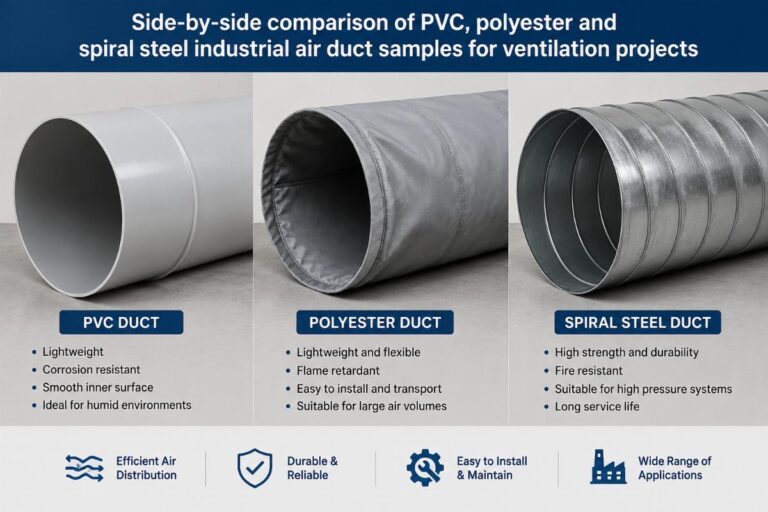
Hardware customization is equally important. Reinforced eyelets, hook-and-loop fasteners, or magnetic strips can simplify installation and usage. For warehouse partitions, quick-release mechanisms allow for easy reconfiguration of space. In mining ventilation, specialized connectors ensure airtight seals between duct sections. Discussing these details with your supplier ensures the final product integrates seamlessly into your workflow.
Do not hesitate to request prototypes or small trial orders. Testing a customized solution in a controlled environment before full-scale deployment minimizes risk. It allows you to verify fit, function, and durability in real-world conditions.
Conclusion
Quality industrial curtains are defined by technical precision, not just price.
Sourcing from a reliable industrial curtain wholesale supplier involves verifying material specs, understanding environmental demands, and insisting on certified performance data. By focusing on GSM accuracy, UV stability, and fire ratings, buyers can avoid costly failures. Prioritize suppliers who offer transparency in their production processes and flexibility in customization. This approach ensures long-term value and operational safety.