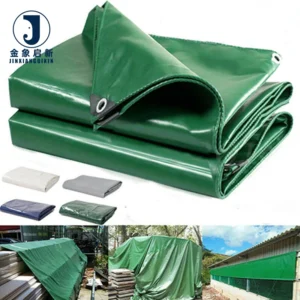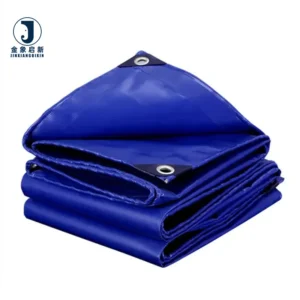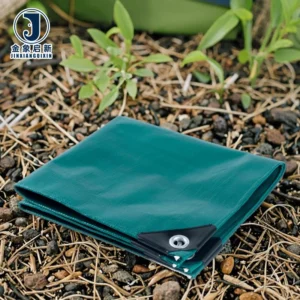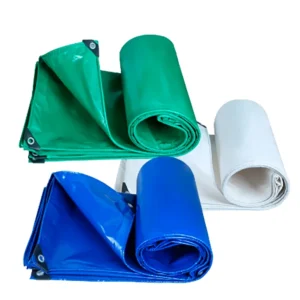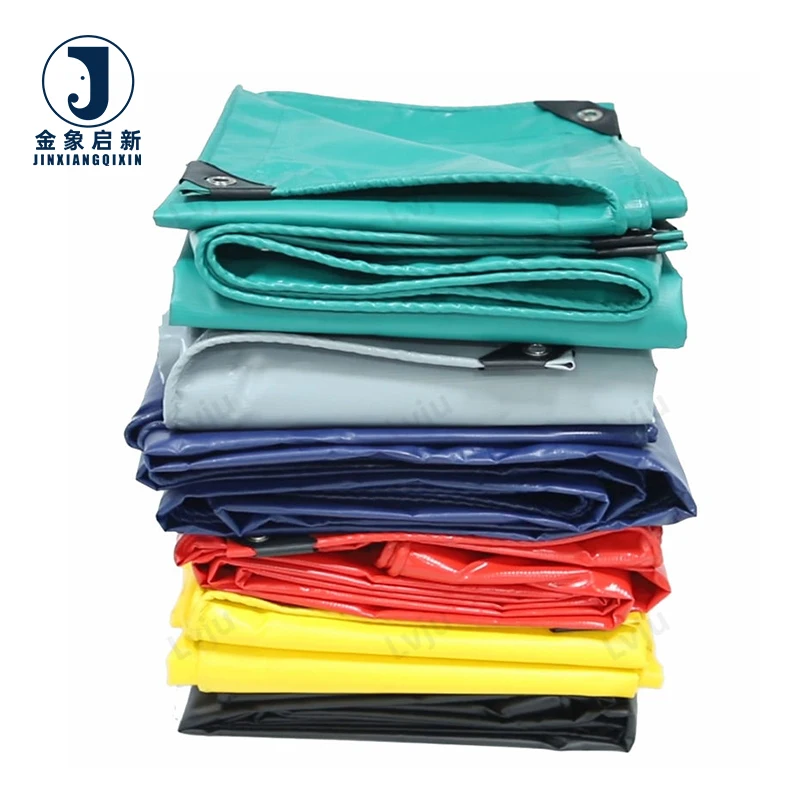
Deep Process Control — Coating weight and adhesion are verified at every stage across three full production lines, ensuring this 500 GSM PVC knife-coated tarpaulin meets fleet-wide specifications for truck and trailer covers without deviation.
Technical Specifications
| Parameter | Value |
|---|---|
| Product Type | PVC Knife-Coated Tarpaulin |
| Weight | 500 GSM |
| Coating Material | High Density Virgin PVC |
| Coating Method | Knife-Coated |
| Waterproof | Yes |
| Color Options | Multiple colors available |
| Surface Finish | Customizable (glossy/matte) |
| Flame Retardant Grade | Available — confirm the grade required for your market |
| UV Treatment | Available — confirm the treatment level required for your application |
| Standards | ISO, CE |
Application Suitability
| Application | Exposure & Requirement |
|---|---|
| Truck and trailer side curtain | Constant flexing at load points, road spray, abrasion from tie-down straps, wind-driven rain |
| Truck top cover and load wrap | Direct sunlight exposure, pooling water, tension at reinforced hems during transit |
| Ship and marine rainproof cover | Salt-laden moisture, sustained wind load, UV exposure on open deck |
| Awning and canopy for transport hubs | Prolonged outdoor weathering, tension across support frames, public safety requirements |
| Tent and canopy fabrication | Multi-season assembly and teardown, wind uplift stress at seams and eyelet lines |
Why Generic Sizing Fails Transport Fleets — and What 500 GSM PVC Knife-Coated Tarpaulin Changes
A cover cut to a generic size leaves the most critical flex and tie-down zones exposed, which is where cargo damage and fabric failure begin.
Fleet operators ordering truck covers often receive sheets cut to standard dimensions that do not align with the specific trailer model in service. The result is excess fabric flapping at high speed or insufficient overlap at the rear doors, both of which accelerate wear. When a 500 GSM PVC knife-coated tarpaulin is cut to the exact trailer dimensions — including allowance for side curtain tracks, buckle straps, and rear roll-up mechanisms — the load stays sealed and the fabric lasts longer [NEED_CITE: typical fleet cover replacement intervals linked to sizing accuracy]. Colour varying between rolls in the same order becomes visible once installed side by side on a fleet of identical trailers, undermining brand presentation across the vehicles.
How Knife-Coated Construction Handles Road and Weather Exposure
The knife-coated process forces PVC compound into the base fabric under controlled pressure, creating a mechanical bond between coating and yarn that resists delamination when the cover flexes repeatedly during transit. For fleet operators, this means the coating stays intact at the exact points where tie-down straps press against the fabric and where the side curtain folds into its track. A 500 GSM PVC knife-coated tarpaulin built this way maintains its waterproof barrier through the constant flex-and-release cycle that road transport demands.
Colour Consistency Across a Fleet Order
When a logistics company orders covers for an entire fleet, every roll must match the specified colour reference within a tight tolerance. Batch variation is a frequent complaint in bulk tarpaulin procurement — one roll shifts slightly warmer or cooler, and the difference becomes obvious once adjacent panels are installed on neighbouring trailers [NEED_CITE: colour measurement standards for coated textiles in fleet livery applications]. Dedicated QA inspection at the coating stage checks pigment dispersion and coating thickness roll by roll, so the 500 GSM PVC knife-coated tarpaulin arrives with uniform colour across every roll in the shipment.
Weight, Coating Adhesion, and Real-World Performance at the Seam
The 500 GSM weight grade positions this fabric in the heavy-duty range for transport covers, providing sufficient mass to resist wind flap and mechanical abrasion from cargo shifting behind the curtain. However, GSM alone does not determine how well a cover holds up — the bond between the PVC coating and the base fabric governs whether the material delaminates at a welded seam when the load flexes. Knife coating delivers deeper penetration of the PVC compound into the yarn structure compared to laminating methods, which produces higher peel strength at the weld line. High density virgin PVC as the base coating material ensures consistent plasticiser content, meaning the fabric retains its flexibility across the temperature swings a truck cover encounters from a cold morning start to a hot afternoon on the motorway. The customizable glossy or matte finish option allows fleet operators to choose a surface that either sheds road grime more easily or provides a non-reflective appearance for branded liveries.
What Happens When Welded Seams Fail Before the Fabric Does
The most common failure point on a truck side curtain is not the body of the fabric but the welded seam where two panels join, particularly at the zone where the load flexes most during cornering and braking. If the heat weld temperature or dwell time is set incorrectly for the coating formulation, the seam peels open under tension while the surrounding 500 GSM PVC knife-coated tarpaulin remains intact. This type of failure leaves cargo exposed and forces an unplanned cover replacement mid-contract. Specifying reinforced hem construction and requesting a pre-shipment weld peel test record reduces this risk before the cover ever reaches the vehicle [NEED_CITE: peel strength test methods for heat-welded PVC coated fabrics].
Sourcing This Fabric for Transport Cover Production
Three full production lines and 36 sets of professional equipment support bulk roll output with consistent on-time dispatch, so fleet operators and transport equipment builders receive material when the vehicle build schedule demands it. A 10-person R&D team handles custom width, cut-to-model sizing, colour matching, and eyelet placement specifications — developing samples within days rather than weeks for transport cover trials. Every roll of 500 GSM PVC knife-coated tarpaulin undergoes dedicated QA/QC at each production stage with 100% inspection before shipment, catching coating weight deviations and colour drift before they reach the loading bay. Nearly 30 years of focused coated fabric production means the process parameters for this weight grade are well established, reducing the variability that newer suppliers struggle to control. ISO and CE certification underpins the documentation package, giving procurement teams the compliance trail their quality systems require.
Documentation & Verification
- Material specification sheet stating verified 500 GSM weight, base fabric detail, and PVC coating type
- Pre-shipment inspection record confirming roll-by-roll weight and colour check before dispatch
- Test report for UV or flame retardant grades where applicable to your transport cover specification
- Roll packing list with individual roll ID, net weight, and colour reference for receiving inspection
- Certificate of origin and customs documentation supporting international freight clearance
Fabrication, Handling & Storage
- Heat weld temperature and dwell time must match the high density virgin PVC formulation to avoid seam peel
- Eyelet spacing at hem lines should account for 500 GSM weight and expected tie-down tension loads
- Store rolls upright on a flat surface to prevent permanent creasing in the knife-coated PVC layer
- Allow cold-weather rolls to reach ambient temperature before unrolling to prevent coating crack at the fold
- Clean with mild detergent only — solvents can soften the PVC coating and compromise waterproof performance
What to Include in Your Enquiry
Provide the specific truck and trailer models in your fleet along with the cover type required — side curtain, top sheet, or full wrap — so the cut sizing can be matched to the vehicle dimensions. State your target market and any fire safety or compliance requirements the cover must meet at the destination. Indicate the colour reference or branding colours needed and whether you require rolls for your own fabrication or finished cut-to-size covers with eyelets and reinforced hems already installed.
Frequently Asked Questions
Q: How do I verify the 500 GSM weight matches the quotation when the rolls arrive?
A: Request a pre-shipment inspection record that documents actual weight measurements taken from each roll before dispatch. On receipt, you can cross-check using a calibrated scale and a measured sample cut from the roll end. The material specification sheet supplied with the shipment states the agreed GSM, base fabric, and coating details for your records.
Q: How is custom truck cover sizing specified for different trailer models?
A: Provide the trailer make, model, and body type along with the cover style — side curtain, top cover, or rear door sheet. The R&D team develops a cutting pattern that accounts for track channels, buckle strap positions, and hem overlap. A sample cover is produced for fitment trial before the full fleet order enters production.
Q: How is welded seam performance ensured at load flex points?
A: Weld parameters are set to match the high density virgin PVC coating formulation so that peel strength at the seam matches or exceeds the fabric body strength. Reinforced hem options add extra material layers at high-stress zones. A weld peel test record can be included in the pre-shipment documentation for your quality review.
Q: How is colour consistency maintained when ordering covers for an entire fleet?
A: Pigment batches are matched to your specified colour reference at the coating stage, and each roll is inspected for colour uniformity before packing. The pre-shipment inspection record documents the colour check result per roll. This prevents visible variation when covers are installed side by side across multiple trailers.
Q: What documentation accompanies an international shipment of this tarpaulin?
A: Each shipment includes a material specification sheet, pre-shipment inspection record, roll packing list with individual roll identification, certificate of origin, and ISO and CE certificates. Where UV or flame retardant treatments are specified, the relevant test report is included to support customs clearance and end-use compliance.