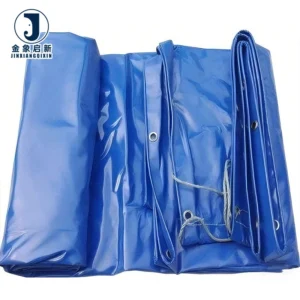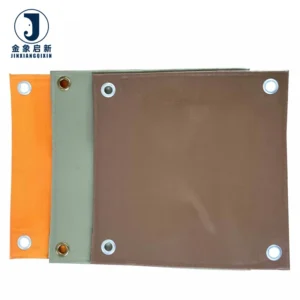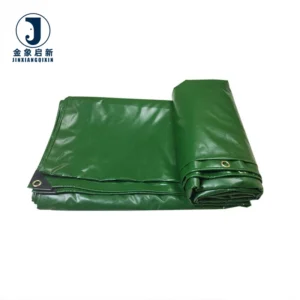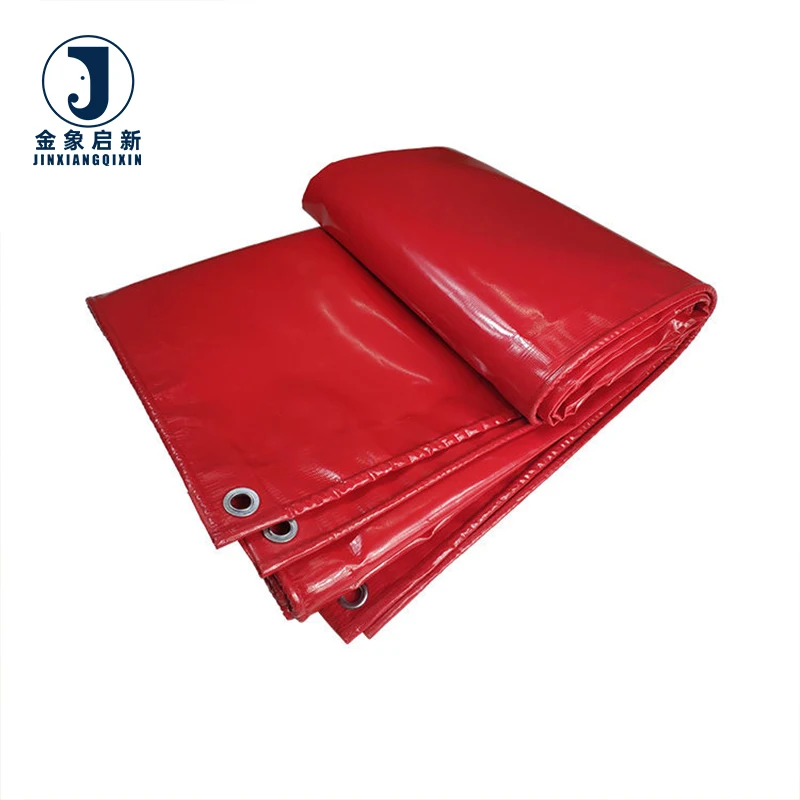
Deep process control over coating weight and adhesion — verified through stage-by-stage QA on every roll of PVC Coated Tarpaulin for farming applications, ensuring the GSM you specify is the GSM you receive.
Technical Specifications
| Parameter | Value |
|---|---|
| Product Type | PVC Coated Tarpaulin |
| Weight Range | 500gsm–1000gsm (range covers product family — confirm the grade for this item) |
| Density Parameter | 1.15–2.00 g/cm³ |
| Tensile Strength | 50–80 MPa |
| Brittle Temperature | ≤ -50 to -60 ℃ |
| Softening Temperature | ≥ 80 ℃ |
| Melting Point | 212 ℃ |
| Treatment Options | High frequency hot melt, Hot air, Sewing |
| Edge Rope | 5mm thick rope without splicing |
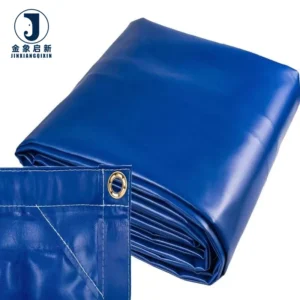
| Edge Wrapping | High temperature heat sealed seamless edge wrapping |
| Eyelets | 3cm enlarged aluminum alloy buttonhole |
| Corners | Reinforced corners on all sides |
| Key Features | Waterproof, Fire Retardant (grade not stated in source), Anti UV (test basis not stated in source), Heavy Metal Free, Anti Mildew, Flexible, Heavy Duty, Self Clean |
| Printing | Printable, Customized |
| Standards | ISO 9001, CE |
Application Suitability
| Application | Exposure & Requirement |
|---|---|
| Tractor and implement covers | Field storage with rain saturation, UV exposure, mechanical abrasion from repeated fitting and removal |
| Greenhouse and polytunnel weather protection | Continuous UV loading, wind-driven rain, temperature fluctuation across seasons |
| Livestock feed and bedding storage | Moisture ingress prevention, rodent and puncture resistance, prolonged outdoor stacking load |
| Temporary agricultural shelters | Multi-directional wind tension, structural flex at frame joints, rapid deployment and teardown |
| Pallet cover and transport protection | Road exposure during transit, tie-down strap abrasion, flex fatigue at load edges |
| Garden and plant rainproof covers | Seasonal rain and hail impact, UV degradation over growing cycles, frequent repositioning |
Why Generic Tarps Fail on Working Farms Within One Season
PVC Coated Tarpaulin for farming must be specified by exposure condition, not by generic weight claims alone.
Most agricultural tarpaulin failures I have investigated share a common pattern: the material was selected by a single number — the quoted GSM — without matching the actual mechanical and environmental stress the cover faces on site. A tractor cover endures flexing every time it is pulled on and off, while a feed storage cover sits under static load and UV for months without movement. Treating both applications as interchangeable leads to early seam splitting, edge tearing around eyelets, and coating delamination at fold lines [NEED_CITE: coated fabric failure modes under cyclic flex versus static UV loading per ISO 1421]. The consequence is replacement cost compounded by damage to whatever the cover was meant to protect.
How Reinforced Edge Construction Handles Farm Tie-Down Loads
The 5mm thick rope without splicing runs the entire perimeter of this PVC Coated Tarpaulin for farming, distributing tie-down tension evenly rather than concentrating force at individual eyelet points. On a working farm, covers are secured with bungee cords, ratchet straps, or rope through grommets — and a splice in the edge rope creates a weak node that fails under cyclic loading from wind. The high temperature heat sealed edge wrapping bonds the rope inside the folded hem without adhesive, eliminating the glue cracking and edge lifting that sewn-only hems develop after repeated wet-dry cycles in field conditions.
Aluminum Alloy Eyelets and Corner Reinforcement for Repeated Fitting
The 3cm enlarged aluminum alloy buttonhole provides a smooth, corrosion-resistant anchor point that accommodates standard farm tie-down hooks and strap buckles without galling or pull-through. Farm covers are removed and refitted frequently — sometimes daily during harvest — and undersized or mild steel eyelets corrode, deform, or tear free from the fabric under this cycle. Reinforced corners on all sides add extra material layers at the four highest-stress points where diagonal tension converges, preventing the corner blowouts that render an otherwise intact cover unusable [NEED_CITE: tensile concentration factors at reinforced versus unreinforced tarpaulin corners].
Reading the Specification Sheet Beyond the GSM Number
The weight range of 500gsm–1000gsm covers multiple grades within this product family, and the correct selection depends on what the cover must withstand. Heavier grades carry more coating mass, which improves puncture resistance and impermeability but also increases stiffness — a problem when the cover must be folded and stored between uses. The tensile strength of 50–80 MPa reflects the combined contribution of the base fabric weave and the coating adhesion, not the coating alone. A high-GSM fabric with poor base fabric density will show adequate weight on a scale but tear easily along the warp or weft under load. The brittle temperature of ≤ -50 to -60 ℃ indicates the lower boundary where the PVC coating loses flexibility and may crack on impact, while the softening temperature of ≥ 80 ℃ sets the upper limit for storage near heat sources such as greenhouse vents or exhaust proximity. Density of 1.15–2.00 g/cm³ and a melting point of 212 ℃ are consistent with plasticized PVC formulations and confirm the material’s behaviour during hot-air or high-frequency welding [NEED_CITE: relationship between PVC density, plasticizer content, and heat-seal performance in coated fabrics].
The Cost of Specifying Without Matching the Application
When a farm purchases a cover based solely on a low quoted GSM price without verifying the actual delivered weight, the material often arrives lighter than agreed. The shortfall is not visible until the cover fails prematurely — splitting at seams during the first winter storm or developing pinholes after a single season of UV exposure. Batch colour variation between orders is another frequent complaint: two covers bought six months apart for the same equipment row show visibly different shades once installed side by side, which matters when covers are used in customer-facing farm shop environments. Welded seams that fail before the fabric body itself are almost always traceable to incorrect heat or pressure settings during fabrication, leaving the load exposed at exactly the point where flex stress is highest [NEED_CITE: weld seam versus fabric body failure incidence in field-returned tarpaulin samples].
Why Source This PVC Coated Tarpaulin for Farming From Jinan Jinxiang
Nearly 30 years of continuous production in coated fabric means the coating weight and adhesion parameters on the specification sheet are held within tolerance through process control, not post-production sorting. Three full production lines and 36 sets of professional equipment provide the capacity to fulfil bulk agricultural orders on schedule, even during peak seasonal demand when lead times compress. A 10-person R&D team handles material selection and custom sizing, so covers can be developed to match specific tractor models, greenhouse frame dimensions, or storage bay layouts rather than forcing a generic size. Dedicated QA/QC inspection at every production stage, with 100% inspection before shipment, catches GSM deviation and visual defects before the roll leaves the facility. Samples for custom farming covers are developed within days, allowing you to verify weight, colour, and weld quality before committing to a full production run.
Documentation & Verification
- Material specification sheet stating confirmed GSM, base fabric construction, and coating type for the grade selected
- Colour reference with batch consistency record across rolls in the same order
- Test report for UV and fire retardant grades where applicable — confirm the grade required for your market
- Pre-shipment inspection record covering weight verification, visual defect check, and dimensional accuracy
- Roll packing list with net and gross weight per roll for receiving verification
- Certificate of origin and customs documentation for cross-border agricultural supply
Fabrication, Handling & Storage
- High frequency hot melt or hot air welding recommended for seams; confirm temperature and dwell time for the selected GSM grade
- 3cm aluminum alloy eyelets require clean, burr-free die punching to avoid coating micro-cracks at the insertion point
- Store rolls upright on a flat surface to prevent permanent creasing in the PVC coating layer
- Deploy at ambient temperature above 5 ℃ to maintain coating flexibility during unfolding and tensioning
- Clean with mild detergent and soft brush; avoid solvent-based cleaners that attack plasticized PVC surfaces
- Field repairs at puncture points using compatible PVC patch material heat-welded at matching temperature settings
Request a Specification Match for Your Farming Application
Provide the specific equipment or structure dimensions, the primary exposure conditions (UV intensity, wind load, rain frequency), and the tie-down method you use on site. If your market requires fire retardant or UV-rated material, state the standard or grade so the correct formulation is quoted. Indicate whether you need finished cut-to-size covers with eyelets and edge reinforcement, or roll stock for your own fabrication. Samples in the selected GSM grade and colour are available for evaluation before production commitment.
Frequently Asked Questions
Q: What GSM weight should I specify for outdoor farm equipment covers?
A: The product family covers 500gsm–1000gsm, and the correct grade depends on exposure intensity and mechanical load. Heavier grades suit static long-term storage covers exposed to wind and UV, while lighter grades work for frequently handled implement wraps. Request a sample in two adjacent grades to compare flexibility against puncture resistance for your specific handling routine.
Q: Can you match my existing tarpaulin colour for uniform farm appearance?
A: Custom colour matching is available, and batch consistency across rolls within a single order is verified during pre-shipment inspection. Provide a physical colour reference or Pantone code with your inquiry. For orders placed across multiple batches over time, request a retained sample from the original production to minimize visible shade variation when installed side by side.
Q: How do I measure for a custom farming equipment cover?
A: Measure the equipment at its widest, tallest, and longest points, then add allowance for the cover to drape past the base and accommodate any mounting brackets or protrusions. Specify the tie-down point locations so that the 3cm aluminum alloy eyelets align with your strap or hook positions. A dimensional drawing with these measurements enables accurate sample development.
Q: What is the difference between hot melt and sewn seam construction?
A: High frequency hot melt and hot air welding produce a bonded seam where the PVC coating layers fuse, creating a waterproof joint that flexes with the fabric. Sewn seams rely on thread tension and leave needle holes that can admit moisture. For farming covers exposed to rain and cyclic flexing, welded seams generally outperform sewn construction at the stress points where the load moves most.
Q: Do you provide test certificates for UV and fire retardant claims?
A: UV and fire retardant treatments are available in multiple grades, and test reports are supplied for the specific grade produced. Confirm the standard required by your market or end-use regulation with your inquiry — for example, a particular UV exposure duration or fire classification — so the correct formulation is applied and documented before production begins.