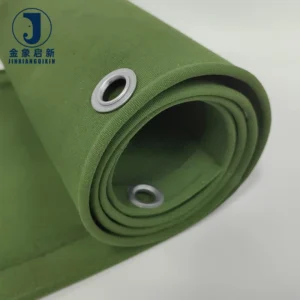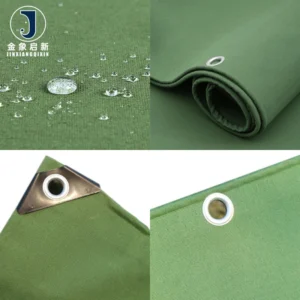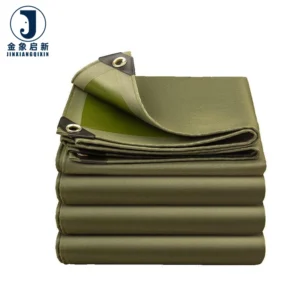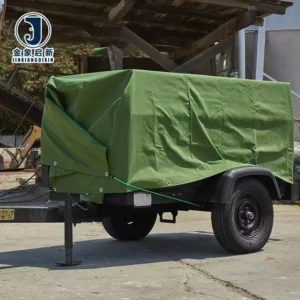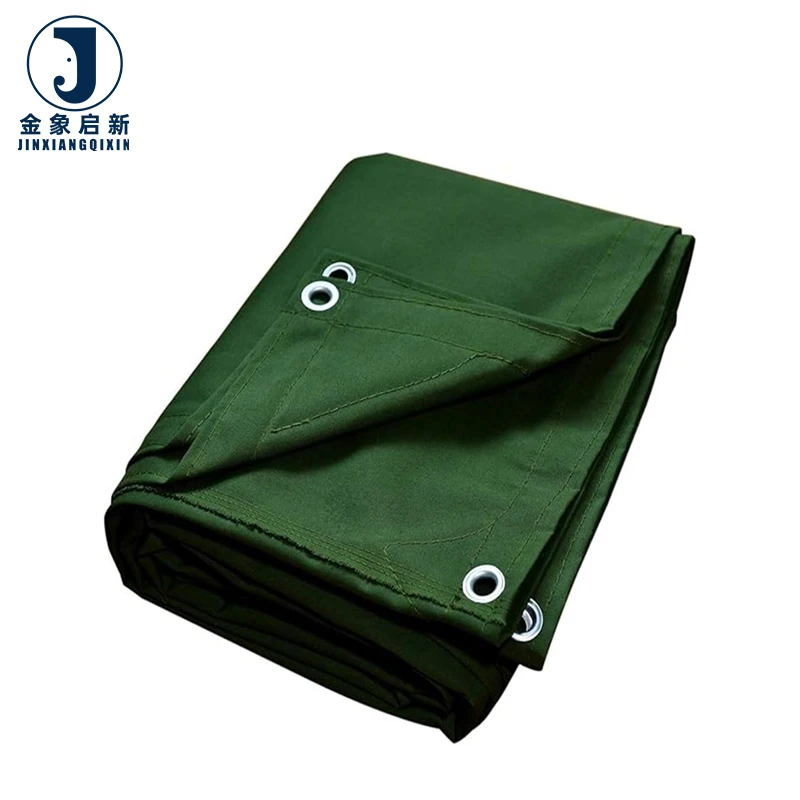
Coating Process Control — three full production lines and 36 sets of equipment ensure batch-to-batch adhesion consistency on every roll of PVC laminated canvas dispatched for fleet covering.
Technical Specifications
| Parameter | Value |
|---|---|
| Product Type | Heavy Duty Woven PVC Laminated Industrial Canvas Tarpaulin |
| Material | Polyester cotton industrial textile, 8-12 strands of fine cotton yarn |
| Weight | 600gsm |
| Total Thickness | 0.5mm / 0.6mm / 0.7mm |
| Roll Width | 2m |
| Roll Length | 100m |
| Color | Army Green Camouflage / Custom |
| Coating Method | PVC Laminated |
| Key Features | Wear-resistant, corrosion-resistant, tensile-resistant, high- and low-temperature resistant, waterproof, mold resistant |
| Eyelet Spacing | Rust-proof aluminum holes every 1 meter at corners and hem |
| Seam Construction | Welded and sewn with poly ropes |
| UV Treatment | Yes (test basis not stated in source) |
| Service Life | 5-8 years (source value — verify against manufacturer catalog) |
| Standards | CE, ISO |
Application Suitability
| Application | Exposure & Requirement |
|---|---|
| Truck and trailer load cover | Constant road vibration, wind flap, UV exposure, tie-down abrasion at eyelets and hems |
| Side curtain fabric for transport trailers | Repeated flexing at folds, road debris impact, weather ingress prevention |
| Construction site equipment cover | Standing water, soil contact, puncture from sharp edges, UV degradation |
| Open-air asphalt and material cover | High-temperature contact, chemical exposure from bitumen, wind uplift forces |
| Tent and temporary structure fabric | Prolonged outdoor exposure, tension loads at guy ropes, mold in humid climates |
Why Generic Sizing Fails a Fleet Operator
A canvas tarpaulin cut to exact trailer dimensions eliminates the gaps where weather and road debris enter.
Fleet operators who source generic-sized covers spend time and money trimming, folding excess material, and patching gaps that form where the tarp shifts under wind load. The result is cargo exposed mid-haul, tarpaulin edges flapping against paintwork, and tie-down straps pulling through unreinforced hem sections. A canvas tarpaulin for truck cover applications must be finished to the vehicle model, not the other way around. [NEED_CITE: fleet tarpaulin failure rates related to improper fit and hem stress]
Cut and Finished to Your Trailer Model
This canvas tarpaulin for truck cover applications is produced as custom finish product sized to match specific truck and trailer models. The pattern is developed from vehicle dimensions so the cover sits flush against the load bed, side rails, and tailgate without excess fabric catching wind or dragging on the road surface.
Reinforcement Where the Load Flexes Most
Welded seams are combined with poly-rope sewn hems at every perimeter edge. This dual-construction approach addresses the two most common failure points on transport covers: the weld line cracking under repeated flex, and the hem tearing where tie-down straps apply concentrated load. Rust-proof aluminum eyelets spaced every 1 meter distribute tie-down forces across a wider hem section rather than concentrating stress at a single point. [NEED_CITE: tensile and tear test methods for coated fabrics per ISO 1421]
Decoding the 600gsm Polyester-Cotton Construction
The base fabric uses 8-12 strands of fine cotton yarn woven into a polyester cotton industrial textile. This blended weave balances the dimensional stability of polyester with the flexibility and abrasion tolerance of cotton fiber. The 600gsm weight reflects the combined mass of base fabric plus PVC lamination — not the base fabric alone. PVC lamination bonds a continuous film to the woven surface under heat and pressure, creating a waterproof barrier with strong peel adhesion. Compared to knife-over-roll coating, lamination produces a more uniform coating thickness across the full 2m roll width, which matters when multiple panels are welded side by side on a large trailer cover. The three available thickness options — 0.5mm, 0.6mm, and 0.7mm — allow specification matched to exposure severity, with the heavier option suited to applications involving frequent contact with abrasive surfaces or high mechanical stress at fold lines.
The Cost of Underspecifying Transport Covers
A canvas tarpaulin that arrives lighter than the quoted 600gsm may pass initial inspection but will show accelerated wear at stress points within months of fleet service. Covers that lack documented UV treatment fade and embrittle along south-facing surfaces, forcing premature replacement across an entire fleet rather than a scheduled rotation. Color variation between rolls in the same batch becomes visible once multiple covers are deployed side by side on parked trailers, undermining fleet appearance standards. Seam failures that occur before the fabric itself degrades indicate either incorrect welding temperature for the PVC laminate or insufficient hem reinforcement for the strap tension applied in service. [NEED_CITE: field failure analysis of laminated transport covers under UV and mechanical stress]
Why Source This Fabric Here
Process control over lamination temperature and pressure ensures consistent coating adhesion across every roll, verified through in-process quality checks at each production stage. The 10-person R&D team develops vehicle-specific patterns and finish dimensions, producing samples within days for buyer approval before full production runs. Dedicated QA/QC inspection covers 100% of output before dispatch — not statistical sampling — so GSM weight, color consistency, and eyelet placement are confirmed per roll. Three full production lines with 36 sets of professional equipment support the volume requirements of fleet-scale orders without extended lead times. Custom widths, colors, and finish sizes are handled on the same lines as stock grades, meaning no separate minimum order barriers for bespoke specifications.
Documentation & Verification
- Material specification sheet stating 600gsm weight, polyester-cotton base, and PVC lamination type
- Pre-shipment inspection record confirming 100% check of weight, color, and eyelet placement
- UV treatment test report provided where applicable to confirm outdoor durability
- Custom sizing confirmation referencing specific truck or trailer model dimensions before production
- CE and ISO certification documentation included with dispatch paperwork
Fabrication, Handling & Storage
- Weld PVC laminated panels at temperatures matched to the 600gsm laminate thickness to avoid delamination at seams
- Sew poly-rope into hems before eyelet insertion to distribute strap load across the full perimeter
- Store 2m × 100m rolls upright on pallets to prevent flat-spotting and permanent crease marks on the laminate surface
- Allow cold-stored rolls to reach ambient temperature before unrolling to prevent cracking of the PVC film
- Clean with mild detergent only — solvents can degrade the PVC lamination bond on the polyester-cotton base
What to Include in Your Enquiry
Provide the truck or trailer make and model so the cover pattern can be developed to exact dimensions. Specify whether you need rolls for your own fabrication or finished covers with eyelets and hems already installed. Indicate any color requirements beyond Army Green Camouflage and whether UV treatment documentation is needed for your market compliance.
Frequently Asked Questions
Q: How is GSM verified on arrival to ensure the canvas tarpaulin matches the quoted weight?
A: Every roll undergoes weight verification during pre-shipment inspection. The inspection record documents actual GSM measured against the 600gsm specification. This record ships with your order so you can cross-check on arrival. Random sampling at receiving is also recommended to confirm consistency across the batch.
Q: Can the tarpaulin be cut and finished to fit a specific truck or trailer model?
A: Yes. Finish product sizing is developed from your vehicle model dimensions, not from generic templates. The pattern accounts for load bed length, side rail height, and tailgate overlap. Samples are produced for your approval before the full order enters production, ensuring fit is confirmed in advance.
Q: How are welded seams reinforced at points where the load flexes most during transit?
A: Seams are welded and then sewn with poly ropes along the hem, creating a dual-reinforcement system. This prevents the weld line from cracking under repeated flex cycles caused by load movement and wind vibration. Eyelet placement every 1 meter further distributes mechanical stress across the hem section.
Q: What eyelet spacing and hem reinforcement options are available for tie-down security?
A: Standard configuration includes rust-proof aluminum eyelets spaced every 1 meter at corners and along the hem. The hem is folded and sewn with poly ropes before eyelet insertion. Custom spacing and additional reinforcement patches at high-load points can be specified during the pattern development stage.
Q: How is UV treatment validated for extended outdoor and road exposure?
A: UV treatment is applied during the PVC lamination process. A test report documenting UV resistance is available where applicable — confirm the specific test standard required for your market when placing your enquiry so the correct documentation is prepared with your shipment.