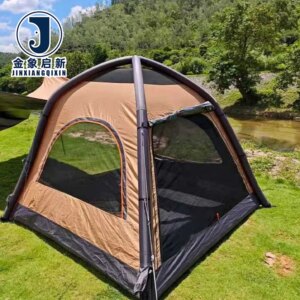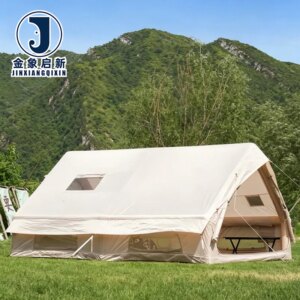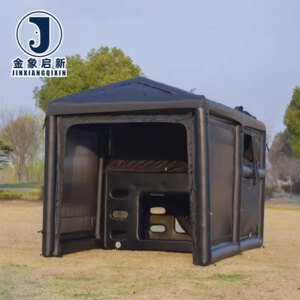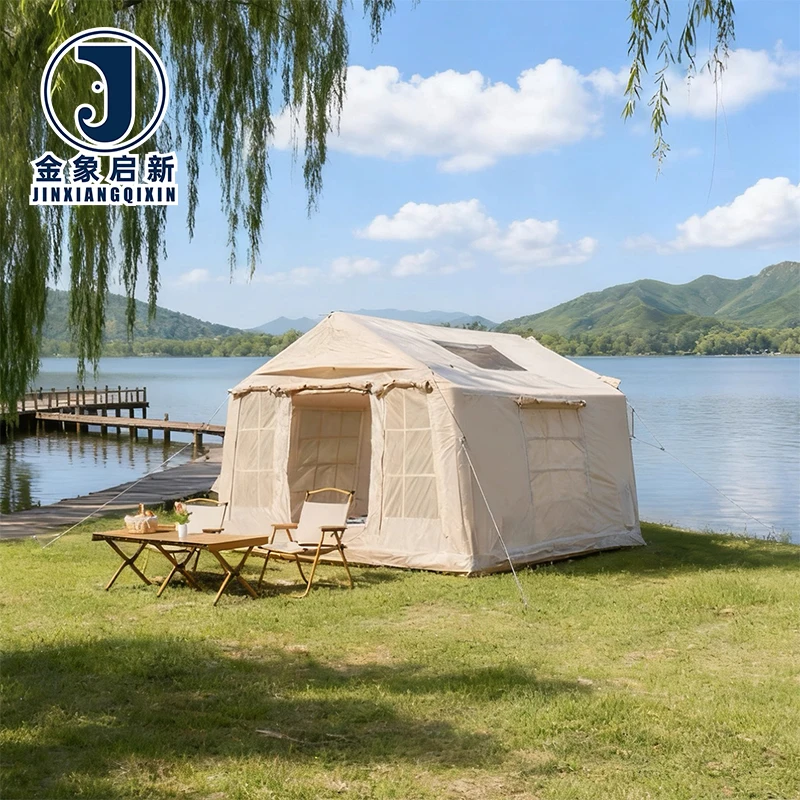
Process Control at Every Seam — three full production lines with in-line fusion temperature monitoring ensure heat-sealed joints on this inflatable tent fabric hold through repeated inflation cycles and structural flex.
Technical Specifications
| Parameter | Value |
|---|---|
| Product Type | Inflatable Tent |
| Core Material | Waterproof PVC Fabric |
| Water Resistance | ≥10,000mm water column |
| UV Resistance | Stabilized additives (test basis not stated — confirm grade for your market) |
| Tear Strength | ≥300N warp/weft (test standard not stated) |
| Structure | Single-layer inflatable with pump |
| Setup | Quick automatic opening |
| PVC Thickness Tolerance | ±0.02mm |
| Pressure Test | 24-hour air leakage test |
| Standards | ISO 9001, ISO 14001, ISO 45001, CE |
| Customization | OEM & ODM, sample customization, pattern printing, custom dimensions, color matching, logo application |
| Sample Lead Time | 7–10 days |
| Production Lead Time | 15–20 days for standard orders |
| R&D Support | 10 technicians |
Application Suitability
| Application | Exposure & Requirement |
|---|---|
| Commercial glamping resorts | Continuous outdoor weather exposure, repeated inflation/deflation cycles, guest-facing aesthetics and comfort |
| Transport fleet depot shelters | Cargo staging areas, driver rest zones, rapid deployment and teardown at logistics hubs |
| Event venue temporary structures | High-frequency setup across multiple sites, wind loading on inflatable beams, UV and rain exposure |
| Adventure tourism base camps | Remote site deployment, transport over rough terrain, resistance to abrasion during ground contact |
When Seam Failure Costs More Than Fabric Replacement
Weld integrity under repeated flex determines whether an inflatable tent lasts a season or a single event.
Colour shifts between rolls, seams that crack before the fabric body yields, and air leakage that surfaces only after installation — these failures appear when inflation cycles and structural movement concentrate stress at heat-sealed joints. For commercial glamping operators running multiple units, a single seam failure means guest relocation, revenue loss, and emergency repair under field conditions [NEED_CITE: tensile and tear test methods for coated fabrics per ISO 1421].
Inflation Cycles and Joint Endurance
Every inflation and deflation event bends the PVC fabric at beam joints and base connections. Inflatable Tent aftermarket supplier operations depend on seam consistency because field repairs during peak season are not viable. Our in-line fusion temperature monitoring records bonding conditions at every weld point during production, so seam strength remains uniform across each unit rather than varying with operator shifts or ambient temperature changes.
Waterproof Verification Beyond the Specification Sheet
A stated water column rating only matters if the coating remains continuous across the entire panel and at every overlap. The Inflatable Glamping Tent with Waterproof PVC Fabric undergoes a 24-hour pressure test before leaving the factory, detecting micro-leaks that visual inspection misses [NEED_CITE: field performance of heat-sealed PVC joints under cyclic loading]. This protocol catches defects introduced during valve installation or panel joining, not just coating imperfections.
Reading Thickness Tolerance in Context
The ±0.02mm PVC thickness tolerance applies across each production roll before cutting and welding. Uniform thickness at the coating stage directly affects how heat transfers through the material during heat-sealing — thicker zones require different dwell times than thinner zones. When tolerance drifts, some weld areas receive insufficient energy while others overheat, creating weak points that emerge during the first inflation cycle. This is why raw material thickness inspection happens before fabrication begins.
The Hidden Cost of Skipped Pressure Testing
Units that ship without 24-hour air leakage verification may hold pressure for the first few days and then slowly deflate as micro-fractures at seam edges propagate under continuous load. For glamping operators charging nightly rates, this means mid-stay guest complaints and the logistics of swapping tents during occupied bookings. Batch-level testing adds time to production but eliminates the far greater cost of field failures during peak operating season [NEED_CITE: commercial tent structure failure modes and warranty claims].
Why This Fabric Source Fits Deployment Schedules
Ten-person R&D teams develop samples within 7–10 days for custom dimensions and printed branding, shortening the validation cycle before full production runs.
Three production lines and 36 sets of processing equipment handle bulk orders with consistent lead times, supporting operators who plan site openings around fixed construction schedules.
Dedicated QA at every production stage means thickness verification, fusion temperature logging, and pressure testing occur in sequence — not as a single final check that catches defects too late to rework.
Sample development includes pattern printing and color matching so that operators can confirm aesthetics and branding alignment before committing to full container quantities.
ISO 9001, ISO 14001, ISO 45001, and CE documentation ships with each order, supporting compliance audits at resort developments and event sites that require certified materials on file.
Documentation & Verification
- Material specification sheet stating PVC composition, waterproof rating, and UV treatment basis for each batch
- Pre-shipment inspection record with batch-specific water resistance test results and thickness measurements at ±0.02mm tolerance
- 24-hour pressure testing log for air leakage verification on every inflatable unit before dispatch
- ISO 9001/14001/45001 and CE certificates included per shipment for site compliance documentation
- Roll packing list with roll count, weight, and dimension breakdown for container loading planning
- Certificate of origin and customs support documentation for cross-border shipment clearance
Fabrication, Handling & Storage
- Heat-seal at manufacturer-specified fusion temperature to maintain bond strength across PVC fabric panels
- Store rolls upright on pallets to prevent creasing that weakens the coating layer before fabrication
- Use compatible PVC adhesive for field repairs on single-layer inflatable sections to maintain waterproof continuity
- Avoid dragging cut panels across abrasive ground surfaces to protect the PVC coating face during installation
- Clean with mild detergent only — solvent-based cleaners degrade the UV-stabilized additive formulation
- Allow full inflation in moderate temperatures; cold PVC fabric stiffens and resists proper beam formation
Specifying Your Order
Provide the intended deployment environment and expected inflation frequency so that material grade and seam construction can be matched to actual operating conditions. Confirm whether your market requires specific fire classification documentation or UV test reports for regulatory approval. Specify custom dimensions, colour references, and any logo or pattern printing requirements along with estimated annual volume to support accurate sampling and lead time planning.
Frequently Asked Questions
Q: What is the test basis for UV resistance and expected outdoor service life?
A: The PVC fabric contains stabilized additives designed to extend material lifespan during outdoor deployment. The specific test standard and exposure hours are not stated in the current specification. Buyers should request the UV test report for their target market’s requirements before placing bulk orders, as regional standards vary significantly.
Q: How are seams heat-sealed and tested for flex-point durability?
A: In-line fusion temperature monitoring records bonding conditions at every weld during production. Each completed unit then undergoes a 24-hour pressure test to detect air leakage at seam junctions before shipment. This two-stage process catches both thermal inconsistencies during welding and structural weaknesses that only appear under sustained inflation.
Q: What custom dimensions and MOQ apply for OEM/ODM inflatable tent orders?
A: Sample development takes 7–10 days with full OEM and ODM support including custom dimensions, colour matching, and pattern printing. Production lead time runs 15–20 days for standard orders. MOQ varies by specification complexity — contact with your target dimensions and annual volume for a specific quotation.
Q: How is colour consistency maintained across rolls and production batches?
A: Colour matching occurs during the sample approval stage with a physical reference retained for production. Raw material thickness inspection at ±0.02mm tolerance ensures coating uniformity, which directly affects colour appearance. Buyers specifying multi-unit deployments should request batch-level colour inspection records with their shipment documentation.
Q: How can buyers verify PVC fabric weight and thickness upon delivery?
A: The pre-shipment inspection record includes batch-specific thickness measurements taken at ±0.02mm tolerance. Buyers can conduct independent thickness and weight verification upon receipt using standard calipers and scales. Discrepancies should be flagged within the inspection window stated on the packing documentation for resolution.