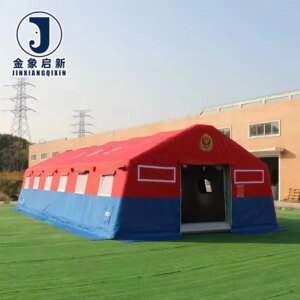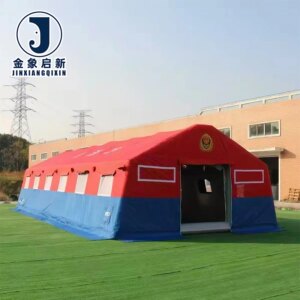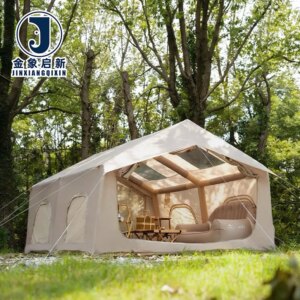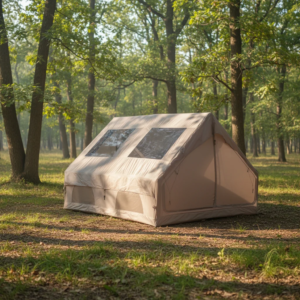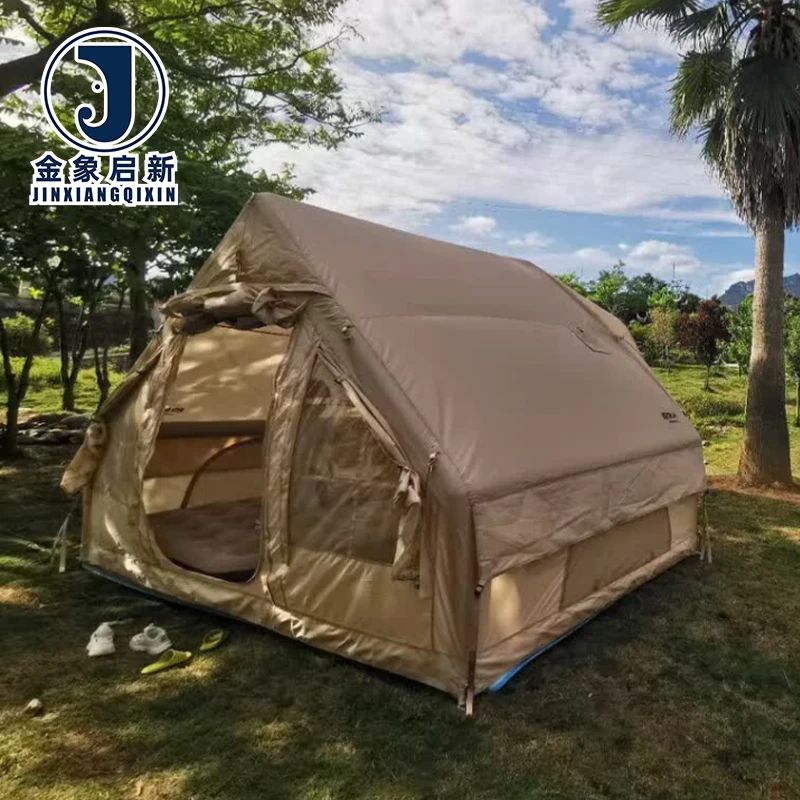
Proven process control — nearly 30 years focused on coated fabric with three full production lines, delivering consistent inflatable tent material for commercial deployment.
Technical Specifications
| Parameter | Value |
|---|---|
| Product Type | Inflatable Tent |
| Core Material | PVC tarpaulin |
| Capacity | 8-10 Person |
| Season Rating | 4 Season |
| Opening Mechanism | Automatic inflatable opening |
| Water Resistance | Waterproof coated construction |
| UV Resistance | UV-resistant (test basis not stated — confirm requirement) |
| Flame Retardancy | Fire-retardant (grade not stated — confirm market requirement) |
| Anti-Static | Anti-static (standard not stated — verify site compliance) |
| Customization | OEM & ODM, sample customization, pattern printing |
| Standards | ISO9001, ISO14001, ISO45001, CE |
Application Suitability
| Application | Exposure & Requirement |
|---|---|
| Commercial campground operations | Continuous weather exposure, guest turnover abrasion, seasonal UV load |
| Outdoor exhibitions and festivals | Rapid deployment, repeated inflation cycles, public safety compliance |
| Temporary workforce housing | Remote site wind loading, dust ingress, extended occupancy wear |
| Adventure tourism base camps | Altitude temperature swings, transport folding fatigue, moisture resistance |
| Construction project accommodation | Site debris contact, heavy-duty ground anchoring stress, fire safety codes |
Why Material Consistency Defines Commercial Inflatable Tent Performance
Colour and coating variation across rolls compromises both structural integrity and professional appearance on commercial sites.
When sourcing an Inflatable Tent for Commercial Outdoor Use, operators frequently encounter fabric batches where colour shifts between rolls become obvious once panels are inflated side by side [NEED_CITE: colour tolerance standards for PVC coated textiles]. Beyond aesthetics, inconsistent coating weight across a production run can mean one panel inflates rigid while an adjacent panel remains soft, creating uneven stress distribution on welded seams. For commercial campground operators and event organisers, this translates into guest complaints, premature panel replacement, and reputational damage. Generic consumer-grade tents simply cannot withstand repeated professional inflation cycles and the transport handling that commercial operations demand.
Rapid Deployment Reliability for Commercial Operators
The automatic inflatable opening mechanism of this 4 Season Inflatable Camping Tent eliminates manual pole assembly, allowing a two-person team to deploy an 8-10 person structure within minutes. For outdoor event organisers managing tight setup windows between bookings, this operational speed directly affects scheduling capacity and labour costs. The PVC tarpaulin core material provides the structural rigidity needed to maintain the tent’s inflated form under wind loading typical of open commercial sites.
Compliance Documentation for Regulated Commercial Sites
Mining camps, construction projects, and publicly accessible event venues require verifiable fire-retardant and anti-static documentation before any temporary structure is approved on site [NEED_CITE: fire safety compliance for temporary structures on construction sites]. This Inflatable Tent aftermarket supplier provides material specification sheets and test reports where applicable, allowing procurement teams to submit compliance packages without delays. Available fire-retardant grades should be confirmed against the specific standards your local authority or site safety officer requires before order placement.
Understanding PVC Tarpaulin Construction for Inflatable Applications
The inflatable beam structure of a camping tent depends entirely on the coated fabric’s ability to hold air pressure without stretching or delaminating. PVC tarpaulin achieves this through its coated construction, where the coating penetrates and encapsulates the base fabric weave, creating a composite material resistant to air permeability. The tear-resistant properties of the base fabric determine how the material behaves when a puncture occurs on a commercial site — a small tear in the beam fabric must not propagate under internal pressure. Waterproof performance is inherent to the fully coated construction, preventing moisture ingress through the fabric body during extended rainfall. Operators should request the specific GSM and base fabric specification to confirm the material matches their wind load and inflation pressure requirements.
The Hidden Cost of Underspecified Inflatable Tent Fabric
Selecting material based on price per roll rather than verified coating adhesion and seam performance leads to failures at the most critical structural junctions [NEED_CITE: failure analysis of welded seams in inflatable fabric structures]. When the coating does not bond adequately to the base fabric, repeated inflation and deflation cycles cause delamination at beam junctions — the exact points carrying the highest cyclic stress. For commercial operators running year-round glamping sites, this means mid-season tent downtime, emergency replacement orders, and guest relocation costs that far exceed the initial material savings. Batch-specific quality inspection reports traceable by order number help identify and isolate any production variation before it reaches the field.
Why Procurement Teams Specify Jinxiang for Inflatable Tent Fabric
Deep process control over coating weight and adhesion comes from three decades focused exclusively on coated fabric production, not from generalist manufacturing. Three full production lines and 36 sets of professional equipment provide the capacity to fulfil large commercial orders with consistent lead times. A 10-person R&D team handles material selection, structural pattern development, and sample creation, enabling custom specifications to be validated before bulk commitment. Dedicated QA/QC inspection at every production stage with 100% pre-shipment inspection ensures the material leaving the facility matches the agreed specification. Samples for custom colours, pattern printing, and OEM configurations are developed within days, shortening the approval cycle for time-sensitive commercial projects.
Documentation & Verification
- Material specification sheet stating GSM, base fabric, and coating for each inflatable tent order
- Test reports for UV and flame-retardant grades supplied where applicable to market requirements
- Pre-shipment inspection record confirming 100% inspection before dispatch
- Batch-specific quality inspection report traceable by order number for commercial audits
- Roll packing list with individual roll weights for receiving verification
Fabrication, Handling & Storage
- Heat-welding parameters must match the PVC tarpaulin coating thickness for airtight beam seams
- Reinforce all anchoring and tie-down attachment points to distribute load across the coated fabric
- Store rolls upright in climate-controlled conditions to prevent compression creasing on the coating surface
- Allow cold-stored rolls to acclimatise before unrolling to avoid coating micro-cracking
- Use PVC-compatible cleaners only to protect the surface coating during repeated commercial use
Requesting Your Inflatable Tent Material Quotation
Provide your intended application, expected deployment frequency, and the environmental conditions your inflatable tent will face — wind exposure, temperature range, and UV intensity all affect material selection. Specify the fire-retardant or anti-static standards your local jurisdiction or site safety plan requires so the correct grade is quoted. Confirm whether you need rolls for your own fabrication or finished OEM units with custom sizing and pattern printing.
Frequently Asked Questions
Q: What fire-retardant and anti-static certifications are provided with the tent fabric?
A: Fire-retardant and anti-static treatments are available in various grades. The specific certification supplied depends on your market requirement — confirm the standard your local authority or site safety plan demands, and the matching test report will be included with your shipment documentation package.
Q: Can the inflatable tent be customised in size, colour, and branding?
A: Full OEM and ODM customisation is supported, including custom dimensions, colour selection, and pattern printing. The R&D team develops samples for approval before mass production, allowing you to verify material, colour consistency, and printed branding accuracy against your project specifications.
Q: How does the sample approval process work before bulk production?
A: Once your specifications are confirmed, the R&D team produces samples covering material, colour, and any custom features. After you approve the sample, bulk production begins with in-process QA checks and a full pre-shipment inspection before dispatch.
Q: What documentation accompanies each shipment for compliance verification?
A: Each shipment includes a material specification sheet, applicable test reports for UV and flame-retardant grades, a pre-shipment inspection record, a batch-specific quality report traceable by order number, and a roll packing list for receiving verification.
Q: How is colour consistency maintained across multiple rolls for large orders?
A: Production follows controlled coating and colouring processes with dedicated QA/QC inspection at every stage. Batch-specific quality reports are generated per order, and pre-shipment inspection covers visual consistency checks to ensure uniform colour across all rolls in your commercial order.