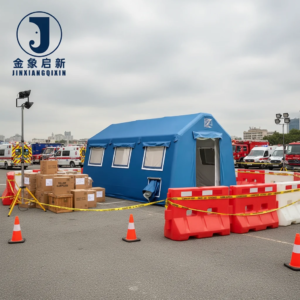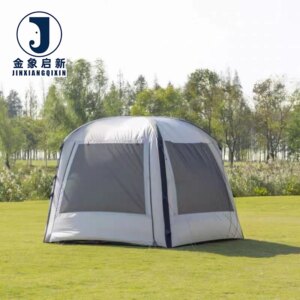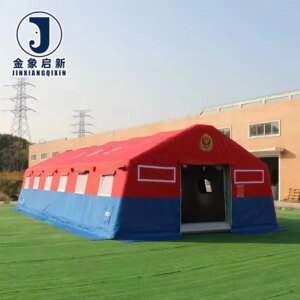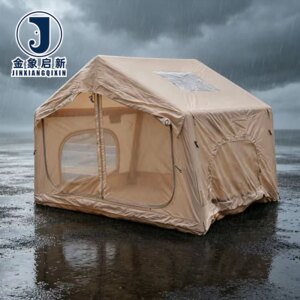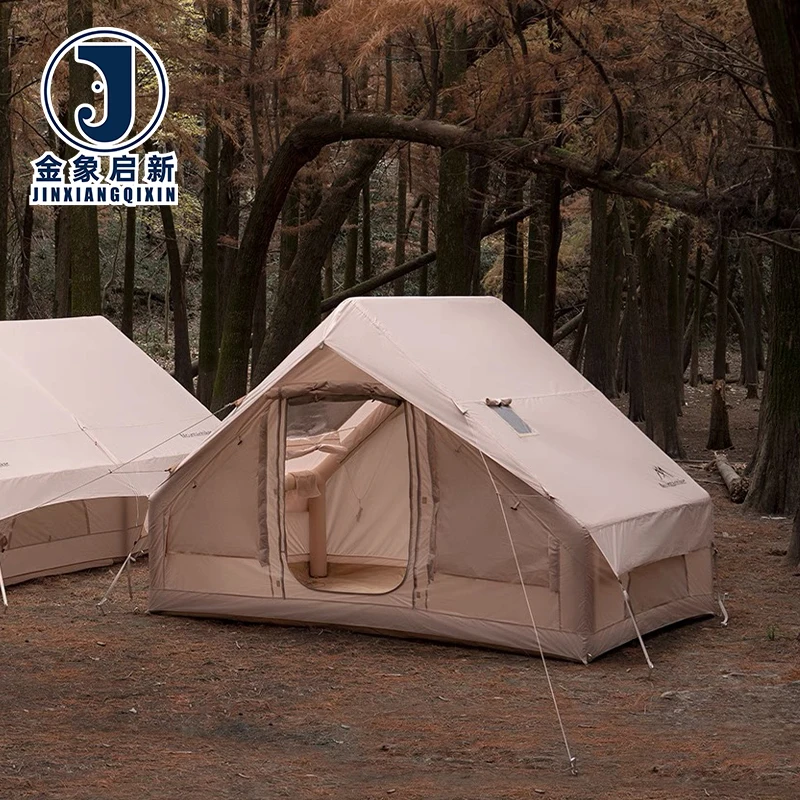
Coated Fabric Focus — Three full production lines and 36 sets of equipment delivering consistent PVC inflatable tent fabric with dedicated QA at every coating stage.
Technical Specifications
| Parameter | Value |
|---|---|
| Product Type | Inflatable Tent |
| Core Material | PVC tarpaulin |
| Capacity | 1-12 person |
| Material Thickness | 0.3mm-0.8mm (available across the range — confirm grade for your application) |
| Tear Strength | 200N force per ISO 13937-2 |
| Waterproof Rating | Tested per ISO 20811 |
| UV Resistance | Tested per ASTM D4329 |
| Usage Cycles | 300+ setup cycles |
| Customization | OEM & ODM, size adjustments, custom color matching, pattern printing |
| Quality Control | 12-point inspection during production |
| Certifications | ISO9001, ISO14001, ISO45001, CE |
Application Suitability
| Application | Exposure & Requirement |
|---|---|
| Fleet vehicle maintenance shelters | Rapid inflation cycles, ground abrasion, exposure to road salts and fluids |
| Transport equipment trailer integration | Repeated folding at flex points, wind load stress during deployment, UV exposure on tarmac |
| Loading dock temporary weather covers | Continuous moisture contact, forklift proximity puncture risk, daily setup and breakdown |
| Expedition base camp structures | Extended outdoor weathering, temperature fluctuation, high wind resistance requirement |
Why Batch Consistency Matters More Than Quoted Thickness for Inflatable Shelters
Uniform coating weight across every roll prevents seam failure during inflation.
Fleet operators deploying inflatable shelters across multiple vehicles expect every unit to behave identically under pressure. When coating thickness drifts between batches, heat-seam parameters that worked on the first batch burn through the next, or fail to bond entirely. Transport equipment builders integrating inflatable systems into trailer configurations cannot recalibrate fabrication settings for every shipment. [NEED_CITE: coating weight variance and heat-seam adhesion in PVC tarpaulin]
Weld Integrity Under Repeated Inflation Stress
Inflatable tent structures place continuous stress on welded seams at air chamber junctions. The PVC tarpaulin used in this Inflatable Camping Tent maintains bond strength through repeated pressurization and deflation cycles. Coating adhesion to the base fabric determines whether the seam holds or delaminates at the flex point. Fleet maintenance teams deploying these shelters daily need confidence that the weld line will not split before the fabric body reaches its service limit.
Fabric Behavior at Trailer Integration Points
Transport equipment builders mounting inflatable tent systems onto trailer frames require material that tolerates mechanical fastening and edge tension. The tear resistance verified at 200N force per ISO 13937-2 indicates how the fabric resists propagation once a fixing point introduces a stress concentration. Edge reinforcement and seam placement must align with the structural load path. [NEED_CITE: tear propagation behavior in coated fabrics under mechanical fastening]
Material Thickness Selection for Transport Shelter Demands
The 0.3mm-0.8mm thickness range serves different deployment scenarios within fleet and transport operations. Lighter grades suit rapid-deploy maintenance canopies where weight and pack-down volume matter. Heavier grades address semi-permanent loading dock shelters exposed to forklift traffic and sustained wind. The base fabric denier and coating weight together determine puncture resistance and inflation pressure tolerance — thickness alone does not define structural performance. Selecting the correct grade requires matching the specific abrasion and wind load conditions of the installation site.
The Hidden Cost of Underspecifying Inflatable Shelter Fabric
Choosing a material grade below what the deployment cycle demands leads to premature chamber failure. Coating that is too thin for the inflation pressure results in micro-leaks that increase compressor run time and energy consumption. Fabric that lacks verified UV resistance per ASTM D4329 degrades at mounting points where the material contacts metal frames, causing edge brittleness and tear initiation. Transport companies replacing entire shelter fleets mid-season absorb costs far beyond the initial material savings. [NEED_CITE: premature failure modes in PVC inflatable structures]
Why Transport Operators Source Inflatable Tent Fabric Here
Dedicated QA and QC staff conduct 12-point inspections during production, catching coating inconsistencies before they reach the welding table. The 10-person R&D team develops custom sizing and color samples within days, allowing fleet operators to verify material behavior before committing to full production runs. Three full production lines support volume orders for multi-vehicle fleet deployments without extended lead compromises. Every shipment includes pre-shipment inspection records tied to specific batch numbers, providing traceability across fleet inventory.
Documentation & Verification
- Material specification sheet listing base fabric denier, coating weight, and thickness grade per order
- UV resistance and waterproof test reports per ASTM D4329 and ISO 20811 included with batch documentation
- ISO9001, ISO14001, ISO45001, and CE certificates supplied for compliance submissions
- Pre-shipment inspection record with 12-point check results for each production batch
- Roll packing list with batch-specific identification for fleet inventory traceability
Fabrication, Handling & Storage
- Heat-seam temperature and dwell time must be validated against the specific PVC tarpaulin thickness grade before production runs begin
- Reinforced edge binding required at all mechanical fastening points to distribute load across the base fabric weave
- Store rolls upright on pallets to prevent flat-spot deformation that affects inflation chamber geometry
- Allow cold-stored material to reach ambient temperature before unrolling to avoid coating micro-cracking
- Clean with mild detergent only — solvent-based cleaners compromise the PVC coating surface and UV treatment layer
Request a Material Recommendation for Your Fleet Application
Specify the vehicle model or trailer dimensions, expected deployment frequency, and the environmental conditions at your primary operating locations. Indicate whether you require finished inflatable tent units or fabric rolls for in-house fabrication. Provide your target market so we can confirm applicable certification and test standard requirements. Confirm if color matching to existing fleet livery or custom pattern printing is needed for brand integration.
Frequently Asked Questions
Q: How do I verify tear strength matches the quotation when the inflatable tent fabric arrives?
A: Every shipment includes batch-specific inspection records from our 12-point production check. You can request a sample cut from your production batch for independent ISO 13937-2 testing. We recommend confirming the required tear strength value during the specification stage so the correct base fabric grade is selected before production begins.
Q: What custom sizing options exist for specific trailer and vehicle model fitment?
A: Our R&D team develops size-adjusted samples within days based on your vehicle dimensions and mounting configuration. Custom color matching and pattern printing are available with a minimum order of 50 units for most modifications. Pre-production sample approval ensures the fit and inflation behavior meet requirements before mass production.
Q: How is welded seam durability maintained during repeated inflation cycles?
A: Coating adhesion to the base fabric is controlled at every production stage to prevent delamination at seam junctions. The 200N tear strength per ISO 13937-2 provides a verified baseline for structural integrity at stress points. We recommend sharing your inflation pressure specifications so seam parameters can be calibrated to your deployment cycle.
Q: How do you ensure batch-to-batch color consistency across multi-unit fleet orders?
A: Color reference standards are established during sample approval and locked for the entire production run. The 12-point inspection includes visual comparison against the approved reference under controlled lighting. Batch-specific packing lists enable you to trace every unit back to its production run for consistency verification across your fleet inventory.