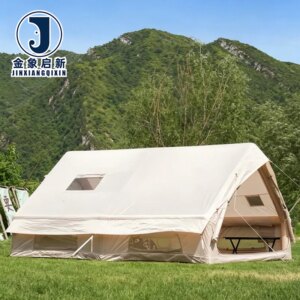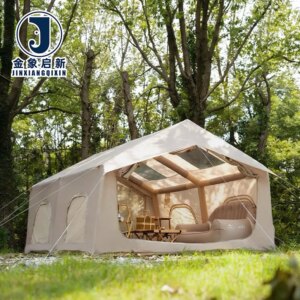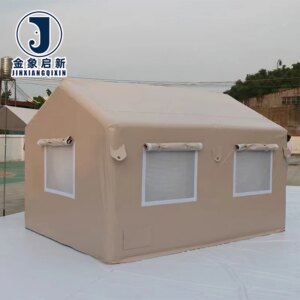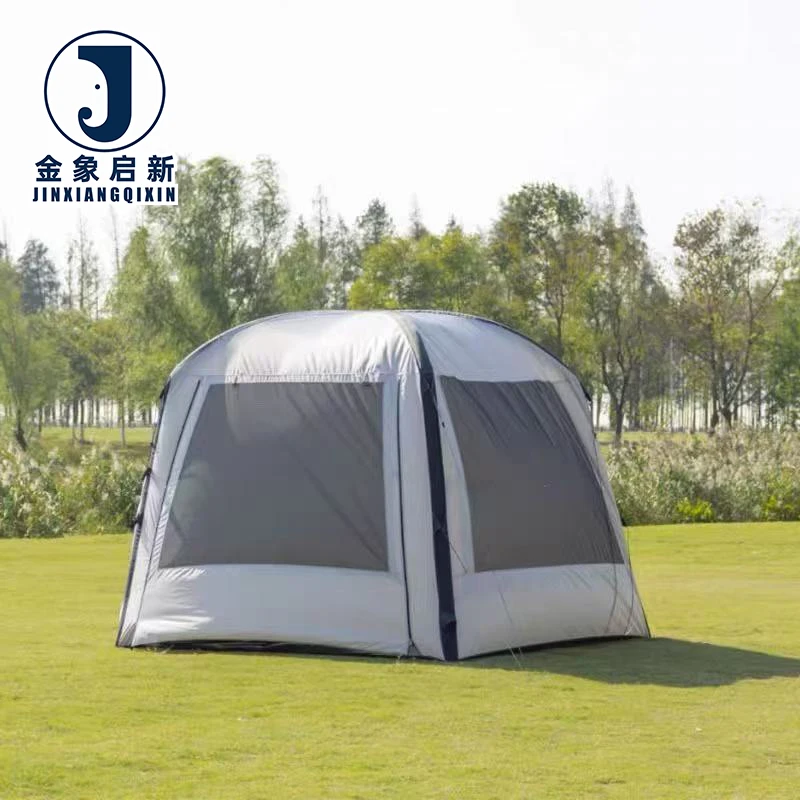
Coating Weight Control — Every roll of PVC tarpaulin leaving the Jinan facility passes through dedicated QA checkpoints, with coating weight verified against the stated GSM before the inflatable tent fabric is cut and welded.
Technical Specifications
| Parameter | Value |
|---|---|
| Product Type | Inflatable Tent |
| Core Material | PVC tarpaulin |
| Product Form | Inflatable structure with automatic opening mechanism |
| Material Thickness Range | 0.3 mm to 1.2 mm |
| Key Performance | Waterproof, UV-resistant, tear-resistant (test basis not stated — confirm test reports required for your market) |
| Customization Service | OEM & ODM (sample customization, pattern printing) |
| Production Lines | 3 full production lines |
| Processing Equipment | 36 sets of professional equipment |
| R&D Team | 10 technicians |
| Quality Control | Full-process inspection with dedicated QA & QC staff |
| Certifications | ISO 9001, ISO 14001, ISO 45001, CE |
Application Suitability
| Application | Exposure & Requirement |
|---|---|
| Event temporary shelters | Rapid deployment, repeated inflation cycles, public foot traffic abrasion, sun and rain exposure |
| Construction site field offices | Dust ingress, wind loading on inflatable beams, prolonged UV and thermal cycling |
| Promotional exhibition spaces | Visual consistency across panels, branded pattern printing, frequent teardown and storage |
| Outdoor hospitality and glamping | Four-season temperature swings, guest comfort expectations, long-term weathering on PVC membrane |
| Beach camping | Sand abrasion at base contact, salt spray corrosion on fittings, high UV index exposure |
| Fleet mobile field offices | Transport vibration during relocation, diesel exhaust residue on fabric surface, limited on-site labor |
Why a Generic PVC Inflatable Tent Size Costs You More Than You Think
An inflatable structure that does not match your site dimensions creates dead space, wind catch, and wasted heating.
Fleet operators and outdoor logistics contractors frequently order off-the-shelf inflatable shelters only to discover the footprint does not align with their loading dock clearance or trailer service bay width. The result is a PVC inflatable tent aftermarket supplier order that sits half-collapsed in high wind because the beam spacing was designed for a generic rectangle, not your actual ground plan [NEED_CITE: site-specific sizing versus generic inflatable structure dimensions]. When the inflatable tent for transport and outdoor commercial use is cut to OEM dimensions, every beam and panel aligns with the anchor points available on your concrete pad or truck deck, reducing the lateral load on the PVC envelope during gusts.
How Automatic Opening Changes Deployment on Multi-Site Rotations
When a transport fleet runs inflatable shelters across several depots in a single week, the labor cost of manual inflation and structural assembly compounds quickly. The automatic opening mechanism integrated into this PVC inflatable tent reduces the on-site crew requirement, allowing a two-person team to have the structure upright and anchored within a single setup cycle. This matters most when the inflatable tent for transport and outdoor commercial use is relocated between construction staging areas or event venues where every hour of downtime delays revenue-generating activity.
Thickness Selection Between 0.3 mm and 1.2 mm for Different Envelope Loads
The PVC tarpaulin used in this inflatable structure is available in thicknesses from 0.3 mm to 1.2 mm, and the correct choice depends on which part of the tent you are specifying. Inflatable beams that carry internal air pressure and resist buckling under wind load benefit from the heavier end of the range, while roof and wall panels that primarily shed water and block UV can use lighter grades to keep packed weight manageable. A 10-technician R&D team reviews each OEM request to match thickness to structural role, so the inflatable tent for transport and outdoor commercial use performs without excess material cost [NEED_CITE: coated fabric thickness and structural beam design for inflatable architecture].
Reading PVC Tarpaulin Specs Beyond the Thickness Number
Thickness alone tells you how much PVC sits on the base fabric, but the base fabric itself — its denier, weave density, and yarn count — determines how the material resists tearing once a puncture starts. A 0.6 mm coating on a loosely woven 500-denier base will tear more easily than a 0.5 mm coating on a tightly woven 1000-denier base, because the yarn spacing controls how far a rip propagates before the next cross-yarn arrests it. Coating adhesion method also matters: knife-over-roll coating produces higher peel strength than lamination, which means heat-welded seams on inflatable beams resist delamination during repeated inflation and deflation cycles. Surface finish — glossy or matte — affects both cleanability and pattern printing adhesion, so the choice should align with whether the tent will carry branded graphics or simply serve as a plain shelter in dusty construction environments.
What Happens When Welded Seams Fail Before the Fabric Does
Inflatable structures concentrate stress at the junctions where beams meet panels, and these are exactly the spots that flex the most during setup and teardown. If the heat-welding temperature or dwell time is calibrated for a different PVC formulation, the welded seam becomes the weakest link — the fabric survives, but the seam peels open under air pressure. This failure mode is especially common when a PVC inflatable tent aftermarket supplier switches tarpaulin batches without re-validating weld parameters. On this product, full-process quality inspection includes seam peel checks at every production stage, so the inflatable tent for transport and outdoor commercial use arrives with welds rated to match the parent fabric strength [NEED_CITE: weld peel strength testing methods for PVC coated fabrics].
Why Sourcing From a Coated-Fabric Specialist Matters for Inflatable Structures
Three full production lines and 36 sets of professional processing equipment give this facility the capacity to run OEM inflatable tent orders alongside standard tarpaulin rolls without queue conflicts. The 10-person R&D team handles material selection, pattern printing layout, and custom sizing in-house, which means sample development does not depend on an external design house. Dedicated QA and QC staff inspect every stage — coating weight, colour consistency across panels, weld integrity on inflatable beams — rather than relying on end-of-line spot checks. Sample production is available before bulk commitment, so you can verify fit, thickness, and print registration on a physical unit. Full documentation including ISO 9001, ISO 14001, ISO 45001, and CE certification ships with every order, satisfying compliance audits in regulated construction and event markets.
Documentation & Verification
- Material specification sheet confirming PVC grade, thickness, and base fabric denier for each inflatable tent order
- UV and tear-resistance test reports provided where applicable to support outdoor exposure claims
- ISO 9001, ISO 14001, ISO 45001, and CE certificates included with shipment paperwork
- Pre-shipment inspection record covering weld integrity and panel colour consistency
- Batch-specific coating weight verification against stated GSM before dispatch
- Certificate of origin and customs documentation for cross-border inflatable tent shipments
Fabrication, Handling & Storage
- Heat-weld inflatable beam seams using temperature and dwell settings validated for the specific PVC tarpaulin thickness ordered
- Store rolled inflatable tent panels flat or on wide-diameter cores to prevent permanent crease marks in the PVC coating
- Clean glossy-finish panels with mild detergent only; solvents can degrade the plasticiser in the PVC surface layer
- Inflate structures gradually in cold weather to allow PVC tarpaulin to reach flexibility before full internal pressure is applied
- Repair minor punctures with PVC-compatible adhesive patches matched to the coating thickness of the tent envelope
What to Include in Your Inflatable Tent Inquiry
Provide the exact ground dimensions and clearance height your site requires, along with the expected wind load and temperature range for your operating region. Specify whether pattern printing or branded graphics are needed on the roof or wall panels, and indicate the material thickness preference or let the R&D team recommend based on structural role. Confirm the target market so the correct fire classification and compliance documentation can be prepared before the PVC inflatable tent aftermarket supplier begins sample production.
Frequently Asked Questions
Q: What customization options are available for size, thickness, and printing on the inflatable tent?
A: The inflatable tent for transport and outdoor commercial use supports OEM sizing to match your exact site footprint. PVC tarpaulin thickness is selectable from 0.3 mm to 1.2 mm depending on whether the panel serves as a structural beam or a weather envelope. Pattern printing and branded graphics can be applied to roof and wall panels, with sample approval required before the bulk run begins.
Q: How do I access batch-specific quality inspection reports for my inflatable tent order?
A: Each order receives a pre-shipment inspection record that covers coating weight verification, weld peel strength, and colour consistency across all panels. These documents reference your order number and can be cross-checked against the material specification sheet provided at the quoting stage. Request the inspection package during the sample approval phase to confirm the documentation format your compliance team requires.
Q: What documentation is provided for international compliance when importing PVC inflatable tents?
A: Shipments include ISO 9001, ISO 14001, ISO 45001, and CE certificates alongside a certificate of origin and customs support documents. If your destination market requires specific fire classification or UV-resistance test reports, these are prepared during the sampling stage so the inflatable tent for transport and outdoor commercial use arrives with the correct paperwork for site inspection and regulatory approval.
Q: Can I request a physical sample before confirming a bulk inflatable tent order?
A: Yes. A sample unit is developed within days for custom sizing, thickness, and pattern printing requirements. The sample lets you verify PVC tarpaulin hand feel, weld quality on inflatable beams, and print registration before committing to full production. Approving the sample also locks in the heat-weld parameters used for your batch, ensuring consistency across the entire order.
Q: What is the typical lead time for a customized PVC inflatable tent order?
A: Lead time depends on the complexity of custom sizing, pattern printing scope, and the volume of units in the order. After sample approval, production runs on dedicated lines with full-process QA checkpoints at each stage. Confirm your required delivery date during the inquiry so the production schedule can accommodate any fire classification testing or additional documentation your market requires.