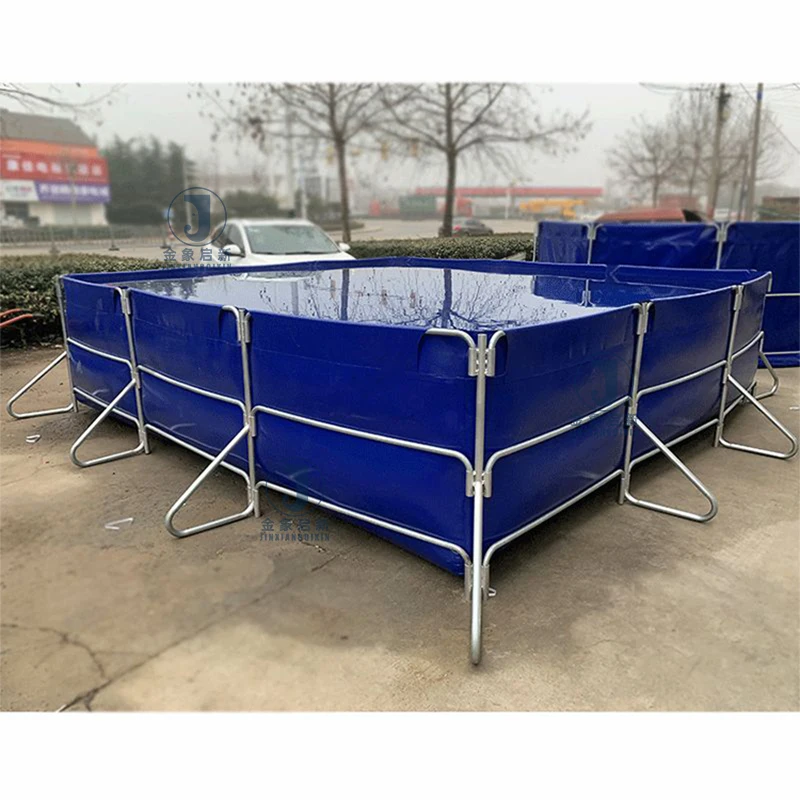
Coated Fabric Specialist — nearly 30 years of process control over PVC coating weight and adhesion, applied to fish pond liners that demand watertight seam integrity under transport conditions.
Technical Specifications
| Parameter | Value |
|---|---|
| Product Type | PVC Tarpaulin Pond Liner |
| Base Fabric Options | 500D×840D / 500D×1000D / 1000D×1000D / 1000D×1300D / 1300D×1300D / 1000D×2000D |
| Weight Range | 350 / 400 / 420 / 500 / 600 / 650 / 750 / 900 g/m² |
| Thickness Range | 0.29mm / 0.32mm / 0.38mm / 0.44mm / 0.46mm / 0.55mm / 0.65mm |
| Mesh Density | 20×20 / 30×19 / 30×15 |
| Warp Tensile Strength | 1650N – 3900N (test basis not stated) |
| Weft Tensile Strength | 1600N – 3500N (test basis not stated) |
| Coating | Double-sided PVC on polyester base fabric |
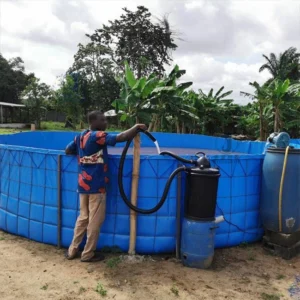
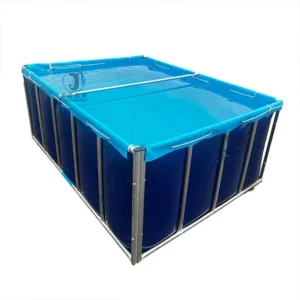
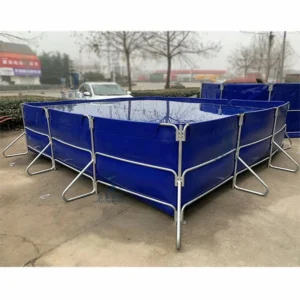
| Shape Options | Circular / Rectangular / Foldable |
| Key Features | Waterproof / Anti-UV (test basis not stated) / Flame Retardant (grade not stated) |
Application Suitability
| Application | Exposure & Requirement |
|---|---|
| Transport fleets carrying live aquaculture stock | Road vibration, flex-point stress, abrasion against trailer frames, constant water contact |
| Mobile fish farming operations | Repeated folding and unfolding, UV exposure during transit, puncture from handling equipment |
| Agricultural water containment on trailers | Dynamic load shifting, weather exposure, need for reliable watertight seals at seams |
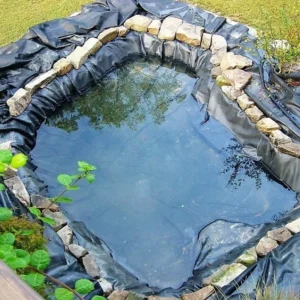
| Stock watering ponds relocated seasonally | Soil contact, standing water pressure, UV degradation risk during extended outdoor placement |
Why Seam Failure at Flex Points Undermines a Perfectly Good PVC Tarpaulin Fish Pond Liner
A liner is only as watertight as its weakest welded joint — and transport environments expose every joint to repeated flexing.
Fleet operators and aquaculture transporters regularly encounter a frustrating failure mode: the PVC fish pond tarpaulin fabric itself holds up, but the welded seams split where the load flexes most during transit. The liner arrives intact, gets loaded onto a trailer, and within a handful of trips the seams begin to weep or separate entirely. This is not a material defect — it is a construction and specification mismatch. When the base fabric denier, coating thickness, and welding parameters are not matched to the dynamic stresses of road transport, the seams become the failure point rather than the fabric. [NEED_CITE: tensile and tear test methods for coated fabrics per ISO 1421]
How Base Fabric Denier Determines Liner Behaviour Under Road Vibration
The polyester base fabric is the structural skeleton of every PVC tarpaulin fish pond liner. Lower denier options such as 500D×840D produce lighter, more flexible liners that fold easily and suit shallow tanks or short-haul relocation. Higher denier constructions including 1000D×2000D deliver substantially greater resistance to the sustained vibration and load-shifting forces encountered on long-haul trailer transport. Choosing the correct denier is not about selecting the heaviest option — it is about matching the fabric structure to the specific transport profile and pond depth.
What Double-Sided PVC Coating Delivers for Water Containment in Transit
Double-sided PVC coating on the polyester base fabric provides continuous waterproof sealing across the entire liner surface. For fleet operators transporting live fish or aquaculture stock, this means water containment integrity is maintained even when the trailer frame flexes over uneven road surfaces. The coating encapsulates the base fabric on both faces, preventing water ingress into the yarn structure that would otherwise lead to biological growth, odour retention, and accelerated degradation of the polyester core. [NEED_CITE: DIN 4102 fire classification for building materials and coated textile testing]
Reading the Specification Sheet: What GSM, Denier, and Density Actually Tell You
GSM alone does not define how a PVC tarpaulin fish pond liner will perform. A 500 g/m² liner built on a 1000D×1000D base with 20×20 mesh density will behave very differently from a 500 g/m² liner on a 500D×840D base at 30×19 density. The first concentrates more coating mass on a heavier yarn structure, producing higher tensile resistance but less flexibility. The second distributes coating across a finer weave, yielding a more pliable liner better suited to folding. Mesh density interacts with coating penetration — tighter weaves can limit coating adhesion between yarn intersections, while more open weaves allow deeper PVC encapsulation but may sacrifice surface smoothness. Understanding these relationships prevents specification mismatches that lead to premature liner failure.
The Hidden Cost of Specifying a Liner Without Matching It to the Transport Frame
When a pond liner is cut to a generic size that does not match the specific trailer or tank frame, the consequences compound quickly. Excess material bunches at corners, creating fold lines where abrasion concentrates. Insufficient material stretches taut across frame edges, placing sustained tension on welded seams at precisely the points where road vibration is most aggressive. Either scenario accelerates seam failure — and the liner is typically blamed rather than the sizing mismatch. Fleet operators who specify pond liners without providing exact frame dimensions end up replacing liners far more frequently than necessary. [NEED_CITE: field reports on coated fabric failure modes in transport applications]
Why Procurement Verification Matters for Aquaculture Transport Liners
Every PVC fish pond tarpaulin order shipped from this facility passes through dedicated QA/QC at each production stage with 100% inspection before dispatch. The 10-person R&D team handles material selection and custom sizing to ensure each liner matches the transport frame it will serve. Three full production lines and 36 sets of professional equipment support consistent coating weight control across the entire order — meaning roll-to-roll consistency is maintained even when multiple liners are required for a fleet. Deep process control over coating adhesion means the welded seams are tested to withstand the flex-point stresses specific to transport environments, not just static water containment.
Documentation & Verification
- Material specification sheet stating exact GSM, base fabric denier, and coating weight per liner ordered
- Pre-shipment inspection record confirming seam weld integrity and dimensional accuracy against trailer frame specifications
- Test report for UV treatment where applicable, documenting the test basis for the anti-UV claim
- ISO and CE certificates included with shipment documentation package
- Roll packing list with individual liner identification for multi-unit fleet orders
Fabrication, Handling & Storage
- Hot air welding parameters must be matched to the specific GSM grade — heavier grades require higher temperature and dwell time settings
- Folded pond liners should be stored flat and avoid sustained compression to prevent permanent crease lines in the PVC coating
- When deploying foldable liners on trailers, allow the material to acclimatise and relax before final seam sealing at edges
- Field repairs to the double-sided PVC coating are achievable with portable hot air welding equipment rather than full liner replacement
- Avoid dragging liners across abrasive trailer surfaces during installation — lift and position to protect the coating face
Requesting a Liner Specification That Matches Your Fleet
Provide the exact internal dimensions of the trailer frame or tank structure, the intended pond depth when loaded, and the typical transport distance and road conditions. If your operation requires UV treatment or flame retardant grades for specific market compliance, state the applicable standard so the correct grade is specified. Confirm whether you need pre-cut circular or rectangular liners, or roll stock for on-site fabrication.
Frequently Asked Questions
Q: How do I confirm the GSM of the liner I receive matches what was quoted?
A: Request a pre-shipment inspection record that documents weight verification per roll or per cut liner against the stated GSM. Every production stage includes QA/QC checkpoints, and 100% inspection is completed before dispatch. If your order requires third-party verification, this can be arranged before the shipment leaves the facility.
Q: What documentation supports the anti-UV claim on these pond liners?
A: Anti-UV treatment is available across the PVC tarpaulin fish pond liner range, but the specific test basis must be confirmed for your market requirements. Request the applicable test report with your quotation so you can verify the UV stability claim is documented rather than merely stated. Different markets require different testing standards.
Q: Can pond liners be cut to fit specific trailer frames rather than generic sizes?
A: Yes. Custom sizing is available for circular and rectangular configurations. Provide the exact internal frame dimensions and required water depth so the liner is patterned to your transport equipment. This eliminates the excess material bunching or over-stretching that causes premature seam failure on generic-cut liners.
Q: How are welded seams protected against failure during road transport?
A: Hot air welding creates a homogeneous bond between PVC coating layers rather than a mechanical stitch that can unravel. The welding parameters are calibrated to the specific GSM grade and base fabric denier of your liner. Pre-shipment inspection includes seam weld verification at the flex points most likely to experience stress during transit.
Q: Can I order multiple pond liners with consistent colour across the entire fleet order?
A: Colour consistency across multiple liners within the same order is addressed through dedicated batch control during coating production. Specify your colour requirement at the quotation stage and request roll-to-roll colour confirmation documentation. This prevents visible variation when multiple pond liners are installed side by side at your facility or across your fleet.