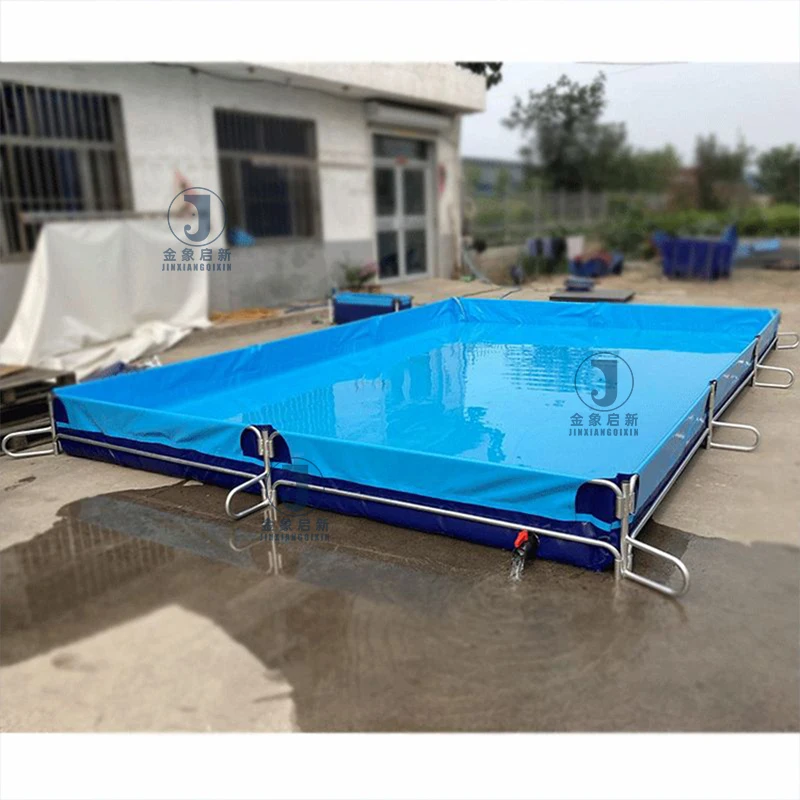
Roll-to-Roll Consistency — verified coating weight and adhesion testing on every PVC coated tarpaulin roll before dispatch, preventing batch variation across your fabrication line.
Technical Specifications
| Parameter | Value |
|---|---|
| Product Type | PVC Tarpaulin Fish Tank Pond Liner |
| Material Base | High-strength polyester mesh fabric |
| Weight Range Available | 350gsm / 420gsm / 500gsm / 550gsm / 600gsm / 750gsm |
| Thickness Range Available | 0.32mm / 0.35mm / 0.4mm / 0.45mm / 0.5mm / 0.65mm |
| Roll Width | 2m / 2.1m |
| Roll Length | 75m (for 2m width) / 50m (for 2.1m width) |
| Coating Technology | Laminated technology & hot-melt coating technology |
| Color Options | Blue / Red / Yellow / Light Blue / Grey (customizable) |
| Flame Retardant | Available as special treatment — confirm the grade required for your market (grade not stated in source) |
| Key Features | Cold crack resistance, anti-mildew, anti-static treatment, waterproof, sunproof |
| Certifications | ISO, CE |
Application Suitability
| Application | Exposure & Requirement |
|---|---|
| Commercial fish ponds and tanks | Permanent water contact, bio-fouling, fish activity abrasion, need for watertight seams |
| Aquaculture shrimp farms | Saline water exposure, soil chemistry interaction, puncture risk from substrate |
| Agricultural water reservoirs | UV exposure, algae growth, temperature fluctuation, long-term water containment |
| Irrigation storage ponds | Sediment abrasion, seasonal filling cycles, mechanical damage during maintenance |
| Fabricated portable fish tanks | Welded seam integrity under water pressure, folding and unfolding stress |
Why Generic Pond Liners Fail at the Seams Before the Fabric Does
Welded seams on pond liners typically fail because the fabric flexes under water pressure at the stress points, not because the material itself tears. When you specify a PVC pond liner for fish tank or aquaculture use, the coating adhesion to the base fabric determines whether the seam holds longer than the panel. Hot-melt coating technology bonds the PVC to the polyester mesh at a molecular level, producing peel strength that resists the cyclic loading water pressure applies to every weld line. [NEED_CITE: peel strength testing methods for coated fabrics per ISO 1421]
I have seen aquaculture operators replace entire pond liners within the first season because the seams delaminated while the fabric body remained intact. The failure is almost never the PVC itself — it is the interface between the coating and the base yarn, and the heat-weld parameters used on-site. Generic liner material sourced without verified coating weight leaves you guessing at the correct weld temperature and dwell time, which changes as the material composition varies between batches.
How Coating Adhesion Affects Your Pond Fabrication
Hot-melt coating technology fuses the PVC layer directly into the high-strength polyester mesh, rather than simply pressing a film onto the surface as laminated methods do. For PVC pond liner for fish tank fabrication, this matters because every welded seam depends on the PVC coating melting uniformly and bonding to the adjacent panel. If the coating adhesion is weak, the seam peels apart under hydrostatic pressure long before the base fabric reaches its tear limit. This is why the coating method is just as critical as the GSM when you evaluate roll stock for pond construction.
What Water Pressure Does to Your Weld Lines
A filled pond exerts continuous outward and downward force on every seam, with the highest stress concentrating at corners, drain fittings, and any change in liner direction. The outstanding tearing strength of this PVC coated polyester fabric at welded zones is specifically relevant here — when a seam is heat-welded correctly, the tear resistance at the weld should approach that of the parent material. Without verified weld testing data, fabricators rely on visual inspection alone, which cannot predict how the joint will behave once the pond is filled and the liner settles into the substrate over time. [NEED_CITE: tensile and tear test methods for coated fabrics per ISO 1421]
Reading GSM and Base Fabric Together
The weight in GSM tells you how much PVC coating is applied per square metre, but it does not tell you how that weight is distributed between coating and base fabric. A heavier grade with a loosely woven mesh may have more PVC but less structural yarn, resulting in lower tear resistance than a lighter grade with a denser base. For pond liners, the base fabric denier and weave density determine puncture resistance from sharp stones or root penetration, while the coating weight determines chemical resistance and weldability. Both must be confirmed on the material specification sheet before you commit to a roll purchase.
The coating method further influences how GSM translates to real-world performance. Hot-melt coated fabric achieves higher adhesion values because the PVC penetrates the mesh structure during application, locking into the yarn interstices. Laminated fabric may show the same GSM on paper but can have a distinct separation layer between film and mesh, which becomes the weak plane when the liner is folded or when a seam is stressed during installation.
The Real Cost of Unverified Specifications on Pond Projects
Specifying a PVC pond liner for fish tank or aquaculture use without confirming the coating weight against the delivered roll creates a cascade of downstream problems. Material that arrives lighter than quoted will have thinner PVC layers, reducing puncture resistance and shortening the interval before pinhole leaks develop. Worse, if the coating formulation differs between what was quoted and what was shipped, your established heat-weld parameters will produce inconsistent seams — some fusing correctly, others delaminating weeks after the pond is filled. [NEED_CITE: impact of GSM variation on coated fabric mechanical properties]
Batch colour variation across rolls in the same pond project is visible once panels are welded side by side, particularly in lighter colours used for ornamental or display ponds. This is not an aesthetic concern alone — colour variation between rolls often signals inconsistency in the PVC compound mix, which correlates directly with variation in coating weight and weld behaviour across the batch.
Why Sourcing This PVC Pond Liner Fabric Through Jinxiang
Three full production lines and 36 sets of professional equipment maintain consistent coating application across the full GSM range available, so the roll you receive matches the specification on the quotation. The 10-person R&D team develops samples within days when you need to confirm weld compatibility, colour match, or custom sizing before committing to a production run. Dedicated QA and QC inspection occurs at every production stage, with a pre-shipment record confirming the GSM weight on every roll against the stated value.
Nearly 30 years of focused coated fabric production means the process control over coating weight and adhesion is not learned on your order — it is established. ISO and CE certified production with full documentation support ensures your procurement file is complete before the material leaves the facility. Custom widths, lengths, and colours are produced to order with the same inspection rigour as stock grades, eliminating the compromise between availability and specification accuracy.
Documentation & Verification
- Material specification sheet stating exact GSM, base fabric denier, and colour reference for each roll
- Pre-shipment inspection record confirming weight verification per roll against the quoted value
- Test report for anti-UV or flame-retardant grades where applicable to your market requirements
- Roll packing list with batch identification for traceability across your pond fabrication projects
- Certificate of origin and customs documentation to support international shipment clearance
Fabrication, Handling & Storage
- Heat-weld at temperatures suited to the specific GSM grade — heavier grades require higher dwell time for full PVC fusion at the seam
- Store rolls horizontally on pallets to prevent edge compression marks that transfer into visible creases on installed pond liners
- Allow cold-stored rolls to acclimatise before unrolling — cold crack resistance is a feature, but rigid PVC at low temperature resists flat lay-out
- Use compatible PVC welding tape for patch repairs on-site, matching the coating technology to maintain adhesion continuity
- Plan cutting layout around 2m or 2.1m roll widths to minimise welded seams in high-stress pond floor zones
- Clean fabricated ponds with mild detergent only — anti-mildew treatment can degrade under aggressive chemical contact
What We Need to Quote Your Pond Liner Requirement
Provide the application environment — freshwater fish pond, saline aquaculture, or agricultural water storage — along with the expected water depth and substrate conditions. Confirm your target GSM or let us recommend a grade based on the puncture and seam strength your installation demands. Specify whether you need roll stock for your own fabrication or custom-cut panels with welded seams to drawing dimensions.
Let us know your colour requirement and whether multiple rolls must match across a single project. If your market requires flame-retardant or certified anti-UV grades, state the standard so we can confirm the available treatment and provide the relevant test documentation with your sample.
Frequently Asked Questions
Q: How do I verify the GSM weight matches what was quoted on my pond liner rolls?
A: Every roll ships with a pre-shipment inspection record confirming the measured GSM against the quotation value. You can independently verify by cutting a measured sample from the roll edge and weighing it on a calibrated scale. We provide the base fabric weight and coating weight breakdown on the material specification sheet so you can confirm the coating proportion matches your specification.
Q: Can you provide test reports for UV and anti-mildew treatments on pond liner fabric?
A: Test reports for anti-UV treatment are available where the grade has been specified and tested — confirm the standard required for your market or application. Anti-mildew performance is included as a standard feature of the coating compound. Request the specific test report for your compliance file when you place your inquiry, and we will supply documentation matched to the roll batch.
Q: What welding methods work best for fabricating custom fish tank shapes from this material?
A: Hot-air welding and high-frequency welding both produce strong seams on this PVC coated polyester fabric, with the hot-melt coating technology providing excellent adhesion at the weld zone. The correct temperature and speed settings depend on the GSM grade you select — heavier grades require more heat input. Request a sample roll section to run weld tests on your equipment before committing to full production.
Q: How do you ensure colour consistency across multiple rolls in a large pond project?
A: Rolls within a single production batch are coated from the same PVC compound mix, which controls colour variation. We record the batch reference on every packing list for traceability. For large projects requiring multiple production runs, we retain a colour reference sample from the first batch to match subsequent runs against, and we confirm the match before dispatch.
Q: What is the minimum order for custom width or colour pond liner rolls?
A: Custom widths and colours are produced to order with minimums that depend on the specific GSM grade and the width requested. Stock widths in 2m and 2.1m carry lower minimums and shorter lead times. Submit your required width, colour reference, and annual volume when you inquire, and we will confirm the minimum order quantity alongside the production lead time.