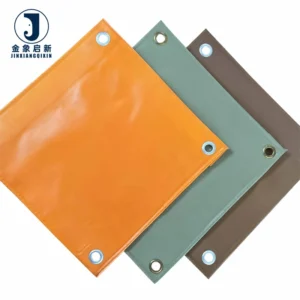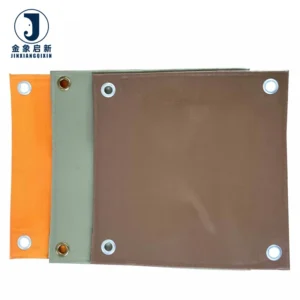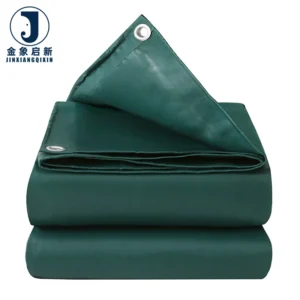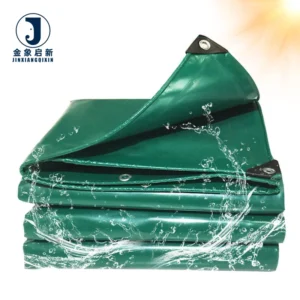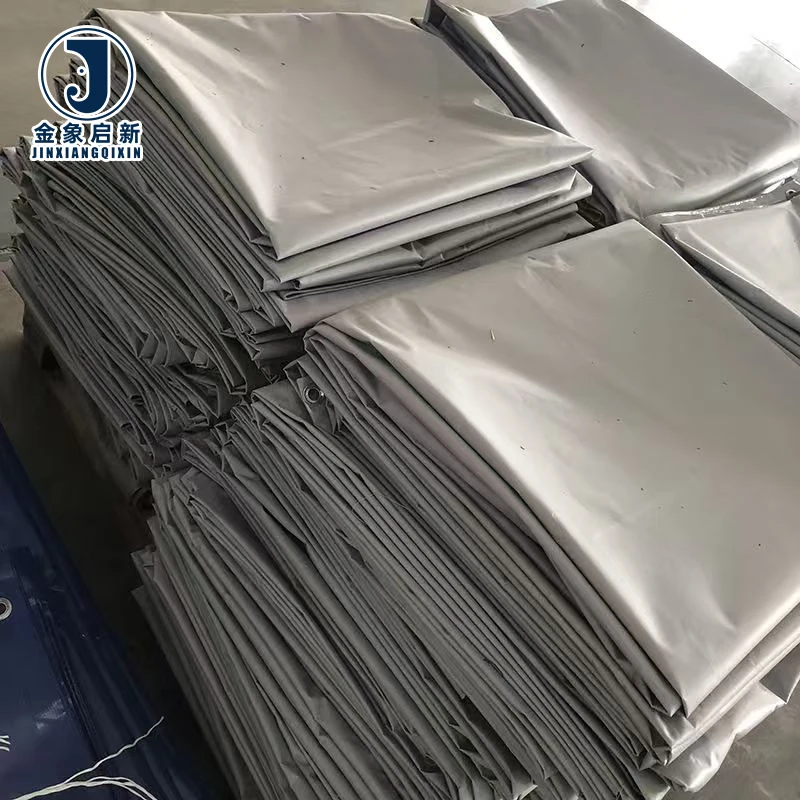
Coating Process Control — Every roll of PVC Trailer Tarpaulin for Trucks passes through dedicated QA checkpoints where coating weight and adhesion are verified against specification before reaching the cutting table.
Technical Specifications
| Parameter | Value |
|---|---|
| Product Type | PVC Coated Tarpaulin |
| Base Fabric | 100% high toughness polyester yarn |
| Coating Material | PVC |
| Coating Technology | Lamination and hot melt coating |
| Standard Sheet Size | 12m × 12m |
| Weight | 650gsm |
| Total Thickness (medium-duty) | 0.35–0.45 mm |
| Total Thickness (heavy-duty) | 0.70–1.0 mm |
| Total Thickness (super heavy) | 1.2–1.5 mm |
| Knitting Density (medium-duty) | 500D |
| Knitting Density (heavy-duty) | 1000D |
| Knitting Density (super heavy) | 500D–2000D |
| Tensile Strength (medium-duty) | Warp 1500–2000 / Weft 1200–1800 N/5cm |
| Tensile Strength (heavy-duty) | Warp 2000–2500 / Weft 1800–2200 N/5cm |
| Tensile Strength (super heavy) | Warp 2500–3000 / Weft 2200–2800 N/5cm |
| Welding Tear Strength | Excellent (no standard stated) |
| Eyelet & Hem Finish | Reinforced eyelets and hems included |
| Key Features | Waterproof, cold resistant cracking, mold proof |
| Treatment Options | Flame retardant grades, anti-static grades, UV treatment (3–5 years weather resistance) — confirm the grade required for your market |
| Color Options | Custom color available |
| Standards | ISO, CE |
Application Suitability
| Application | Exposure & Requirement |
|---|---|
| Long-haul truck and trailer load covering | Constant road vibration, wind load at speed, UV exposure, rain ingress at seams |
| Fleet side curtain fabric | Repeated flex cycles at load-bearing points, abrasion against cargo edges, tie-down strap tension |
| Transport equipment OEM fitment | Model-specific cut dimensions, consistent colour across production batches, weld seam integrity under flex |
| Bulk agricultural load protection | Moisture exposure during transit, strap compression on organic loads, seasonal temperature swings |
| Construction material transport | Abrasive contact with steel and masonry loads, crane hook proximity, site dust contamination |
Why a Generic-Size PVC Trailer Tarpaulin for Trucks Costs Your Fleet More Than You Think
A cover that does not match your trailer bed dimensions forces compromises at every tie-down point.
Fleet operators frequently order truck covers in standard widths and lengths, then discover on the loading bay that excess material flaps in the wind at motorway speed while load edges remain exposed at the corners. Straps pull unevenly across bunched fabric, concentrating stress at the eyelets and accelerating tear propagation. [NEED_CITE: tarpaulin failures at eyelet and hem stress points in transport applications]. The result is a reorder cycle that was never budgeted for, and cargo claims that could have been prevented with a dimension-specific sheet.
Cut-to-Model Fitment Eliminates On-Site Guesswork
Every trailer model has a distinct bed length, side profile height and tie-down rail position. When a PVC Trailer Tarpaulin for Trucks is cut to those exact dimensions, the eyelets align directly with the strap anchor points on the vehicle, distributing load evenly across the hem. This removes the need for operators to fold, tuck or clip excess fabric — practices that create abrasion hotspots where the cover rubs against itself during transit.
Heat-Welded Seams Where the Load Flexes Most
The highest stress on any truck cover occurs at the points where cargo shifts and the fabric flexes under strap tension. High-frequency welding fuses the PVC coating layers into a continuous bond, so the seam strength tracks closely with the base fabric tensile rating. Stitched seams, by contrast, introduce needle holes that become failure origins under cyclic loading. [NEED_CITE: high-frequency welding versus stitched seam performance in coated transport fabrics].
Coating Adhesion as the Real Durability Indicator
The 650gsm weight of this PVC Trailer Tarpaulin for Trucks results from the combined mass of the polyester base fabric and the PVC coating applied through lamination and hot melt coating technology. What matters on the road is not just the total weight but how firmly the coating bonds to the yarn. Delamination at the coating-to-fabric interface exposes the polyester core to moisture and UV degradation, leading to premature stiffness and cracking in cold conditions.
How Base Fabric Density and Coating Weight Interact on the Road
The tensile strength figures across the medium-duty, heavy-duty and super heavy grades reflect the combined contribution of knitting density and PVC coating mass. A 1000D base fabric distributes strap load across more yarns per centimetre, reducing the chance of a single yarn failure propagating into a full-width tear. The hot melt coating fills the interstices of the weave, adding dimensional stability and preventing the fabric from stretching out of shape under sustained tension. Knitting density alone does not determine tear resistance — the coating must penetrate fully and bond uniformly to lock the yarn crossings in place [NEED_CITE: tensile and tear test methods for coated fabrics per ISO 1421]. Where flame retardant or anti-static treatment is specified, the additive package must be compatible with the PVC formulation to avoid compromising coating adhesion over time.
What Happens When Cover Specifications Miss the Mark
A PVC Trailer Tarpaulin for Trucks that arrives lighter than the quoted GSM means the coating layer is thinner than specified, reducing both abrasion resistance and waterproofing reliability at the weld seams. Colour variation between rolls in a single fleet order becomes visible the moment two covers are installed side by side on adjacent trailers — a cosmetic issue that signals inconsistent coating formulation and raises questions about treatment uniformity. [NEED_CITE: batch colour consistency standards in PVC coated fabric production]. Missing fire-retardant or anti-static certification documentation can halt a vehicle at a compliance checkpoint, delaying delivery schedules and triggering contractual penalties. These are not material defects in the conventional sense — they are specification-to-delivery gaps that only emerge when the sheet reaches the fleet operator.
Why Source PVC Trailer Tarpaulin for Trucks Through This Facility
Three full production lines and 36 sets of professional equipment support bulk capacity with reliable on-time delivery for fleet-scale orders. A 10-person R&D team handles material selection, custom sizing and sample development, enabling dimension-specific cut sheets matched to individual trailer models. Dedicated QA and QC inspection at every production stage with 100% pre-shipment inspection ensures GSM, dimensions and eyelet placement are verified before dispatch. Nearly 30 years of focused coated fabric production provides deep process control over coating weight and adhesion consistency. Samples are developed within days for custom requirements, allowing fleet operators to validate fit and finish before committing to a production run.
Documentation & Verification
- Material specification sheet stating 650gsm weight, polyester base fabric and PVC coating details
- Pre-shipment inspection record covering 12m × 12m dimensions and eyelet spacing
- Test report for flame retardant or anti-static grades where specified for fleet compliance
- Roll packing list with individual sheet identification for multi-vehicle fleet orders
- Certificate of origin and customs documentation for cross-border fleet procurement
Fabrication, Handling & Storage
- High-frequency welding parameters must match 650gsm coating thickness for consistent seam bond strength
- Eyelet spacing should align with specific trailer tie-down rail positions to distribute strap load evenly
- Store rolls flat in shade to prevent permanent creasing in the PVC coating layer
- Allow cold-stored sheets to reach ambient temperature before unfolding to avoid coating cracking
- Use mild detergent only; solvent cleaners can degrade the hot melt coating surface bond
- Repair minor field damage with compatible PVC patch kits matched to coating formulation
What to Include With Your Enquiry
Provide the exact trailer make, model and bed dimensions along with tie-down rail positions so the sheet can be cut to match. Specify any fire-retardant or anti-static grade required by your operating region or client contract. Confirm the quantity per colour and whether you need finished sheets with eyelets or roll stock for your own fabrication line. Indicate your target dispatch date so production scheduling can account for custom colour matching and sample approval cycles.
Frequently Asked Questions
Q: How is the 650gsm weight verified before dispatch?
A: Every roll undergoes coating weight measurement during production, and the pre-shipment inspection record confirms the final GSM against the quotation specification. Sample swatches from each batch are retained for reference.
Q: Can sheets be cut to fit specific trailer model dimensions?
A: Yes. Provide the trailer make, model, bed length, width and side height. The R&D team develops a cutting pattern with eyelet placement matched to your vehicle tie-down points, and a sample is produced for fit approval before the full order runs.
Q: What eyelet spacing and hem reinforcement options are available?
A: Eyelet spacing is configured to your trailer tie-down rail layout. Hems are heat-welded and reinforced with additional PVC layers at load-bearing edges. Spacing intervals and reinforcement width are confirmed during the sample approval stage.
Q: How is colour consistency maintained across multiple sheets in one fleet order?
A: All sheets in a single order are coated from the same PVC batch formulation. The QA team compares colour reference samples under controlled lighting at both the coating stage and pre-shipment inspection to flag any deviation before dispatch.
Q: What fire-retardant or anti-static certification can be supplied for road transport compliance?
A: Flame retardant and anti-static treatments are available in grades suited to transport applications. Specify the standard required by your operating jurisdiction — such as regional transport safety regulations — and the relevant test report is included with the shipment documentation.