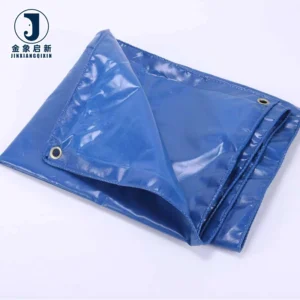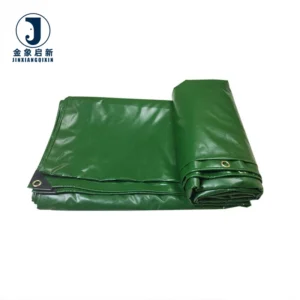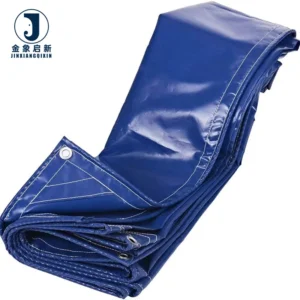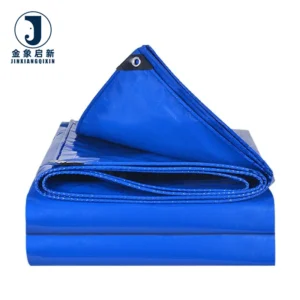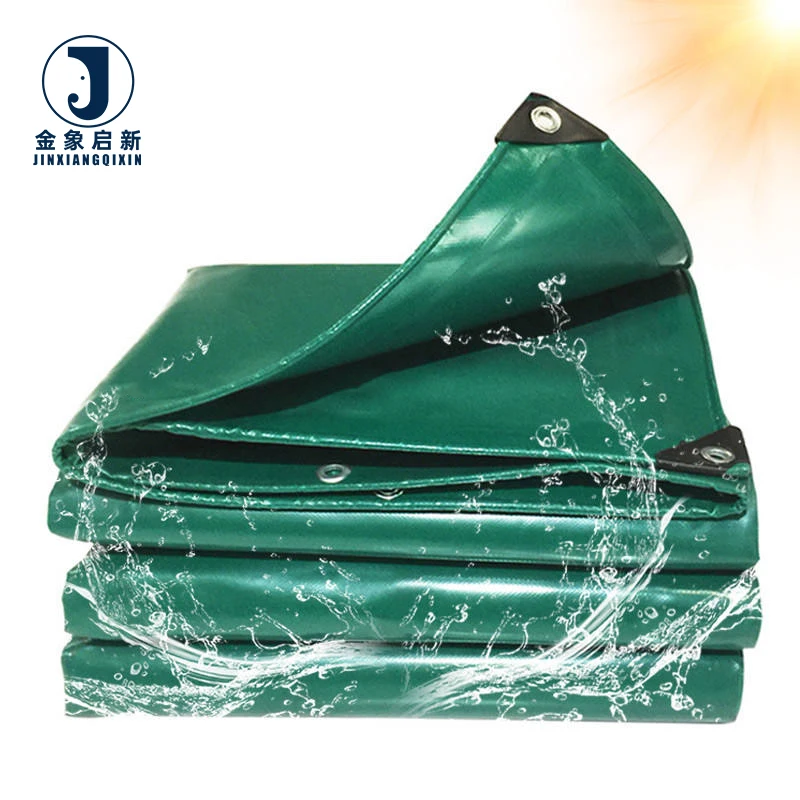
Truck-Ready Edge Construction — heat-sealed seamless edge wrapping and 3cm enlarged aluminum alloy buttonholes address the highest-stress failure points on transport covers where loads flex most during transit.
Technical Specifications
| Parameter | Value |
|---|---|
| Product Type | PVC Coated Tarpaulin |
| Material | Polyester Base Fabric + Double-Sided PVC Coating |
| Weight Range | 350 / 400 / 420 / 500 / 600 / 650 / 750 / 900 GSM |
| Yarn Count Options | 500D×840D / 500D×1000D / 1000D×1000D / 1000D×1300D / 1300D×1300D / 1000D×2000D |
| Thickness Range | 0.29mm – 0.65mm (varies by grade) |
| Warp Tensile Strength | 1650N – 3900N (varies by grade) |
| Pick (Weft) Tensile Strength | 1600N – 3500N (varies by grade) |
| Density | 1.15 – 2.00 g/cm³ |
| Brittle Temperature | ≤ -50 to -60℃ |
| Softening Temperature | ≥ 80℃ |
| Melting Point | 212℃ |
| Coating Method | High frequency hot melt / Hot air / Sewing |
| Key Features | Waterproof, Fire Retardant (grade not stated), Anti UV (test basis not stated), Heavy Metal Free, Anti Mildew, Flexible, Heavy Duty, Self Clean |
| Edge Construction | 5mm thick rope without splicing, high temperature heat sealed seamless edge wrapping |
| Eyelet & Reinforcement | 3cm enlarged aluminum alloy buttonhole, brass eyelets every 1 meter, reinforced corners on all sides |
| Printing | Printable, Customized |
| Repairability | Repairable by hot air welding |
Application Suitability
| Application | Exposure & Requirement |
|---|---|
| Truck and trailer cover | Road debris impact, UV exposure, wind flap, tie-down tension at eyelets |
| Side curtain for transport | Constant flexing at fold points, abrasion against cargo frame, weather ingress |
| Pallet and equipment cover during transit | Vibration, stacking compression, moisture during open-yard staging |
| Outdoor event and block-out tent | Wind load on fabric panels, UV exposure, repeated rigging and dismantling |
| Awnings and rain shelter | Sustained UV, water pooling on horizontal spans, thermal expansion |
| Carriage and army tent | Multi-environment deployment, rapid field erection, abrasion from ground contact |
Why Generic-Size Truck Covers Cost More Than Custom Fit
A PVC coated tarpaulin for truck and transport cut to your exact trailer model eliminates the slack that causes wind flap, abrasion, and premature eyelet pull-out.
Fleet operators frequently receive covers that are labelled to fit a trailer category rather than a specific chassis. The excess material flaps at highway speed, wearing against the cargo frame and accelerating fabric fatigue at fold points. Tie-down straps over loose fabric concentrate load on individual eyelets instead of distributing tension across the hem, which is where most field failures originate [NEED_CITE: tensile and tear test methods for coated fabrics per ISO 1421]. Sizing a PVC coated tarpaulin for truck and transport to the actual vehicle model, with eyelet spacing matched to the tie-down rail, removes this failure mode entirely.
Reinforcement Where Transport Loads Flex Most
The highest stress on any PVC coated tarpaulin for truck and transport occurs at the edge where the fabric meets the tie-down system and at fold lines where a side curtain concertinas during opening. This range uses high temperature heat sealed seamless edge wrapping, which bonds the hem without relying on adhesive that can crack under repeated thermal cycling. Reinforced corners on all sides add material layers at the points where strap tension concentrates, reducing the chance of corner tear-out during transit.
Matching Denier and Tensile to Trailer Duty Cycle
Transport applications differ widely in the mechanical demand they place on fabric. A light urban delivery trailer that opens and closes a dozen times daily subjects a side curtain to flex fatigue, requiring a fabric with strong weft tensile and good low-temperature flexibility. A long-haul flatbed cover faces sustained wind load and UV exposure, demanding higher warp tensile and UV treatment. The available yarn count options from 500D×840D through 1000D×2000D allow specification by the actual tensile demand of the route and load type [NEED_CITE: DIN 4102 fire classification for building materials].
Reading the Specification Table Like a Technical Buyer
Weight alone does not define the strength of PVC coated tarpaulin for truck and transport. Two fabrics at the same GSM can have very different tensile performance depending on the base fabric denier and mesh density. A 650 GSM grade built on 1000D×1300D yarn will carry higher tensile loads than the same weight woven from finer yarns, because the thicker filaments resist break propagation. Coating method also matters: high frequency hot melt produces a uniform bond between the PVC layer and the polyester scrim, supporting reliable heat-sealed seam construction in the field. The brittle temperature rating of -50 to -60℃ indicates the fabric remains flexible during cold-climate winter transit, while the softening point at 80℃ sets the upper thermal boundary for storage near heat sources or in direct summer sun on dark-coloured covers.
What Happens When Specification Does Not Match the Load
Specifying a lighter GSM grade to reduce material cost on a long-haul trailer cover often leads to early failure at the weld seams, because the fabric cannot sustain the tie-down tension without stretching and concentrating stress at the hem. Colour variation between rolls in the same fleet order becomes visible once covers are installed side by side on adjacent trailers, requiring re-dyeing or replacement. Flame retardant treatment claimed without a supporting test report can cause a load to fail site safety inspection at a mine or construction depot, delaying the entire shipment. These are specification errors, not manufacturing defects, and they are avoidable with correct grade selection at inquiry stage [NEED_CITE: field failure analysis of coated fabric transport covers].
Procurement Advantages Specific to This Range
Deep process control over coating weight and adhesion means the GSM stated on your quotation matches the material that arrives, verified at pre-shipment inspection. Three full production lines with 36 sets of professional equipment support bulk roll capacity for fleet-wide orders while maintaining on-time dispatch. The 10-person R&D team handles pattern printing, custom sizing to specific trailer models, and sample development so that fit and colour are confirmed before bulk production. Dedicated QA/QC at every production stage with 100% inspection before shipment catches colour drift, coating inconsistency, and edge defects before the roll leaves the facility. Samples are developed within days for custom size, colour, and print requirements, reducing the risk of committing to a specification that does not match the actual vehicle.
Documentation & Verification
- Material specification sheet confirming GSM, base fabric denier, coating type, and colour reference per roll
- Test report for UV and flame retardant grades supplied where applicable to your market
- Pre-shipment inspection record documenting weight verification against stated GSM before dispatch
- Roll packing list with individual roll dimensions and net weight for container loading planning
- Certificate of origin and customs documentation for cross-border transport shipments
Fabrication, Handling & Storage
- Use hot air welding at 500–600℃ for field repairs on PVC coated tarpaulin seams to maintain waterproof integrity
- Space 3cm aluminum alloy buttonholes to match the trailer tie-down rail pitch, avoiding concentrated strap load
- Store rolls upright on pallets to prevent flat-spot deformation of the PVC coating layer
- Allow cold-stored rolls to acclimatise before unrolling to avoid cracking below the -50℃ brittle threshold
- Clean with mild detergent only; solvent-based cleaners degrade the self-clean surface treatment
- Plan cutting layout on full-width rolls to minimise cross-grain seams at high-stress flex zones
Before You Send an Inquiry
Provide the specific truck or trailer model, the tie-down system type, and the typical route climate so the correct GSM grade and treatment can be recommended. If flame retardant or anti-static certification is required by the destination site, state the applicable standard at inquiry stage. Indicate whether you need finished covers cut to vehicle dimensions or fabric by the roll for in-house fabrication, and whether colour matching or printed branding is required across a fleet order.
Frequently Asked Questions
Q: How do I choose the correct GSM and denier for my truck or trailer application?
A: Match the grade to the mechanical demand of the route. Light urban delivery with frequent curtain operation suits lower GSM with finer denier for flex fatigue resistance. Long-haul flatbed covers exposed to sustained wind load require higher GSM with heavier yarn counts like 1000D×1300D or above. Provide your trailer model and route profile so the correct grade can be recommended.
Q: Can truck covers be cut to fit specific trailer models rather than generic sizes?
A: Yes. Covers are sized to the exact chassis and body dimensions of your truck or trailer, with eyelet spacing matched to the tie-down rail pitch. This eliminates the excess fabric that causes wind flap and premature abrasion. Confirm the vehicle model, body length, and tie-down configuration at inquiry stage for accurate pattern development.
Q: What test reports support UV and flame retardant treatment claims?
A: Test reports for UV resistance and flame retardant grades are provided where applicable to your market requirements. Specify the standard required by your destination site — such as a local building code or mining safety regulation — at inquiry stage so the correct treatment grade and documentation can be matched to your order.
Q: How is colour consistency maintained across multiple rolls for a fleet order?
A: Colour reference is documented on the material specification sheet, and dedicated QA/QC inspects every production stage for colour drift. A 100% pre-shipment inspection compares rolls side by side before dispatch. For fleet-wide orders requiring visible uniformity, request a sample approval step before bulk production begins.
Q: What is the lead time and minimum for custom width, colour, or printed tarpaulin?
A: Lead time and minimum depend on the grade, width, and print complexity. Custom samples are developed within days so fit, colour, and print quality can be confirmed before bulk commitment. Contact with your target quantity, colour reference, and required certification to receive a quotation with specific production scheduling.