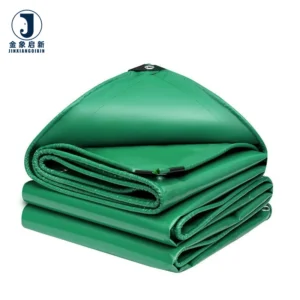
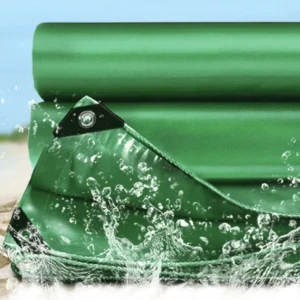
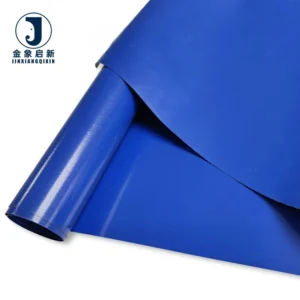
Precision Knife Coating — 36 sets of professional coating and welding equipment supporting heavy-duty PVC knife coated tarpaulin roll production with verified GSM and batch colour consistency for fleet cover fabrication.
Technical Specifications
| Parameter | Value |
|---|---|
| Product Type | PVC Coated Tarpaulin |
| Coating Method | Knife Coated |
| Coating Material | PVC |
| Surface Finish | Self-Cleaning System |
| Flexibility | Highly flexible, resistant to cracking |
| Tensile & Tearing Resistance | Excellent (test basis not stated) |
| Peeling Resistance | Excellent |
| Welding Compatibility | HF, Hot Air, Sewing |
| Fire Retardant | Available in flame retardant grades — confirm the grade required for your market |
| UV Resistance | Available with UV treatment — request test report for verification |
| Mildew & Antibacterial | Yes |
| Oil & Stain Resistance | Yes |
| Acid & Alkali Resistance | Yes |
| Temperature Range | High temperature and cold resistance |
| Weather Resistance | Anti-oxidation and weather resistant |
Application Suitability
| Application | Exposure & Requirement |
|---|---|
| Truck and trailer side curtains | Constant flexing, road abrasion, UV exposure, wind load stress at weld seams |
| Custom-fit truck covers | Weather exposure during transit, tie-down tension at flex points, repeated folding |
| Tensile and membrane structures | Permanent outdoor tension, wind uplift, pooled water drainage, architectural aesthetic |
| Portable storage and hangar covers | Large unsupported spans, thermal cycling, abrasion from structural frame contact |
Why Weld Integrity Matters More Than Fabric Weight for Truck Covers
A truck cover fails at the seam long before the fabric gives way — knife coated construction keeps seam strength matched to base tensile.
Fleet operators have seen heavy-grade PVC coated fabric tear along the weld line after months of road vibration, even when the main body of the cover remains intact. The flex points on a trailer side curtain endure thousands of articulation cycles per journey, concentrating mechanical stress exactly where panels join. PVC knife coated tarpaulin for truck and trailer cover fabrication requires a coating method that bonds fully through the base fabric weave, not just onto the surface, so that high-frequency and hot air welding creates a fused joint rather than a surface melt [NEED_CITE: tensile and tear test methods for coated fabrics per ISO 1421].
Knife Coated Construction for Seam-Critical Fabrication
The knife coating process applies PVC paste directly into the interstices of the woven polyester base fabric, filling the gaps between yarn bundles before the surface coat is laid down. This creates a mechanical lock between coating and substrate that directly influences how the material behaves under high-frequency or hot air welding. When fabricators heat-weld panels for truck side curtains or load covers, the fused coating at the joint must carry the same tension as the surrounding fabric. PVC knife coated tarpaulin produced through this method supports consistent weld strength across long seam runs, reducing the likelihood of delamination at flex points on moving loads.
Flex Durability Under Road and Yard Conditions
Truck covers and side curtains undergo continuous deformation from load shifting, cornering forces, and wind buffeting during transit. The PVC formulation used in this knife coated tarpaulin roll maintains flexibility across temperature variations encountered in transport environments, from cold-start mornings to sustained highway exposure in direct sun. A self-cleaning surface finish reduces the accumulation of road grime, diesel soot, and environmental deposits that would otherwise require aggressive chemical cleaning. Mildew proof and antibacterial treatment prevents biological growth on fabric stored in damp yard conditions between trips, while oil and stain resistance protects against accidental contact with lubricants and hydraulic fluids during loading operations [NEED_CITE: DIN standard for flexibility testing of coated textiles].
Reading the Specification Sheet Beyond GSM
Coating weight stated in GSM tells you the total mass per square metre, but it does not isolate the contribution of the base fabric versus the PVC layer. A high GSM driven primarily by thick coating with a light base fabric will behave differently under tearing stress than the same GSM achieved with a heavy denier yarn and thinner coat. Knife coating allows independent control over both variables, giving fabricators the ability to select a grade where tensile strength and tear resistance are balanced for the intended application. The peeling resistance achieved through knife coating directly affects how the material handles post-fabrication stress, particularly at welded seams where layer separation would compromise waterproof integrity. Acid and alkali resistance ensures the PVC surface does not degrade when exposed to industrial atmospheres or cleaning agents used in fleet maintenance bays.
The Hidden Cost of Specifying on Price Per Roll Alone
Selecting PVC coated fabric for truck covers based solely on quoted GSM or unit cost often reveals problems only after fabrication and installation. Rolls that arrive lighter than specified force fabricators to either absorb the loss or re-order, delaying fleet delivery schedules. Coating applied through lamination rather than knife coating may show acceptable peel strength on the test sample but separate at weld lines once the cover is tensioned on a trailer frame. Colour variation between rolls in a single order becomes visible when adjacent side curtain panels are hung side by side on a fleet vehicle, requiring partial replacement. Requesting material specification sheets and pre-shipment inspection records before production begins eliminates these downstream costs [NEED_CITE: batch consistency standards for coated fabric in transport applications].
Production Control and Verification for Fleet Orders
Three full production lines equipped with 36 sets of professional coating and finishing machinery support consistent output across bulk roll orders, with dedicated QA/QC at every stage from base fabric inspection through to final winding. A 10-person R&D team handles material selection and sample development, enabling fabricators to verify weld parameters and colour matching before committing to full production runs. Samples for custom widths, colours, or fire retardant grades are developed within days, allowing truck cover manufacturers to confirm fitment against specific trailer dimensions. Every roll undergoes 100% inspection before dispatch, with coating weight, colour consistency, and surface finish checked against the order specification. Nearly 30 years of focused experience in coated fabric production provides the process depth needed to maintain batch-to-batch reliability across repeat fleet orders.
Documentation & Verification
- Material specification sheet confirming GSM, base fabric denier, and PVC coating weight per roll
- Test report for UV treatment or flame retardant grade where applicable to the order
- Pre-shipment inspection record covering colour consistency, width, and surface quality
- ISO and CE certificates included with dispatch documentation for customs and compliance
- Roll packing list detailing individual roll weights, lengths, and batch references
Fabrication, Handling & Storage
- HF and hot air welding both compatible — adjust temperature and dwell time to PVC knife coated layer thickness
- Sewn seams require UV-stable thread matched to the self-cleaning surface treatment chemistry
- Store rolls horizontally on racking to prevent flat-spot deformation of the coated surface
- Allow cold-stored rolls to acclimatise before unrolling to avoid creasing in the PVC coating layer
- Cut panels with allowance for weld seam overlap, typically 25-40 mm depending on welding method
- Clean with mild detergent only — avoid solvents that attack the oil and stain resistant surface
What We Need to Specify Your Order
Provide your trailer model dimensions and annual roll volume so we can recommend the appropriate grade and width for minimum waste in your cutting layout. If your market requires flame retardant certification, state the specific grade or standard your end customer demands. Let us know whether you need rolls in standard stock colour or a custom colour match, and whether sample rolls are required to verify weld parameters on your equipment before full production.
Frequently Asked Questions
Q: How can I verify the GSM of the PVC knife coated tarpaulin roll on arrival matches what was quoted?
A: Request the material specification sheet with your order, which states GSM, base fabric weight, and coating weight separately. Jinxiang conducts 100% pre-shipment inspection with weight verification per roll before dispatch. If you need independent confirmation, a cut sample from each delivered roll can be weighed on a calibrated scale against the documented specification.
Q: Which welding method works best for truck side curtain seams — HF, hot air, or sewing?
A: High-frequency welding produces the strongest bond for long seam runs on truck side curtains, fusing the PVC coating through the base fabric weave. Hot air welding suits shorter joins and field repairs. Sewing is used where mechanical fastening is preferred, but thread selection must account for UV exposure. Sample panels help you confirm which method matches your fabrication setup.
Q: Can I get custom widths and colours with consistent batch matching across a fleet order?
A: Custom widths and colours are produced on dedicated coating runs with batch-to-batch consistency verified before shipment. The 10-person R&D team develops samples within days so you can approve colour and finish before full production. Ordering your full fleet requirement as a single production batch eliminates roll-to-roll colour variation that becomes visible when panels are installed adjacent to each other.
Q: Do flame retardant rolls come with a test report I can submit for compliance?
A: Flame retardant grades are available with test documentation — specify the standard required for your market when requesting a quotation. The test report accompanies the dispatch documentation, listing the grade achieved and the testing standard applied. Confirm the specific fire classification your end customer or local authority demands before placing your order.
Q: How does UV treatment affect long-term appearance on fleet vehicles exposed to road conditions?
A: UV treatment is incorporated into the PVC coating to reduce degradation from sustained sun exposure during transit and yard storage. Request the UV test report to verify the treatment basis and expected performance level. The self-cleaning surface finish further reduces grime accumulation that can accelerate UV-related discolouration over extended fleet service life.