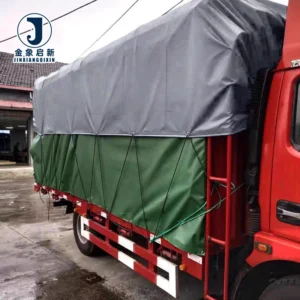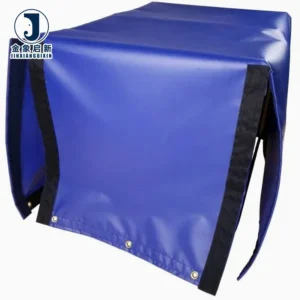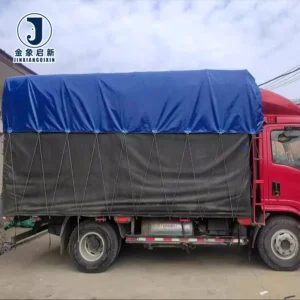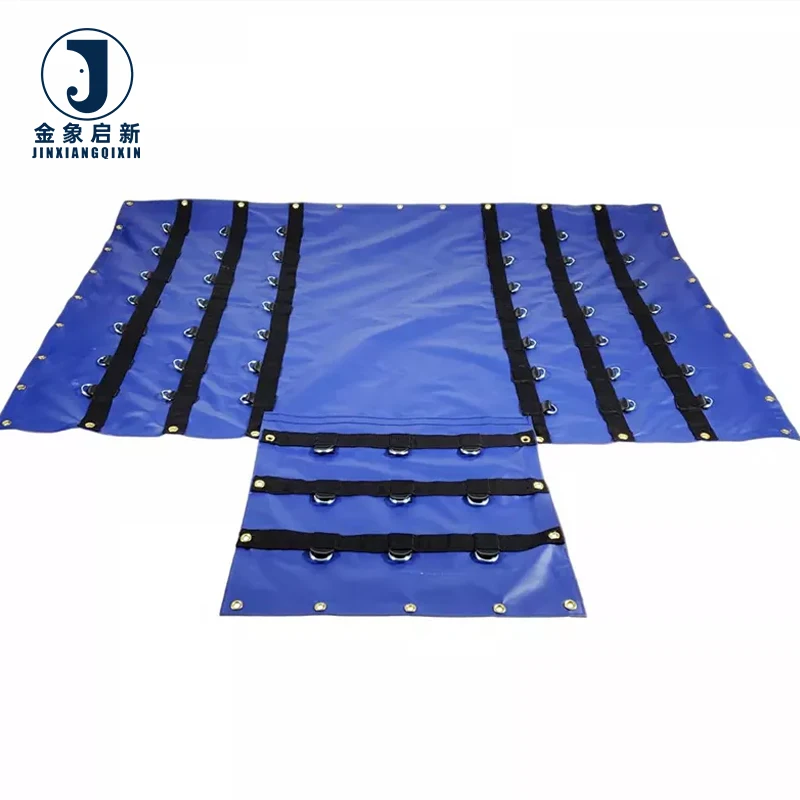
Trailer-Specific Fitment — cut to flatbed dimensions with a verified 8ft drop so lumber loads stay enclosed at highway speed.
Technical Specifications
| Parameter | Value |
|---|---|
| Product Type | PVC Lumber Tarpaulin 8ft. Drop with 3 Rows of D-Rings |
| Dimensions | 24′ X 27′ (with 8 ft. drop) |
| Base Fabric | 1000 x 1000D / 20×20 weave |
| Coating Material | PVC |
| Weight (GSM) | 610gsm / 18 ounces |
| Thickness | 0.70-1.0 mm |
| Tensile Strength | Meridian 2000-2500 N/5cm, Latitude 1800-2200 N/5cm |
| Temperature Range | -35 ~ 70 °C |
| Hardware | 3 Rows of D-Rings |
| Key Features | Tail wing flap, waterproof, acid-resistant, available in black or blue |
Application Suitability
| Application | Exposure & Requirement |
|---|---|
| Flatbed lumber transport | Road debris impact, heavy rain, constant UV exposure, wind drag at speed |
| Wall panel and building material hauling | Abrasion at load edges, tall profile coverage, secure tie-down on long hauls |
| Long-distance freight on irregular loads | End flap exposure, multi-point strapping tension, temperature fluctuation across regions |
Why a Flatbed Lumber Load Needs a Model-Specific PVC Lumber Truck Cover for Flatbed Trailer
A generic-size tarp leaves the rear face of a stacked lumber load exposed, and the edges flap loose within the first fifty miles.
When a PVC Lumber Truck Cover for flatbed trailer is cut to a standard rectangle without accounting for deck height and load profile, the result is predictable. The rear of the timber stack catches crosswinds, the tie-down straps pull through unreinforced fabric, and moisture seeps in through the gap at the tail. I have reviewed field returns where the cover was simply the wrong drop depth for the load, leaving the bottom courses of lumber open to road spray and salt. The tail wing flap on this tarp wraps the rear face fully, removing that gap. [NEED_CITE: aerodynamic drag and load shift risk on flatbed trailers with exposed rear cargo faces]
Deep Drop and Tail Wing Coverage for Tall Stacks
The 8ft drop on this PVC Lumber Truck Cover for flatbed trailer is engineered for stacked lumber and wall panels that sit high on a flatbed deck. The extra depth allows the fabric to hang well past the load edge, and the integrated tail wing flap folds over the rear face to close off the most exposed point. This configuration keeps the PVC Lumber Truck Cover for flatbed trailer tight against the load rather than billowing in the slipstream.
Three-Row D-Ring Layout for Multi-Point Securing
D-ring placement determines whether the cover stays put under strap tension. Three rows of D-rings distribute the tie-down load across the tarp body instead of concentrating it along a single edge line. [NEED_CITE: tie-down point distribution and fabric stress concentration in heavy-duty transport covers] The spacing on this PVC Lumber Truck Cover for flatbed trailer aligns with standard flatbed stake and rail positions, so straps engage at multiple heights without leaving unsupported spans of fabric that can catch wind and tear.
Understanding the Base Fabric and Coating Construction
The 1000 x 1000D base fabric with a 20×20 weave provides a dense grid that resists tear propagation in both directions. Coating weight at 610gsm paired with this base density means the PVC compound penetrates the weave fully, creating a mechanical bond between coating and yarn. This bond is what holds the fabric together at welded seams and D-ring attachment points under repeated flexing. The 0.70-1.0 mm thickness range places this material in the heavy-duty transport grade, balancing pliability for folding with the stiffness needed to resist abrasion against rough-cut timber edges.
What Happens When the Drop Depth Is Wrong
If the drop is too short for the load height, the bottom courses of lumber are left open to rain and road grime. If the D-ring rows do not align with the trailer’s tie-down rails, operators are forced to strap through the fabric body, which cuts the cover within a few trips. [NEED_CITE: common failure modes of flatbed tarpaulins under mismatched tie-down geometry] These failures are not material defects — they are specification errors made at the ordering stage, and they are entirely avoidable when the PVC Lumber Truck Cover for flatbed trailer is built to match the trailer model and typical load profile.
Why Procurement Teams Source This Cover Here
Every PVC Lumber Truck Cover for flatbed trailer is inspected at each production stage, with 100% pre-shipment checks covering D-ring pull strength and weld seam integrity at the flex points most likely to fail in service. The 10-person R&D team handles model-specific sizing and D-ring layout confirmation, developing samples within days so fleet operators can verify fit before committing to bulk. Three full production lines and 36 sets of equipment support consistent output across repeat orders, meaning the second batch matches the first in colour, drop depth, and hardware placement. Material specification sheets are issued with every order, stating the exact GSM, base fabric, and coating weight so there is no guesswork on arrival.
Documentation & Verification
- GSM verification sheet per roll confirming 610gsm against the stated quotation
- D-ring pull strength and welded seam test records included in pre-shipment inspection
- ISO and CE certificates shipped with order documentation
- Material specification sheet listing base fabric denier, weave count, and coating weight
- Certificate of origin and customs documentation for cross-border freight
Fabrication, Handling & Storage
- Heat-weld seams at D-ring zones using temperatures matched to 0.70-1.0 mm PVC coating thickness
- Fold the 24′ X 27′ cover with the tail wing flap inside to avoid permanent crease lines across the coating
- Store rolls or folded covers off concrete floors to prevent acid-resistant coating contact with alkaline surfaces
- Clean with mild detergent only — solvents degrade the PVC coating bond on 1000 x 1000D base fabric
- Inspect D-ring webbing reinforcement patches before each trip, replacing any showing yarn separation
Specify Your Flatbed Cover Requirements
Provide the exact trailer make, model, deck length, and typical load height so the drop depth and tail wing dimensions can be confirmed. State the operating climate range and whether flame-retardant grades are required for your route jurisdictions. Indicate the quantity per order and whether colour consistency across multiple covers is needed for fleet branding.
Frequently Asked Questions
Q: How is GSM verified on arrival to match the quotation?
A: Each PVC Lumber Truck Cover for flatbed trailer ships with a material specification sheet stating the exact GSM, base fabric denier, and coating weight. Buyers can weigh a cut sample on arrival and cross-reference the result against the documented 610gsm specification to confirm consistency.
Q: Can the drop length and tail wing be customised to fit specific trailer models?
A: Yes. The 8ft drop and tail wing dimensions are adjusted based on the trailer deck height and the typical load profile you provide. A sample is produced within days for fit confirmation before the full production run begins.
Q: How are D-rings reinforced to prevent pull-through under tension?
A: Each D-ring is anchored with a webbing reinforcement patch that distributes load across a wider area of the 1000 x 1000D base fabric. Pull strength is verified during the pre-shipment inspection to confirm the hardware holds under rated strap tension.
Q: How are welded seams tested to prevent failure at load flex points?
A: Welded seams at high-flex zones — where the cover folds over load edges — are tested for peel strength and inspected for coating adhesion during the 100% pre-shipment check. This targets the failure point most common in flatbed transport covers.
Q: What documentation ships with the tarp for compliance and warranty?
A: Orders include a material specification sheet, pre-shipment inspection record, ISO and CE certificates, and a certificate of origin. These documents support customs clearance, fleet compliance audits, and warranty claims.