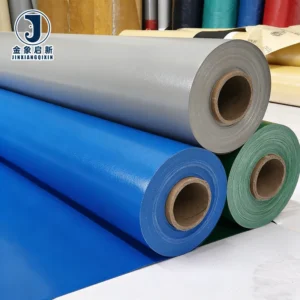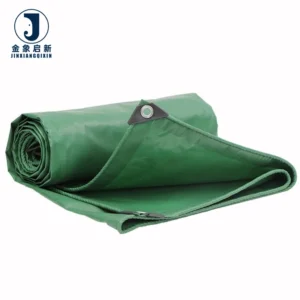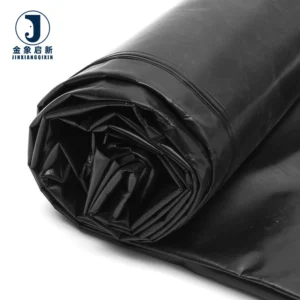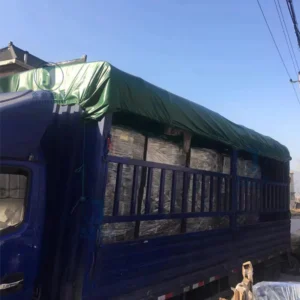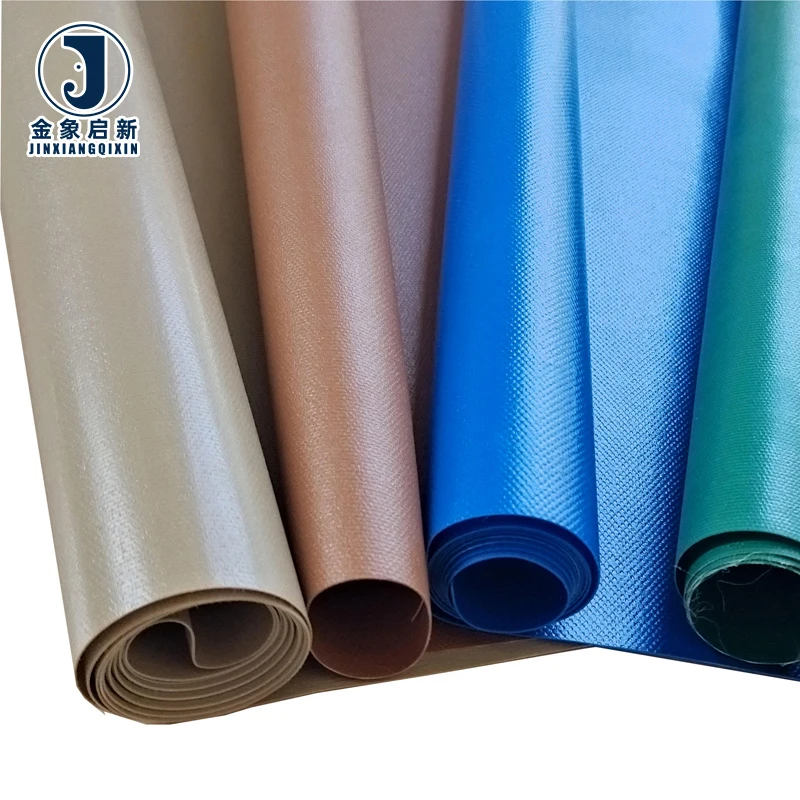
Fabrication Consistency — Every 500gsm roll is inspected for coating weight and adhesion before dispatch, ensuring truck cover fabricators receive material that matches the quoted specification from first to last metre.
Technical Specifications
| Parameter | Value |
|---|---|
| Product Type | PVC Coated Tarpaulin Roll |
| Base Fabric | 1000D polyester |
| Weight | 500gsm |
| Waterproof Rating | Anti-permeable ≥20KPa |
| Low-Temperature Flexibility | Flexible without fracture at -30℃ |
| Flame Retardant | ≤10 seconds (grade not stated — confirm standard required) |
| Seam Construction | High-frequency heat welded |
| Coating Material | PVC |
| Water Absorption | Negligible, quick drying |
| Anti-Mildew | Treated |
| Chemical Resistance | Acid, alkali and brine corrosion resistant |
Application Suitability
| Application | Exposure & Requirement |
|---|---|
| Truck side curtain | Constant flexing at load points, road spray, abrasion against cargo |
| Trailer flatbed cover | Wind uplift tension, tie-down strap friction, UV and rain exposure |
| Boat and marine cover | Salt spray, prolonged moisture contact, mildew risk in storage |
| Lumber tarp | Heavy point loads from timber stacks, forklift contact, outdoor staging |
| Carport and roof cover | Static water pooling, thermal expansion and contraction, wind shear |
Why Heat-Sealed Seams Fail First on Transport Covers — and What to Do About It
High-frequency heat bonding creates a seam that flexes with the fabric instead of cracking against it.
Fleet operators replacing tarps every season often find the material itself is intact while the welded seams have split open. This happens when the coating chemistry does not bond properly under heat, or when the seam is thinner than the surrounding fabric at the point the load flexes most. [NEED_CITE: tensile and tear test methods for coated fabrics per ISO 1421] A PVC tarpaulin roll for truck and transport cover must hold together at the weld line through thousands of vibration cycles on the road, not just pass a static peel test in the lab.
Base Fabric Density and Road Load Performance
The 1000D polyester base fabric provides the structural backbone for any truck cover fabricated from this roll. Higher denier yarns resist the concentrated point loads that occur when cargo shifts against the inside of a side curtain during braking or cornering. For fleet operators running long-haul routes, the base fabric integrity determines whether the PVC tarpaulin roll for truck and transport cover survives the full service interval or needs mid-cycle replacement. The weave density works together with the PVC coating to distribute stress across multiple yarn intersections rather than letting it concentrate at a single puncture point.
Coating Adhesion Under Repeated Flex Cycles
The PVC coating on this roll is engineered for high-frequency heat welding, which means the material reaches a consistent bonding temperature across the seam width without scorching or under-curing. When a trailer curtain flexes at every suspension movement, the weld line undergoes the same bending stress as the body fabric. Poor adhesion between the coating and the base yarns shows up as delamination starting at the seam edge. [NEED_CITE: coating adhesion test methods for PVC coated polyester fabrics] This fabric maintains coating-to-yarn bond through the thermal cycling that occurs during both fabrication and daily road use.
Reading the Specifications That Actually Matter for Fleet Tarps
The 500gsm weight reflects the combined mass of the 1000D base fabric and the PVC coating applied to both sides. Weight alone does not define tear resistance — a roll with heavier coating but lighter base yarn can show high GSM yet split easily under strap tension. The ≥20KPa anti-permeability rating indicates the hydrostatic pressure the coated surface can resist before water penetrates, which matters when rain hits a taut truck cover at highway speed. Low-temperature flexibility to -30℃ means the PVC formulation stays pliable on cold-climate routes where standard coatings would stiffen and crack at fold lines. The flame retardant response of ≤10 seconds is noted without a specific test standard — buyers should confirm which certification their target market requires before specifying this grade for a fleet order. [NEED_CITE: flame retardant classification standards for transport tarpaulins in European and North American markets]
The Real Cost of Ordering Roll Stock Without Batch Verification
When multiple rolls arrive with visible colour variation, a fabricator cutting truck covers for a single fleet faces a choice: reject the batch and delay delivery, or install covers that look mismatched on adjacent trailers. Weight discrepancies between rolls compound the problem — a cover cut from a lighter roll stretches differently under tie-down tension than one from a heavier roll, causing uneven fit. Seams that fail early in the field generate warranty claims that cost far more than the original material savings. [NEED_CITE: common failure modes in PVC coated tarpaulin field applications] These issues trace back to insufficient in-process quality control during coating and winding.
Why Fabricators Source Transport Cover Rolls Here
Three full production lines with 36 sets of professional equipment support the volume consistency that fleet-scale roll orders demand, with capacity to run multiple container loads while maintaining coating weight within specification. The 10-person R&D team develops custom width, colour and print samples within days, allowing transport equipment builders to approve the exact material before committing to bulk production. Dedicated QA/QC inspection at every production stage means the 500gsm weight and colour reference are checked roll by roll, not sampled once per batch. With nearly 30 years focused on coated fabric, the coating formulation and adhesion parameters are controlled from the base yarn through to the finished roll. Pre-shipment inspection covers 100% of the order, with documentation that traces each roll back to its production run.
Documentation & Verification
- Material specification sheet stating 500gsm weight, 1000D base fabric and PVC coating for every roll
- Pre-shipment inspection record verifying weight and waterproof rating against the quotation
- Flame retardant test report supplied to the standard required by your target market — confirm grade before order
- Roll packing list with batch codes enabling colour consistency traceability across the full order
- ISO and CE certificates included with dispatch documentation
Fabrication, Handling & Storage
- Set high-frequency welder temperature and dwell time to match the 500gsm PVC coating thickness for full seam fusion
- Reinforce eyelet zones with extra PVC patches to distribute tie-down strap load across the 1000D base fabric
- Store rolls horizontally on flat racking to prevent permanent creasing in the PVC coating layer
- Allow cold-stored rolls to reach workshop temperature before unrolling to avoid coating micro-cracking at -30℃ rated flexibility limit
- Use PVC-compatible cleaners only — solvent-based products can soften the coating and reduce the ≥20KPa waterproof barrier
What to Specify When Requesting a Quote
Provide your trailer model dimensions or the finished cover sizes you fabricate most often, along with the annual roll volume your shop consumes. State the flame retardant or other compliance standard your end market requires so the correct test report ships with your order. Confirm whether you need rolls at standard width or a custom slit width to reduce waste on your cutting table.
Frequently Asked Questions
Q: How is the 500gsm weight verified on arrival and what tolerance should I expect?
A: Every roll is weighed during pre-shipment inspection and recorded against the quoted 500gsm specification. The inspection report travels with your shipment so you can cross-check on receipt. Acceptable manufacturing tolerance for coated fabrics typically falls within a narrow band of the stated GSM — request the specific tolerance range when confirming your order.
Q: What flame retardant standard can this roll be supplied to for transport applications?
A: The fabric achieves a flame retardant response of ≤10 seconds, but the specific test standard is not pre-assigned. Transport regulations vary by market — European, North American and Australian standards each require different certification. Confirm the standard your end customer or local regulation demands so the correct test report is prepared before production.
Q: How is colour consistency maintained across multiple rolls for a fleet cover project?
A: Rolls in the same order are produced from the same coating batch and checked against the approved colour reference during pre-shipment inspection. The packing list includes batch traceability codes so you can verify that all rolls in a container originated from a single production run, minimizing the risk of visible shade variation when covers are installed side by side.
Q: What reinforcement options are available when fabricating truck covers from this roll stock?
A: The 1000D base fabric accepts high-frequency welded reinforcement patches at eyelet zones, hem lines and tie-down contact points. Specify your preferred eyelet spacing and hem fold width when ordering finished covers, or request roll stock with pre-marked reinforcement zones if your shop handles fabrication in-house.