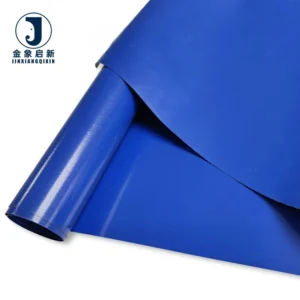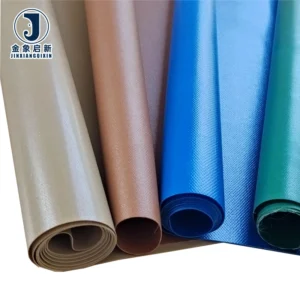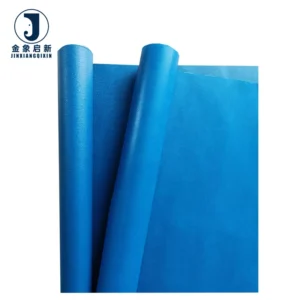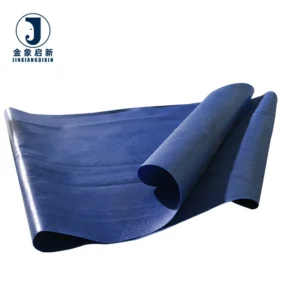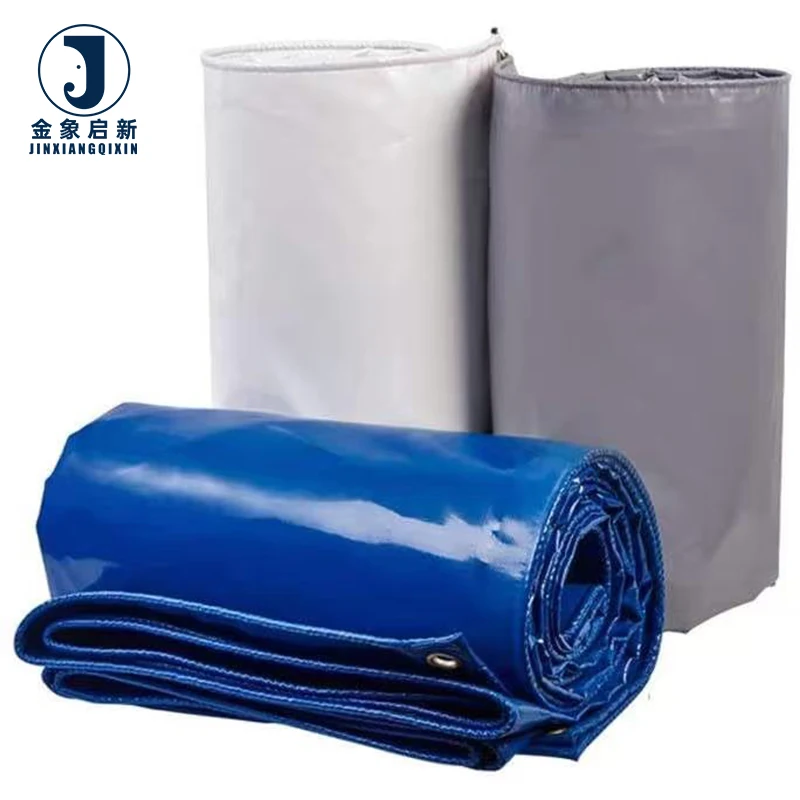
Deep Process Control Over Coated Fabric — coating weight and base fabric adhesion verified at every production stage, ensuring the PVC truck side curtain fabric for transport meets flex-cycle demands without delamination.
Technical Specifications
| Parameter | Value |
|---|---|
| Product Type | PVC Coated Tarpaulin Roll |
| Coating Material | PVC |
| Waterproof Rating | Waterproof (rain and moisture protection) |
| Flame Retardant Grade | Flame retardant (grade not stated in source) |
| UV Treatment | UV resistant (test basis not stated in source) |
| Anti-Shrink | Yes (shape and size retention in extreme weather) |
| Application Grade | Industrial / Heavy-Duty |
| Standards | ISO, CE |
Application Suitability
| Application | Exposure & Requirement |
|---|---|
| Truck side curtains for lorries and trailers | Constant flexing at load shift points, road abrasion, tie-down strap tension, wind-driven rain |
| Tent covers exposed to variable weather | Prolonged UV exposure, sustained rainfall, temperature swings causing fabric expansion and contraction |
| Industrial fabric covers for lorries | Heavy-duty abrasion from load contact, repeated deployment and stowage cycles, depot yard storage |
Why Generic-Sized Truck Covers Fail Where Side Curtain Fabric Should Hold
Curtain failure rarely starts with the fabric itself — it starts at the weld line or the eyelet hem where stress concentrates beyond what generic material can sustain.
When a PVC truck side curtain fabric for transport is cut to a universal dimension rather than matched to the trailer model, the resulting slack or over-tension creates flex zones that generic material was never engineered to handle. I have reviewed field returns where welded seams split within weeks because the base fabric lacked the denier count to anchor the weld. [NEED_CITE: tensile and tear test methods for coated fabrics per ISO 1421] The consequence is cargo exposure mid-route, emergency tarp purchases at depot prices, and fleet downtime that compounds across every scheduled delivery.
Flex-Cycle Demands on Trailer Side Curtain Fabric
Truck side curtains undergo thousands of articulation cycles per journey as the load shifts, the suspension compresses, and wind pressure varies across the trailer face. A PVC truck side curtain fabric for transport must maintain dimensional stability through these cycles without shrinking under cold conditions or softening under summer heat. Anti-shrink behaviour is not a marketing claim here — it is the difference between a curtain that stays tensioned across a 13.6-metre tautliner and one that pulls away from the buckle rail, leaving the load exposed.
Reinforcement Zones Where Abrasion Concentrates
The areas surrounding tie-down points, ratchet strap contact zones, and the lower hem where the curtain meets the trailer bed experience concentrated abrasion that the main body of the fabric never sees. Reinforced hems and appropriate eyelet spacing distribute these loads across a wider base fabric area, reducing the risk of tear propagation. When specifying PVC truck side curtain fabric for transport, the reinforcement layout should match the strap configuration of the trailer — not a generic spacing that assumes one tie-down pattern fits all fleet types. [NEED_CITE: load restraint standards for curtain-side vehicles in regional transport markets]
Reading Beyond the GSM Number
GSM tells you the total weight per square metre, but it does not tell you how that weight is distributed between base fabric and coating. A heavy coating on a low-denier base produces a fabric that feels substantial on the roll but tears easily once a nick reaches the scrim. Conversely, a high-denier base with insufficient coating weight will show strong tensile figures but allow water ingress through pinholes in the thin PVC layer. For truck side curtain applications, the base fabric denier and the coating weight must both be specified and verified — neither alone is sufficient to predict field performance under road conditions.
What Happens When the Specification Does Not Match the Route
A fleet operating regional routes with frequent loading bay stops subjects its side curtains to far more deployment cycles and abrasion events than a long-haul operator covering motorway miles. Specifying the same PVC truck side curtain fabric for transport across both duty cycles without adjusting the base fabric denier or coating weight leads to premature failure on the regional fleet while the long-haul curtains remain serviceable. The cost is not just the replacement fabric — it is the unscheduled downtime, the cargo claims from weather-exposed loads, and the procurement cycle that repeats because the root specification was never corrected. [NEED_CITE: PVC coated fabric failure modes at weld lines and eyelet zones under cyclic loading]
The Hidden Cost of Batch Inconsistency Across Rolls
When a fleet-wide curtain replacement order arrives with visible colour variation between rolls, the installation team faces a choice: proceed with mismatched panels that will be visible across the trailer fleet, or halt installation and request replacements. Either outcome carries cost. Colour consistency across rolls in the same shipment depends on coating batch control and pigment dispersion at the production stage — factors that should be verified through a pre-shipment inspection record rather than discovered on the depot floor. [NEED_CITE: colour consistency standards for coated fabric batches in fleet livery applications]
Why Procurement Verification Matters at Every Stage
Each roll of PVC truck side curtain fabric for transport is produced against a specification sheet that states GSM, base fabric denier, coating weight, and applicable treatments. Verification at dispatch — not at arrival — is what prevents disputes. A material specification sheet stating exact values, paired with a pre-shipment inspection record showing roll-by-roll weight checks and colour reference confirmation, gives the buyer documented evidence before the container is sealed. This is the layer of process control that separates a supplier from a source.
Documentation & Verification
- Material specification sheet stating exact GSM, base fabric denier, and PVC coating weight per roll batch
- UV resistance and flame retardant test reports matched to destination market transport regulations
- Pre-shipment inspection record with roll-by-roll colour consistency and weight verification
- Certificate of origin and customs documentation for cross-border fleet procurement
- Roll packing list detailing net weight, dimensions, and roll count per shipment
Fabrication, Handling & Storage
- Hot-air welding temperature and speed must match the PVC coating weight to prevent seam delamination at flex zones
- Eyelet installation should align with reinforced hem areas to distribute tie-down strap tension across the base fabric
- Store PVC coated rolls upright on pallets to prevent flat-spot deformation and permanent creasing of the coating surface
- Avoid deploying curtains in sub-zero conditions without allowing the PVC coating to acclimatise and regain flexibility
- Clean with mild detergent solutions; solvent-based cleaners may degrade the PVC coating surface and compromise UV treatment
What to Include in Your Enquiry
Provide the trailer model and curtain dimensions so the fabric width and reinforcement layout can be matched to your fleet configuration. Specify the fire-retardant grade required by your operating market’s transport safety regulations, as available grades vary by destination. Confirm whether you need roll stock for in-house fabrication or finished curtains with eyelets and hems installed, and indicate your annual volume to determine production scheduling and batch consistency planning.
Frequently Asked Questions
Q: How is GSM verified on arrival and what happens if the roll weight doesn’t match the quotation?
A: Every roll is weighed during pre-shipment inspection and recorded against the stated GSM before dispatch. If arrival inspection reveals a discrepancy, the inspection record provides documented evidence for resolution. Weight verification is conducted per roll, not averaged across the batch, ensuring each unit meets the quoted specification independently.
Q: Which flame-retardant grades are available and how do they align with transport safety standards?
A: Flame-retardant treatment is available in multiple grades — the specific grade required depends on your destination market’s transport and fire safety regulations. Confirm the standard applicable to your operating region so the correct treatment and test documentation can be supplied with your order.
Q: How do you ensure colour consistency across multiple rolls for a fleet-wide curtain replacement?
A: Colour reference is confirmed per production batch, and a visual inspection record is completed before shipment. Rolls within the same order are produced from matched coating batches to minimise variation. The pre-shipment inspection record documents the colour check roll by roll for your verification.
Q: What eyelet spacing and hem reinforcement options are available for side curtain applications?
A: Eyelet spacing and hem reinforcement can be specified to match your trailer’s tie-down and strap configuration. Provide your trailer model and strap layout so the reinforcement pattern can be engineered to distribute load across the base fabric at stress-concentrated zones.
Q: How is the fabric tested for abrasion resistance at flex points where the load shifts during transit?
A: The base fabric denier and PVC coating weight are selected to withstand cyclic flex loading at strap contact and load shift zones. Material specification sheets state these values for verification, and welded seam strength is confirmed during production to ensure seams survive repeated articulation without splitting.