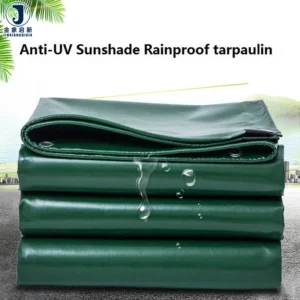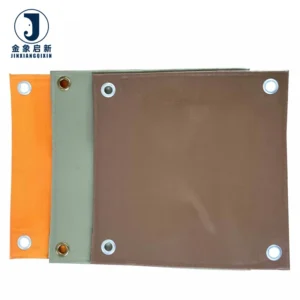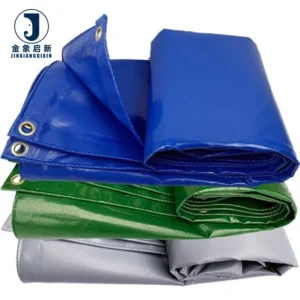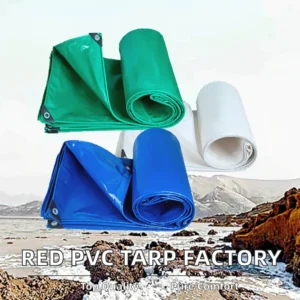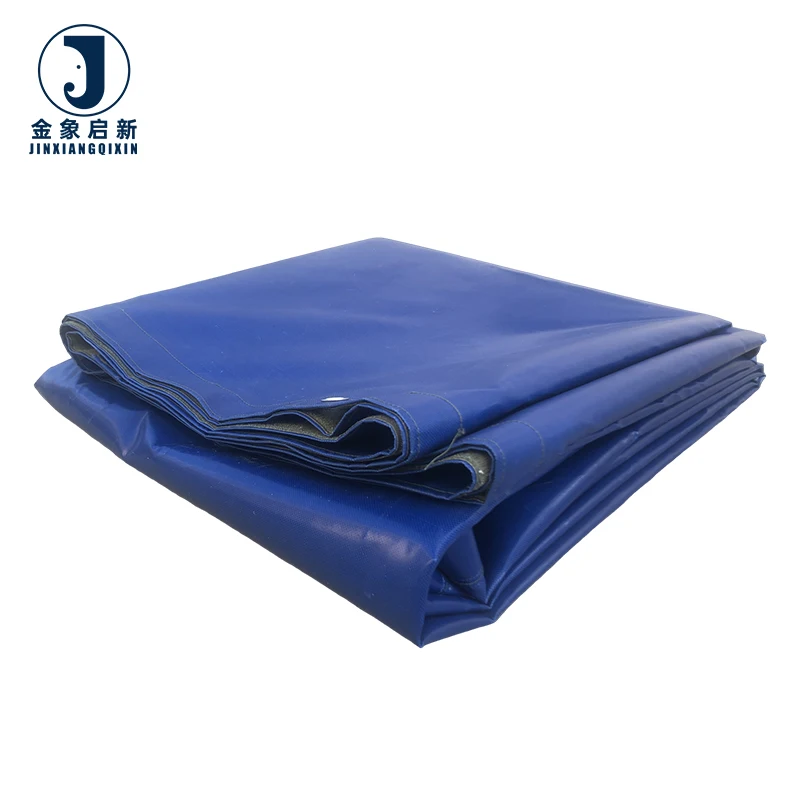
Coating Process Control — Hot melt coating and lamination technology applied across three weight tiers ensures the adhesion integrity that truck side curtains and transport covers depend on under continuous road flex.
Technical Specifications
| Parameter | Value |
|---|---|
| Product Type | PVC Coated Tarpaulin Roll |
| Base Fabric | 100% high toughness polyester yarn |
| Coating Technology | Lamination technology and hot melt coating technology |
| Thickness (medium-duty) | 0.35-0.45 mm |
| Weight (medium-duty) | 400-500 g/m² |
| Base Fabric Denier (medium-duty) | 500D |
| Tensile Strength (medium-duty) | Warp 1500-2000 / Weft 1200-1800 N/5cm |
| Thickness (heavy-duty) | 0.70-1.0 mm |
| Weight (heavy-duty) | 700-1000 g/m² |
| Base Fabric Denier (heavy-duty) | 1000D |
| Tensile Strength (heavy-duty) | Warp 2000-2500 / Weft 1800-2200 N/5cm |
| Thickness (super heavy-duty) | 1.2-1.5 mm |
| Weight (super heavy-duty) | 1100-1500 g/m² |
| Base Fabric Denier (super heavy-duty) | 500D-2000D |
| Tensile Strength (super heavy-duty) | Warp 2500-3000 / Weft 2200-2800 N/5cm |
| Color Options | Blue, Blue/Orange, Green, Grey, Black, Clear, Grey/Green, Orange, or custom |
| Treatment Options | Flame retardant, anti-static, cold resistant, mold proof, anti-UV (confirm the grade required for your market) |
| Weather Resistance | 3-5 years outdoor service life |
| Standards | ISO, CE |
Application Suitability
| Application | Exposure & Requirement |
|---|---|
| Truck side curtain fabric | Constant flexing at load points, road abrasion, high-speed wind pressure, tie-down stress at hems |
| Flatbed trailer cover | Direct UV exposure, water pooling, repeated folding and unfolding at sharp load edges |
| Transport equipment wrap | Contact with metal surfaces, vibration-induced abrasion, temperature swings during transit |
| Fleet operator roll stock | Batch colour consistency across multiple vehicles, reliable weld performance during in-house fabrication |
| Curtain-side repair patch | Must match existing curtain weight and weld compatibility for field or depot repair |
Why Tensile Ratings Matter More Than GSM When Specifying Truck Covers
A 700 g/m² fabric with poor coating adhesion will delaminate at the weld line long before a well-bonded 650 g/m² roll shows any structural failure.
Fleet operators and transport equipment builders often start their specification process by comparing GSM across suppliers, assuming that a higher number on the quotation automatically means a longer-lasting truck cover. In practice, a PVC coated tarpaulin for truck and transport applications lives or dies at the stress concentration points — the welded hems, the eyelet reinforcement zones, and the areas where the fabric wraps around sharp load edges and flexes with every bump in the road. I have seen heavy-grade coated rolls fail at the weld line within the first season, not because the base fabric lacked tensile strength, but because the coating-to-fabric bond was insufficient to transfer load into the polyester yarn structure. The hot melt coating and lamination technology used in this product family addresses that failure mode directly [NEED_CITE: tensile and tear test methods for coated fabrics per ISO 1421].
Coating Adhesion Under Load Flex
When a truck side curtain flexes under road vibration and wind load, the coating and the base fabric must behave as a single composite structure. Any separation between the PVC layer and the polyester yarn creates a point where water enters and the weld seam begins to peel. The hot melt coating technology applied here penetrates the yarn structure rather than sitting on the surface, which is what gives the material its described adhesive strength and excellent welding tear strength. For fleet operators fabricating their own curtains or specifying covers for mixed trailer fleets, this bond quality is the difference between a cover that holds through multiple seasons and one that requires panel replacement after the first long-haul winter.
Tie-Down and Hem Reinforcement Zones
The areas around tie-down straps, D-rings, and hem welds experience concentrated stress that can exceed the general tensile rating of the fabric by a significant margin. Super heavy-duty grades in this range, with warp tensile strength up to 2500-3000 N/5cm and a base fabric denier reaching 2000D, are designed for these high-load zones on flatbed and curtain-side trailers. Specifying a heavier grade specifically for the bottom hem and tie-down strips — while running a medium-duty weight across the main curtain body — is a fabrication approach that balances cost against the real stress profile of a working truck cover [NEED_CITE: stress concentration at welded seams in PVC coated transport fabrics].
Reading the Specification Sheet Beyond the Weight Number
The three weight tiers in this product family — 400-500 g/m², 700-1000 g/m², and 1100-1500 g/m² — each pair a specific base fabric denier with a corresponding coating thickness, and the relationship between these parameters defines how the material performs in service. A 1000D base fabric at the heavy-duty tier provides the yarn thickness and weave density needed to resist tear propagation when a sharp load edge presses against the curtain. The coating method matters equally: lamination technology bonds a pre-formed PVC film to the base fabric under heat and pressure, producing a uniform coating weight that supports consistent weld parameters across the roll. This predictability is what allows fabricators to set heat welder temperature and dwell time once and hold those settings through an entire production run, rather than adjusting for coating variation from one roll to the next. Cold resistant treatment options are available to address low-temperature cracking on winter routes — confirm the grade required for your operating climate.
The Hidden Cost of Specifying on Price Per Square Metre Alone
When a transport fleet orders PVC coated tarpaulin for truck and transport covers based on the lowest cost per square metre, the savings often disappear during the first year of service. A lighter-than-specified coating may pass the initial visual inspection but will show reduced weld tear strength at the hem, leading to seam failure under routine tie-down tension. Colour inconsistency between rolls in the same delivery becomes visible the moment two panels are installed side by side on a trailer, forcing a reorder to maintain fleet appearance standards. Batch variation in coating weight also means that weld parameters that worked on one roll may burn through the next, generating scrap and downtime in the fabrication shop [NEED_CITE: coating weight variation and its effect on heat weld consistency].
Why Fleet Operators Source This PVC Coated Tarpaulin from Jinxiang
Three full production lines and 36 sets of professional equipment give this supplier the capacity to hold roll-to-roll consistency across large fleet orders, which matters when a transport company is re-covering an entire trailer fleet in one procurement cycle. The 10-person R&D team handles custom width, colour matching, and pattern printing, developing samples within days so that fabricators can run weld tests and confirm fitment to specific trailer models before committing to production volume. Dedicated QA/QC inspection at every production stage, with 100% pre-shipment roll-by-roll check, catches coating weight deviations and colour shifts before the material leaves the factory — addressing the two most common complaints fleet buyers raise after receiving a bulk delivery. Nearly 30 years of focused production on coated fabric has refined the process control over coating adhesion that directly determines weld seam life on a working truck cover.
Documentation & Verification
- Material specification sheet confirming GSM, base fabric denier, and coating method for each grade ordered
- Weight verification per roll against the stated GSM before dispatch from the production line
- Pre-shipment inspection record covering coating adhesion, colour consistency, and dimensional accuracy
- Test reports for UV resistance and flame retardant grades where applicable to the specification confirmed
- Roll packing list with certificate of origin and full customs documentation for cross-border transport
- Colour reference sample retained on file for future batch matching across repeat fleet orders
Fabrication, Handling & Storage
- Set heat welder temperature and dwell time based on the specific coating thickness of the grade ordered — 0.35-0.45 mm medium-duty requires lower settings than the 1.2-1.5 mm super heavy tier
- Store rolls horizontally on padded racks to prevent flat-spot deformation on the polyester base fabric, which can cause tracking issues during curtain fabrication
- Allow cold resistant grade rolls to acclimatise to workshop temperature before unrolling and cutting, as stiffened PVC may crack along fold lines at low temperatures
- Reinforce eyelet zones with additional PVC patches welded over the base fabric to distribute tie-down load across multiple yarn intersections
- Use compatible PVC weld tape for field repairs on truck side curtains, matching the coating method to ensure bond strength at the patch edge
What We Need to Quote Your PVC Coated Tarpaulin Roll Order Accurately
Provide the specific trailer models or curtain dimensions you are covering, along with the tie-down system type and typical load profile, so that we can recommend the appropriate weight tier and treatment package. If your fleet operates across regions with different fire safety or anti-static compliance requirements for transport covers, state the applicable standards so that test documentation can be prepared with the quotation. Confirm whether you require roll stock in standard widths for in-house fabrication, or finished cut-to-size panels with welded hems and eyelet reinforcement ready for installation.
Frequently Asked Questions
Q: How is the GSM of each roll verified before shipment to match what was quoted?
A: Every roll undergoes a weight check during pre-shipment inspection, with GSM measured against the material specification sheet for the grade ordered. The inspection record accompanies the shipment documentation so you can cross-reference the verified weight with your purchase order. Any roll falling outside the stated 400-500, 700-1000, or 1100-1500 g/m² range is held and does not ship.
Q: What documentation supports the flame retardant and anti-static claims on this fabric?
A: Where flame retardant or anti-static treatment is specified, test reports confirming the grade achieved are provided with the shipment documentation. Because fire safety and anti-static requirements vary by market and application — mining ventilation ducts, for example, have different standards than road transport covers — we ask you to confirm the specific grade your operation requires before production.
Q: Can colour be matched consistently across multiple rolls for a full fleet curtain order?
A: Yes. Colour reference samples are approved during the sample development stage, and production runs are monitored for batch-to-batch consistency. The pre-shipment inspection includes a visual colour comparison across all rolls in the order. Retained reference samples allow future reorders to be matched to the original fleet colour without visible variation when panels are installed side by side.
Q: How does welding tear strength compare to the base fabric tensile rating?
A: The hot melt coating and lamination technology used in this product family is designed to produce weld seams that approach the tensile strength of the base fabric itself, rather than becoming the weak point. The material specification sheet includes coating method and adhesive strength data so your fabrication team can validate weld parameters through sample testing before committing to a full production run.
Q: What are the lead times and minimums for custom widths or vehicle-specific cut sizes?
A: Custom width rolls and cut-to-size panels with welded hems are produced on the same three full production lines as standard stock, with sample development completed within days for fitment confirmation. Minimum order quantities and lead times depend on the specific grade, colour, and treatment combination requested, and are confirmed in the quotation once your requirements are specified.