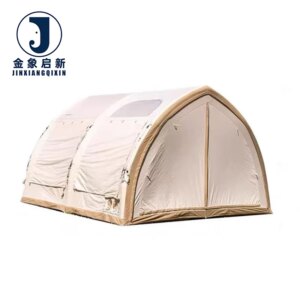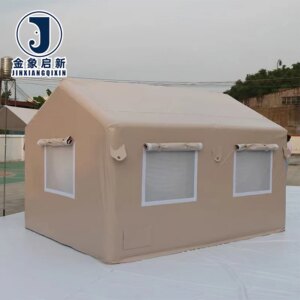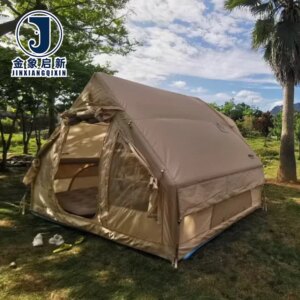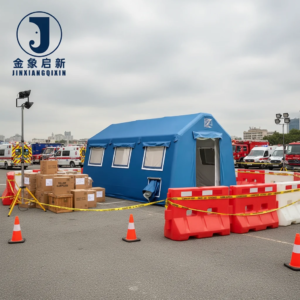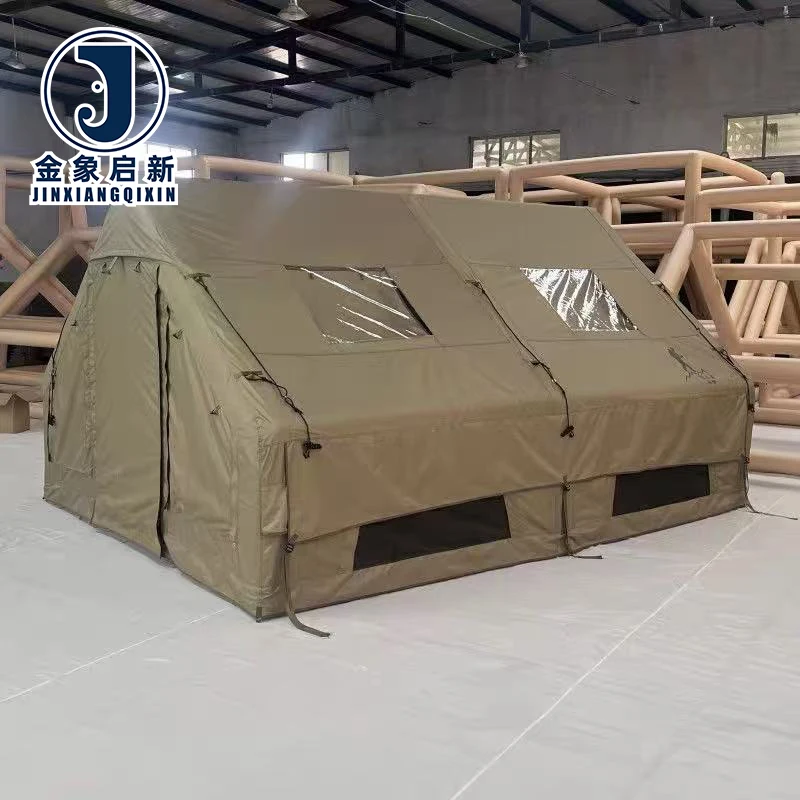
Process Control Over Coated Fabric — Deep expertise in coating weight and adhesion translates to consistent PVC inflatable tent fabric performance across every production batch.
Technical Specifications
| Parameter | Value |
|---|---|
| Product Type | Inflatable Tent |
| Core Material | PVC tarpaulin |
| Key Performance | Waterproof, UV-resistant (test basis not stated), tear-resistant |
| Product Form | Inflatable structure |
| Customization | OEM & ODM, sample customization, pattern printing |
| Quality System | Full-process inspection with dedicated QA & QC staff |
| Standards & Certifications | ISO 9001, ISO 14001, ISO 45001, CE |
Application Suitability
| Application | Exposure & Requirement |
|---|---|
| Disaster relief rapid deployment | Immediate weather protection, repeated inflation and deflation cycles, transport abrasion |
| Temporary site offices at construction projects | Prolonged UV exposure, wind load on inflated panels, ground moisture |
| Equipment storage shelters in remote operations | Dust and moisture ingress prevention, moderate wind and thermal cycling |
| Mobile command centers for infrastructure maintenance | Quick setup on uneven terrain, resistance to handling damage during relocation |
| Temporary covered workspace for outdoor industrial events | High visibility requirements, frequent assembly and teardown |
Why Inflatable Shelter Fabric Fails Before the Structure Does
When procurement teams specify an Inflatable Tent aftermarket supplier, the focus often lands on inflation speed and frame geometry while the fabric itself receives minimal scrutiny. The reality is that inflatable shelter skin carries every environmental load the structure faces.
A tent that deflates unexpectedly in a disaster relief zone is rarely a pump failure — more often the fabric has lost integrity at a seam, a valve penetration, or a high-flex anchor point. Buyers who treat the material as a commodity end up replacing entire shelter units instead of specifying the right coated fabric from the start. [NEED_CITE: common failure modes in inflatable temporary structures under field conditions]
How Inflatable Tent Fabric Differs from Standard Tarpaulin
Inflatable structures place unique demands on coated fabric. Unlike a static truck cover that sits under tension once installed, an inflatable tent undergoes repeated pressurization cycles. The PVC tarpaulin core must tolerate expansion and contraction without micro-cracking at the coating layer. This Inflatable Tent Fabric for truck and transport cover applications is engineered to handle these cyclic loads while maintaining waterproof performance across the entire panel surface.
Seams and Valve Penetrations as the Real Weak Point
Every inflation port, zipper integration, and panel joint introduces a discontinuity in the coated fabric. High-frequency welding is the standard joining method for PVC inflatable structures, and the weld strength depends directly on coating compatibility and base fabric stability. A tear-resistant fabric that flexes predictably at stress concentrations reduces the chance that a weld line will open under inflation pressure or wind-induced movement. [NEED_CITE: weld strength testing methods for PVC coated fabrics used in inflatable applications]
Coating Weight, Base Fabric, and What They Mean Together
The waterproof performance of PVC tarpaulin comes from continuous coating coverage over the base fabric weave. Tear resistance, however, depends on both the coating thickness and the denier and weave density of the underlying yarn structure. A heavier coating does not automatically deliver higher tear strength if the base fabric is loosely woven. For inflatable shelters that face puncture risk from debris during disaster deployment, both elements must be evaluated together rather than relying on a single weight figure. UV-resistant formulation (test basis not stated in source) is available for extended outdoor exposure — confirm the UV treatment level required for your deployment environment and expected service duration.
The Cost of Underspecifying Shelter Fabric
A batch of inflatable tents deployed to a flood relief zone arrived with inconsistent coating adhesion across panels. Within the first inflation cycle, several units developed leaks at factory-welded seams because the coating had not fully bonded to the base fabric at those specific points. The replacement cost included not just new shelters but the logistics of redistributing them under emergency conditions. [NEED_CITE: coating adhesion failure patterns in batch-produced inflatable structures]
Another common scenario involves UV degradation that becomes visible only after several weeks of continuous outdoor exposure. When the coating surface begins to chalk or lose flexibility, the shelter becomes difficult to fold for redeployment and the material becomes prone to cracking at fold lines.
Why This Supply Chain Supports Consistent Output
Three full production lines with 36 sets of professional processing equipment allow batch volume sufficient for multi-unit disaster relief deployments without sacrificing per-roll inspection. The 10-technician R&D team develops samples for custom sizing and pattern printing before production locks in, so fleet branding or project identification can be integrated at the fabric stage. Dedicated QA and QC staff conduct full-process inspection with batch-specific sign-off before dispatch. [NEED_CITE: quality inspection protocols for coated fabric destined for inflatable structure fabrication]
ISO 9001, ISO 14001, ISO 45001, and CE certifications provide the compliance framework that procurement teams in infrastructure and government relief programs require for vendor qualification. OEM and ODM customization extends to material thickness selection and panel sizing matched to specific inflatable frame geometries.
Documentation & Verification
- Material specification sheet stating base fabric type, coating method, and treatment basis for each batch
- Pre-shipment inspection record with batch-specific QA sign-off linked to the inflatable tent order
- UV treatment test report provided where applicable to the specified grade
- Certificate of origin and customs documentation supporting cross-border disaster relief deployment
- ISO 9001, ISO 14001, ISO 45001, and CE certificates available for vendor audit submission
Fabrication, Handling & Storage
- High-frequency welding parameters must be calibrated to the specific PVC coating thickness for consistent seam strength
- Store rolls upright on pallets to prevent permanent creasing that weakens the coating at fold points
- Avoid dragging PVC tarpaulin rolls across abrasive surfaces during warehouse handling to protect coating integrity
- Clean inflated panels with mild detergent only; solvent-based cleaners may compromise the coating surface
- Allow fabric to reach ambient temperature before unfolding in cold conditions to prevent low-temperature cracking
What to Include in Your Inquiry
Provide the intended deployment scenario, expected environmental exposure duration, and any compliance requirements your market mandates for temporary shelters. Specify whether you need raw fabric rolls for your own fabrication facility or require OEM-cut panels matched to a particular inflatable frame design. Include target panel dimensions, color or pattern printing requirements, and anticipated annual volume so the production team can confirm lead time and customization scope.
Frequently Asked Questions
Q: What customization options are available for size and pattern printing on inflatable tent fabric?
A: OEM and ODM services cover custom panel sizing matched to specific inflatable frame geometries and pattern printing for fleet branding or project identification. The R&D team develops samples before mass production, allowing you to verify dimensions, print registration, and coating performance against your deployment requirements prior to full batch commitment.
Q: What certifications support vendor qualification for disaster relief procurement?
A: Production is certified under ISO 9001, ISO 14001, ISO 45001, and CE. Documentation packages including material specification sheets, pre-shipment inspection records, and certificates of origin accompany each shipment. Confirm with the supply team whether additional market-specific compliance documentation is required for your procurement channel.
Q: How does batch-to-batch consistency support multi-unit shelter deployments?
A: Full-process quality inspection with dedicated QA and QC staff ensures that coating weight, color, and material performance remain uniform across production runs. This matters when dozens of identical inflatable tents must deploy together at a single relief site, where visible or performance variation between units creates operational and credibility issues.
Q: Can I receive a customized sample before committing to a full production order?
A: Yes, sample customization is available to verify material feel, coating performance, sizing accuracy, and any pattern printing before mass production begins. The sample stage allows adjustments based on your feedback, reducing the risk of specification mismatches once the full batch enters the production line.