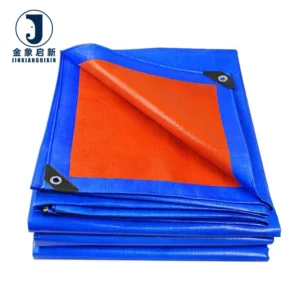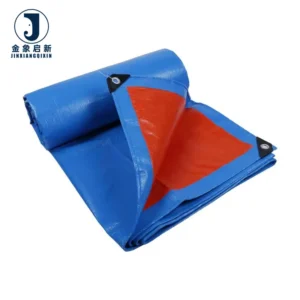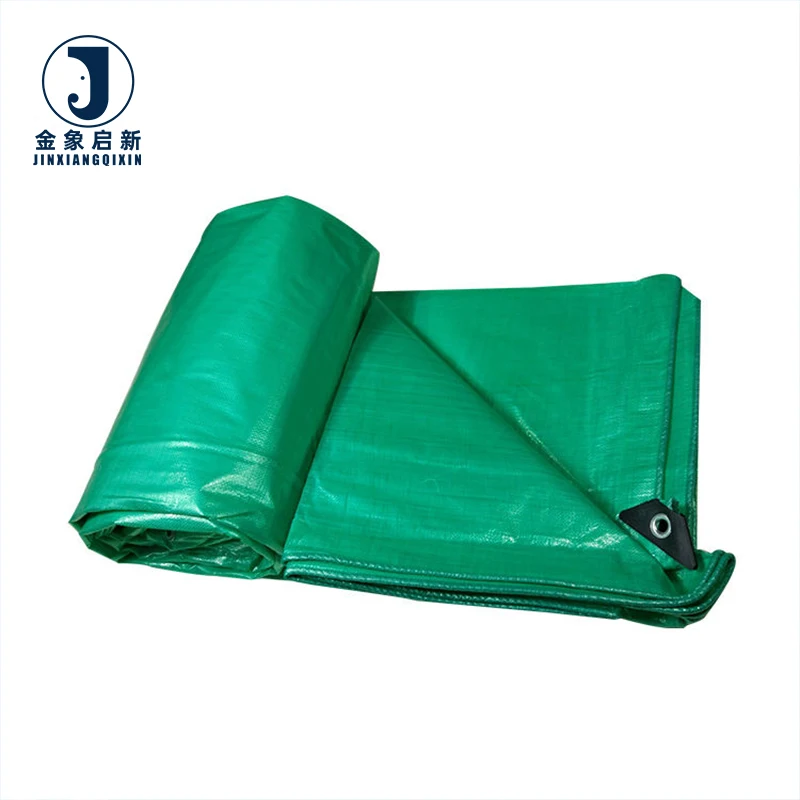
Proven coating process control — three dedicated production lines maintain consistent HDPE weave density and LDPE lamination weight across every roll of PE tarpaulin leaving the facility.
Technical Specifications
| Parameter | Value |
|---|---|
| Product Type | PE Tarpaulin Roll |
| Material | HDPE weaving with LDPE lamination on both sides |
| Coating Method | Laminated |
| Weight (GSM) | 50 gr/m² ~ 300 gr/m² (confirm the grade for this item) |
| Total Thickness | 0.2-0.4mm / 8 mil-16 mil / Custom |
| Mesh Count | 6×6, 6×7, 7×7, 7×8, 8×8, 9×9, 8×10, 10×10, 12×12, 14×14, 14×16 |
| Roll Width | 6ft, 8ft, 10ft, 12ft, 2m, 4m, 6m |
| Roll Length | 100 yards, 100 meters, or custom |
| Edge Finish | All four edges reinforced with PP rope in hem |
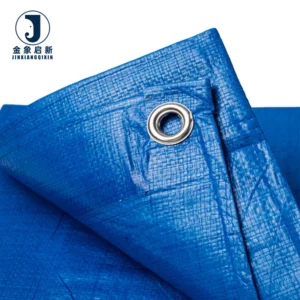
| Eyelets | Galvanized, every 3ft or 1 meter interval |
| Corners | Reinforced plastic corners |
| Color | Blue, Blue/Orange, Green, Grey, Black, Clear, Grey/Green, Orange, or custom |
| Key Features | Waterproof, washable, tear resistant, weather proof, mildew proof, anti-aging |
| UV Treatment | Available (test basis not stated) |
Application Suitability
| Application | Exposure & Requirement |
|---|---|
| Truck and trailer load covers | Constant road vibration, wind flap, UV exposure, tie-down stress at eyelets |
| Boat and container covers | Salt air, rain ingress, abrasion against hull and container edges |
| Construction scaffolding wraps | Wind load, scaffold tube abrasion, site dust and chemical splash |
| Agricultural crop and hay covers | Prolonged sun exposure, ground moisture, puncture from bale edges |
| Garden and pool covers | Standing water, leaf debris, seasonal temperature swings |
When the Quoted GSM Does Not Match What Arrives on the Dock
Weight verification at every production stage ensures the PE tarpaulin you receive matches the specification on the purchase order.
Fleet operators and transport contractors regularly face a frustrating scenario: the quotation states a specific GSM grade, but the rolls that arrive in the container feel noticeably lighter. This discrepancy is not always a deliberate shortfall — it can stem from inconsistent lamination thickness or base fabric substitution at the weaving stage. The consequence is a cover that fails prematurely under transport flex and UV exposure, forcing unplanned replacements mid-season. [NEED_CITE: tensile and tear test methods for coated fabrics per ISO 1421]
Why Roll-to-Roll Consistency Matters in Transport Covering
A fleet ordering twenty finished tarps for an identical trailer model expects every piece to behave the same way in the field. When lamination weight drifts between rolls, some covers stiffen in cold weather while others remain pliable, creating uneven tie-down tension. The HDPE woven base fabric with LDPE lamination on both sides provides a stable platform, but only when the coating weight is controlled from the first roll to the last. This PE tarpaulin for truck and transport covering is produced on dedicated lines where lamination parameters are monitored continuously.
How Weave Density Translates to Real-World Load Protection
Mesh count is not just a specification line — it determines how the fabric distributes the point loads that occur when straps pull against eyelets during transit. A 14×16 weave distributes these forces across a denser yarn matrix compared to a 6×6 construction, reducing the risk of tear propagation at stress concentrations. Transport equipment builders specifying side curtain and load cover fabric need this data mapped directly to the GSM grade they require for their duty cycle. [NEED_CITE: relationship between weave density and tear propagation in coated technical textiles]
Reading the Specification Sheet Beyond GSM
GSM alone tells an incomplete story. The base fabric denier and weave density — available from 6×6 up to 14×16 — determine how tensile and tear loads are carried before the coating even enters the equation. LDPE lamination applied to both sides of the HDPE woven substrate provides the waterproof barrier, but its adhesion to the base fabric governs whether delamination occurs under repeated flexing. A heavier GSM achieved through excessive coating rather than a denser weave will feel stiff and may crack at fold lines in cold conditions. The mesh count to GSM mapping — where 8×8 corresponds to 80 gr/m²~90 gr/m² and 14×14 corresponds to 150 gr/m²~250 gr/m² — gives buyers a framework to specify based on actual structural performance rather than weight alone. UV treatment is available in grades suited to regional solar exposure, though the test basis should be confirmed against your market requirements.
The Hidden Cost of Ignoring Colour Consistency Across Rolls
When a logistics company orders covers for an entire fleet, visible shade variation between tarps installed on adjacent vehicles signals poor quality control to their clients. This colour inconsistency across rolls in the same order forces operators to sort and match pieces manually or, worse, reject batches outright. The problem compounds when re-orders arrive months later in a slightly different shade, making mixed-fleet presentations look unprofessional. Beyond aesthetics, colour drift can indicate changes in the LDPE lamination formulation that affect UV stability and long-term weathering behaviour. [NEED_CITE: impact of pigment concentration on UV degradation rate in polyethylene coatings]
What Consistent Process Control Delivers for Transport Buyers
Deep process control over lamination weight and adhesion means the PE tarpaulin rolls you receive match the data sheet every time. Three full production lines and 36 sets of professional equipment support bulk volume without sacrificing on-time delivery schedules. A 10-person R&D team handles custom width, colour matching and sample development within days rather than weeks. Dedicated QA/QC inspection at every production stage catches lamination defects, eyelet spacing errors and dimensional inaccuracies before they reach the loading bay. Every finished tarp undergoes 100% pre-shipment inspection covering weight verification, eyelet pull strength and hem reinforcement integrity.
Documentation & Verification
- Material specification sheet stating confirmed GSM, base fabric weave and LDPE coating weight
- UV treatment test report provided where applicable to the specified grade
- Pre-shipment inspection record covering eyelet spacing, hem reinforcement and roll dimensions
- ISO and CE certificates included with every shipment
- Roll packing list with net and gross weight for customs clearance
- Certificate of origin and customs documentation prepared per destination country requirements
Fabrication, Handling & Storage
- Galvanized eyelets at 3ft or 1m intervals require matching grommet press tooling to avoid crushing the reinforced plastic corners during fabrication
- PP rope reinforced hems distribute tie-down loads across the LDPE lamination layer without cutting into the HDPE base fabric
- Rolls stored upright on hard paper tubes prevent flat-spot deformation that causes visible crease lines when deployed
- Custom widths up to 6m should be transported flat or rolled — never folded — to preserve lamination adhesion at fold lines
- Cleaning with mild detergent preserves the LDPE surface; solvents can degrade the lamination bond on this waterproof PE tarpaulin
- Field repairs on heavy-grade sheets respond well to hot-air welding; lighter GSM grades may require adhesive patch kits instead
How to Specify for Your Fleet or Transport Project
Provide the exact trailer dimensions, tie-down configuration and the environmental conditions your covers face in service. Confirm whether UV treatment documentation is required for your regional compliance framework, and specify the target GSM grade alongside your preferred colour or fleet branding requirements. State whether you need finished cut-to-size pieces with eyelets and hems, or roll stock for your own fabrication. Request a sample roll or finished piece for approval before production commences on the full order.
Frequently Asked Questions
Q: How do you cut tarps to fit specific truck and trailer models rather than generic sizes?
A: We work from the actual vehicle dimensions or engineering drawings you provide, not a standard template library. Each finished PE tarpaulin is cut to match the specific trailer model, with eyelet placement and hem reinforcement positioned to align with your tie-down hardware. Samples are produced for fit verification before bulk fabrication begins.
Q: How is eyelet spacing and hem reinforcement specified for transport tie-down loads?
A: Galvanized eyelets are set at 3ft or 1m intervals through the PP rope reinforced hem, distributing strap tension across the hem line rather than concentrating it at a single point. Reinforced plastic corners add extra material at the highest stress locations. Spacing and corner reinforcement can be adjusted to match your specific strap configuration.
Q: How do you verify GSM on finished tarps before shipment?
A: Weight is checked at every production stage, from base fabric weaving through LDPE lamination. The pre-shipment inspection record documents actual GSM measurements taken from each roll or finished piece, compared against the specification on your purchase order. Discrepancies are flagged and corrected before the container is sealed.
Q: Can you supply custom colour and fleet branding across a multi-vehicle order with consistent shade?
A: Yes. Colour matching is controlled at the lamination stage with reference samples retained from your approved swatch. For fleet branding, custom printing is available and ink adhesion is verified against the LDPE surface. Roll-to-roll colour consistency is confirmed during pre-shipment inspection so every piece in your order matches visually once installed.