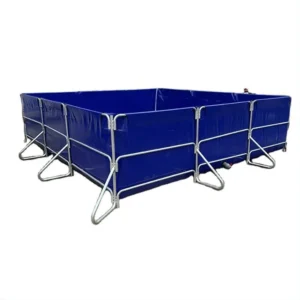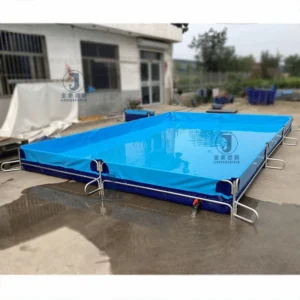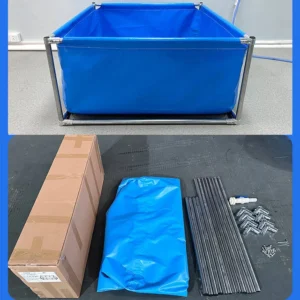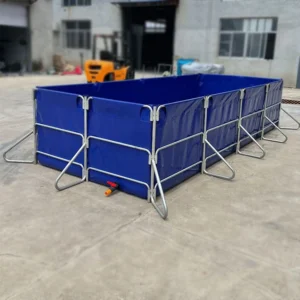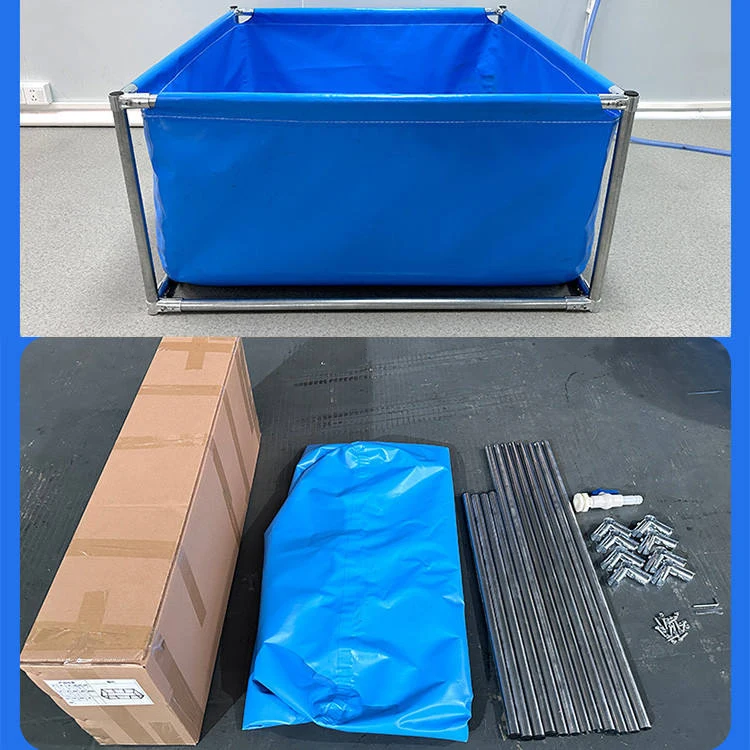
Proven Coating Adhesion Control — nearly 30 years of PVC coating process expertise applied to every pond liner, ensuring consistent bond strength between base fabric and coating layer.
Technical Specifications
| Parameter | Value |
|---|---|
| Product Type | PVC Tarpaulin Fish Pond Liner |
| Shape Options | Circular, Rectangular |
| Material | PVC coated tarpaulin |
| Construction Feature | Foldable |
| Surface Treatment | Anti-UV and flame retardant options available — confirm the grade required for your market |
| Assembly State | Cut-to-size with welded seams |
| Reinforcement | Reinforced hems, optional eyelets |
| Certification | ISO, CE |
Application Suitability
| Application | Exposure & Requirement |
|---|---|
| Commercial aquaculture fish ponds | Permanent water contact, substrate abrasion, continuous UV exposure in open-air installations |
| Hatchery and breeding tanks | Clean water containment, frequent draining and refilling, foldable removal between cycles |
| Agricultural water storage ponds | Seasonal deployment, soil chemistry contact, puncture risk from uneven ground |
| Ornamental and backyard fish ponds | Aesthetic installation, temporary or removable setup, moderate UV and weather exposure |
Why Liner Weight Claims Fail at the Water Line
A quoted GSM means nothing if the coating adhesion lets water migrate between layers.
When a PVC tarpaulin fish pond liner arrives lighter than the material specification sheet stated, the operator has already committed to a full pond build. The base fabric and coating may separate under continuous hydrostatic pressure, creating hidden channels where water works its way through the liner body. This failure mode does not show up during a dry-hand inspection at the dock — it appears weeks after the pond is filled and stock is in the water [NEED_CITE: hydrostatic pressure effects on coated fabric delamination per ISO 1421].
Aquaculture operators who specify PVC tarpaulin fish pond for aquaculture installations need verification that the GSM on the quotation matches the material on the roll, and that the weld integrity holds under the specific water depth their pond design requires.
How Coated Fabric Behaves Under Continuous Water Load
A PVC tarpaulin fish pond liner operates under constant hydrostatic pressure that increases with depth. The coating must maintain full adhesion to the base fabric across every square metre of the liner surface, because even minor delamination creates a pathway for water to penetrate between layers. The foldable construction of this PVC tarpaulin fish pond for aquaculture means the material undergoes repeated folding and unfolding during installation and seasonal teardown, placing additional stress on the coating-to-fabric bond at fold lines and crease points.
Circular and rectangular configurations each create different stress distributions across the liner. A circular pond concentrates tensile load evenly around the circumference, while a rectangular pond places higher stress at the corners where welded seams intersect. Understanding these load patterns during the specification stage helps determine where reinforcement and seam placement matter most.
Weld Integrity at Seam Junctions
The welded seams on a PVC tarpaulin fish pond liner must resist peel forces that increase as water depth and volume increase. High-frequency welding fuses the PVC coating layers together at the joint, creating a bond that should match or exceed the tear strength of the parent fabric. When seam peel strength falls below the fabric tear strength, the joint becomes the failure point — and this failure typically occurs at the corner welds of rectangular ponds where two seam lines meet and stress concentrates [NEED_CITE: peel strength testing methods for welded PVC joints].
Each welded seam on this PVC tarpaulin fish pond for aquaculture application undergoes inspection before shipment, checking for consistent weld width and complete fusion along the entire seam length. Reinforced hems at the perimeter distribute anchoring loads across a broader area, reducing the risk of tear propagation from tie-down points.
Reading the Specification Sheet Beyond GSM
GSM tells you the total weight of base fabric plus coating per square metre, but it does not tell you the ratio between the two. A liner with a heavy base fabric and thin coating may show the target GSM while offering poor water containment integrity. Conversely, a thick coating on a light base fabric may delaminate more easily under flex stress because the coating mass exceeds what the fabric structure can hold. The interplay between base fabric denier, weave density, and coating weight together determines the tensile and tear performance of the finished PVC tarpaulin fish pond liner.
The coating method also influences how the material behaves during fabrication and in service. Different coating processes produce different levels of adhesion between the PVC layer and the polyester base, which directly affects how well the material holds up to welding, folding, and long-term water exposure. Anti-UV treatment, when specified and verified by test report, extends the liner service life under open-air sun exposure by slowing the degradation of the PVC coating surface.
The Real Cost of Underspecifying a Pond Liner
When a PVC tarpaulin fish pond liner is specified at a lighter grade than the installation actually requires, the consequences do not appear immediately. The liner holds water during the first fill and may pass initial visual inspection. But under sustained load, a liner that lacks sufficient tear strength will develop micro-tears at stress points — around eyelets, at seam junctions, and along fold creases — that gradually propagate into leaks [NEED_CITE: tear propagation patterns in coated fabrics under sustained hydrostatic load].
Batch colour inconsistency across panels in the same order may seem like a cosmetic issue, but for aquaculture operations with multiple ponds installed side by side, visible colour variation signals inconsistent coating formulation between production batches, which can indicate broader quality control gaps. Welded seams that fail before the fabric itself tears represent a fabrication process problem, not a material problem, and they force the operator into costly pond drainage and liner replacement mid-season.
What Process Control Means for Your Pond Liner Order
Three full production lines and 36 sets of professional equipment allow dedicated capacity allocation for PVC tarpaulin fish pond liner orders, separating pond liner production from unrelated product runs that could disrupt scheduling. A 10-person R&D team handles the pattern layout for circular and rectangular cuts, optimising material utilisation and seam placement for the specific pond dimensions you provide.
Dedicated QA/QC at every production stage means coating weight is checked during the coating process, not only after the roll is finished. Samples for custom pond sizes and shapes are developed within days, allowing you to verify material feel, weld quality, and fold behaviour before committing to a full production run. Pre-shipment inspection covers every liner at 100 percent, checking seam integrity, dimensional accuracy, and surface condition before packing.
Documentation & Verification
- Material specification sheet confirming base fabric denier, coating type, and GSM for your pond liner order
- Test report for anti-UV and flame retardant treatment where specified for your pond installation requirements
- Pre-shipment inspection record documenting seam weld integrity and dimensional accuracy per liner
- Roll packing list detailing quantity, dimensions, and weight for container loading and customs clearance
- Certificate of origin and ISO/CE certification documentation for international import compliance
Fabrication, Handling & Storage
- Weld PVC tarpaulin pond liner seams using high-frequency equipment calibrated to the specific coating thickness of your ordered material
- Reinforce hem edges with additional PVC strip layers at eyelet locations to distribute anchoring loads across the foldable liner perimeter
- Store rolled PVC tarpaulin pond liner horizontally on a flat surface to prevent permanent creasing in the coated surface
- Allow folded pond liner to acclimatise and relax at installation site temperature before unfolding to reduce stress at crease lines
- Clean PVC coated surfaces with mild detergent only, avoiding solvents that attack the coating adhesion layer
What to Include in Your Enquiry
Provide your pond dimensions, water depth, and whether the installation is circular or rectangular so we can recommend the appropriate material grade and seam configuration. Specify whether the liner will remain in place year-round or be folded and stored between seasons, as this affects the fold-line reinforcement requirement. Confirm any anti-UV or flame retardant treatment needed for your local regulatory environment, and indicate whether you need finished cut-to-size liners or roll stock for your own fabrication.
Frequently Asked Questions
Q: How do I verify the GSM and coating weight match what was quoted?
A: Each PVC tarpaulin fish pond liner ships with a material specification sheet stating the base fabric, coating type, and GSM. Pre-shipment inspection records confirm weight verification per roll before dispatch. You can also request sample cuts from your production batch to independently weigh and confirm the material matches the agreed specification before the full order ships.
Q: Can the liner be cut to fit a non-standard pond shape?
A: Yes. Both circular and rectangular configurations are available as standard, and custom dimensions can be developed based on your specific pond layout. The R&D team prepares cut patterns and seam placement drawings for your approval. Samples are produced within days so you can verify fit, fold behaviour, and weld quality before full production proceeds.
Q: How are seams welded and what holds them together under water pressure?
A: Seams are joined using high-frequency welding that fuses the PVC coating layers at the joint. The weld is inspected for consistent width and complete fusion along the entire seam length. This process creates a bond designed to resist peel forces generated by hydrostatic pressure at your specified pond depth.
Q: Is anti-UV treatment included or specified separately?
A: Anti-UV treatment is available as an option and should be specified based on your installation environment. Where required, a test report can be provided to confirm the treatment basis. Discuss your expected sun exposure duration and local climate conditions during the enquiry stage to determine the appropriate treatment level.
Q: What documentation accompanies the liner for import clearance?
A: Each shipment includes a material specification sheet, pre-shipment inspection record, roll packing list, certificate of origin, and ISO/CE certification documentation. Additional test reports for specific treatments are included where applicable. All documentation is prepared to support customs clearance in your destination country.