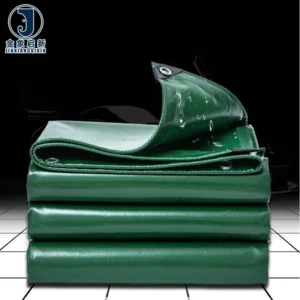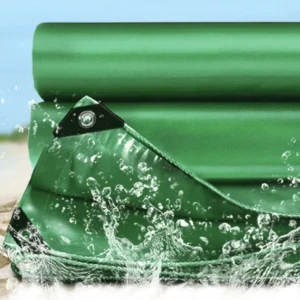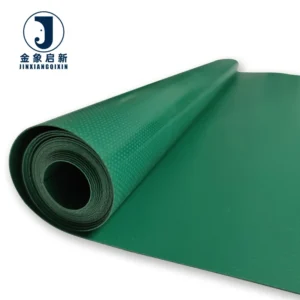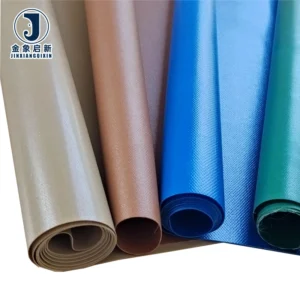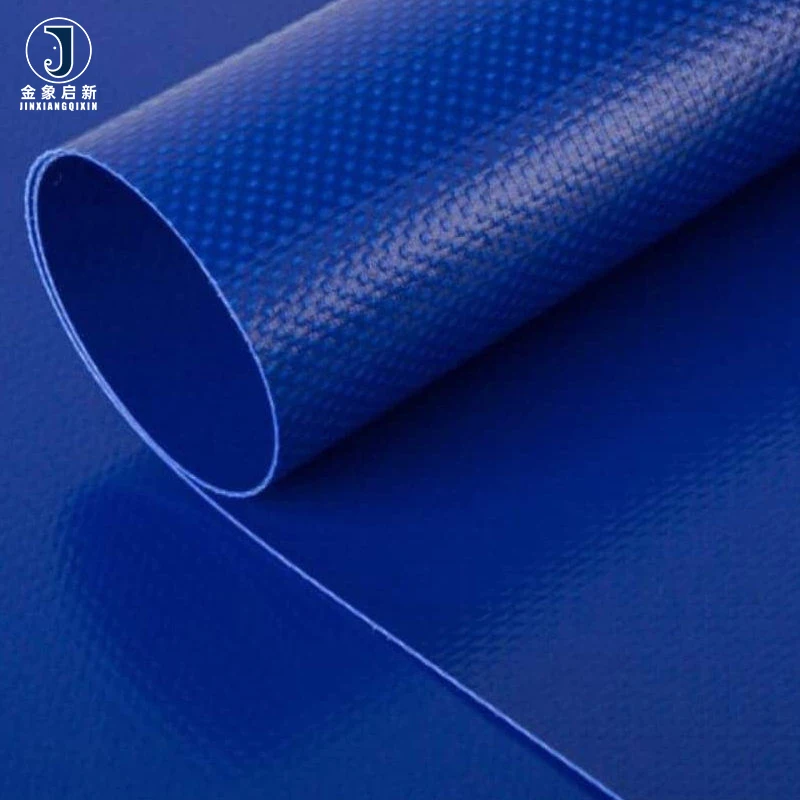
Process Control — Nearly three decades of coating weight and adhesion management ensure every PVC Tarpaulin Roll aftermarket supplier shipment matches the stated GSM roll to roll.
Technical Specifications
| Parameter | Value |
|---|---|
| Product Type | PVC Tarpaulin Roll |
| Material Composition | Polyester Base Fabric + Double-Sided PVC Coating |
| Available Weights | 610 gsm, 650 gsm, 800 gsm |
| Density Parameter | 1.15–2.00 g/cm³ |
| Tensile Strength | 50–80 MPa |
| Brittle Temperature | ≤ -50 to -60°C |
| Softening Temperature | ≥ 80°C |
| Melting Point | 212°C |
| Key Features | Waterproof, Fire Retardant, Anti UV, Heavy Metal Free, Anti Mildew, Flexible, Heavy Duty, Self Clean |
| Treatment Options | High frequency hot melt / Hot air / Sewing |
| Printing | Printable, Customized |
| Eyelets | Brass eyelets every 1 meter, reinforced edges on all four sides |
| Repairability | Repairable by hot air welding |
| Packing | Polyester Bag |
| Standards | ISO, CE |
Application Suitability
| Application | Exposure & Requirement |
|---|---|
| Truck side curtain | Constant flexing at load points, road spray abrasion, UV exposure during long-haul transit |
| Trailer top roof cover | Standing water pooling, thermal cycling, tension from tie-down straps |
| Flatbed tie-down tarp | Direct load contact, friction from shifting cargo, wind flap fatigue |
| Fleet branding surface | Print adhesion under vibration, colour consistency across multiple vehicles |
| Pallet cover (roll stock) | Warehouse dust, forklift handling abrasion, short-term outdoor staging |
Why Generic Sizing Fails on the Road — and What a PVC Tarpaulin Roll aftermarket supplier Should Guarantee
A cover that does not match the trailer profile will fail at the corners long before the fabric itself wears out.
I spent years on the shop floor cutting and welding tarpaulins before moving to the fabric supply side. One job stands out: a logistics fleet ordered PVC-coated nylon for a mixed fleet, cut to a generic dimension set. The trucks arrived with slightly different wheel arch heights and body widths. The corner sections pulled tight, the welded seams cracked at the flex line, and a full load took rain damage on the next run. That single failure changed how I approach every truck and trailer specification — the fabric must be mapped to the actual vehicle geometry, not a catalogue size. [NEED_CITE: welded seam failure patterns in transport tarpaulins under cyclic loading]
Fleet operators who have lived through this know that material weight alone does not solve the problem. A heavier roll with poor adhesion between the polyester base and the PVC coat will delaminate at the hem before a lighter roll with controlled coating weight shows any wear.
Fitting the Fabric to the Fleet — Not the Other Way Around
When sourcing PVC Tarpaulin Roll aftermarket supplier stock for a fleet refurbishment programme, the first question should never be "what GSM do you recommend." It should be "which trailer models are we covering, and how is the fabric tensioned on each one." A side curtain on a curtainsider bends around the same radius every time it is opened and closed, while a flatbed top cover sits under ratchet strap compression across irregular load profiles. The base fabric denier and the coating thickness must be balanced differently for each of these conditions.
Roll width availability matters here because it determines whether a side curtain panel can be produced in a single drop or requires a horizontal weld. Single-drop panels eliminate the most common failure line on a curtainsider. When a horizontal weld is unavoidable, its position should sit above the load line where flex stress is lowest, and the welding parameters must account for the specific coating weight being joined.
Controlling Colour Across a Multi-Vehicle Order
Nothing undermines a fleet rebrand faster than visible shade variation between two trucks parked side by side at a depot. Colour consistency in PVC-coated fabrics depends on pigment dispersion during the coating run and on maintaining the same oven temperature profile from the first roll to the last. [NEED_CITE: pigment dispersion variables in plastisol coating processes]
When an order spans several production batches, reference panels from the first approved roll should be held at the factory and compared against each subsequent batch under controlled lighting before dispatch. This step catches drift that would be invisible on the production line but obvious once the covers are installed and exposed to sunlight at the same angle. Buyers specifying a corporate colour should request a physical swatch approval stage built into the lead time rather than relying on a digital colour code alone.
Reading the Specification Sheet Beyond the GSM Number
A common mistake in transport fabric procurement is treating gsm as a proxy for strength. The 610 gsm, 650 gsm and 800 gsm options available in this range each pair a specific base fabric denier and weave density with a controlled coating weight. Tensile strength of 50–80 MPa comes from the polyester yarn and its weave structure — the PVC coating contributes waterproofing, UV screening and surface durability but adds relatively little to the load-bearing capacity.
Double-sided PVC coating applied to a polyester base fabric also determines how the material behaves during fabrication. High-frequency hot melt welding relies on the PVC layer absorbing electromagnetic energy and fusing at the interface; the coating weight and its plasticiser content directly influence the power setting and dwell time needed for a consistent weld. Hot air welding depends more on surface melting and is less sensitive to coating thickness but requires clean, dry material at the joint line. Understanding which joining method your workshop uses should guide the coating specification you select, not the other way around.
The brittle temperature rating of ≤ -50 to -60°C and softening temperature of ≥ 80°C define the service envelope for cold-chain and hot-climate routes. In regions where winter temperatures approach the lower boundary, the material must remain flexible enough to fold without cracking, which depends on both the plasticiser formulation and the base fabric’s ability to distribute stress across the weave. [NEED_CITE: low-temperature flexibility testing methods for PVC-coated polyester per ISO standards]
The Hidden Cost of Specifying on Price Per Kilogram Alone
When a PVC-coated tarpaulin is priced purely on weight, the incentive is to reduce coating weight while keeping the stated gsm at the nominal figure by using a heavier, cheaper base yarn. The result is a fabric that passes the scale test but performs poorly at the weld line because there is insufficient PVC at the joint interface to form a reliable bond. Welded seams failing before the fabric does is one of the most frequent field complaints in transport tarpaulin applications, and it almost always traces back to this kind of specification shortcut.
Colour variation across rolls in the same shipment is another consequence of cost-driven production. When a coater runs multiple short batches to fill an order instead of a single continuous run, each batch can carry a slightly different pigment ratio and oven profile. The rolls may all sit within tolerance individually, but once installed on adjacent vehicles the shade difference becomes visible. Fleet operators who have experienced this know it forces a full replacement rather than a panel swap. [NEED_CITE: batch-to-batch colour consistency standards in industrial coated fabric production]
Why Sourcing This PVC Tarpaulin Roll Here Makes Sense
Three full production lines and 36 sets of professional equipment support bulk roll output with consistent coating weight control, meaning the gsm stated on your quotation is the gsm you receive on every roll in the shipment.
A 10-person R&D team handles material selection, pattern printing, custom sizing and sample development in-house, so colour matching and width adjustments are resolved before production starts rather than during it.
Dedicated QA/QC runs at every production stage with 100% inspection before shipment, catching adhesion faults, colour drift and eyelet spacing errors before rolls leave the factory.
Samples for custom width, colour or printed branding are developed within days, letting you confirm fit and appearance before committing to a full container order.
Coating weight and adhesion process control built over nearly 30 years of focused production reduces the delamination risk that cheaper roll stock carries at the hem and weld lines.
Documentation & Verification
- Material specification sheet stating gsm, base fabric denier, coating type and colour reference per roll
- Test report for UV and fire retardant grades matching the specific treatment level ordered
- Pre-shipment inspection record with roll-by-roll weight, width, length and eyelet count verification
- Roll packing list cross-referenced to purchase order line items for customs and warehouse receipt
- Certificate of origin and customs documentation prepared for destination country requirements
- ISO and CE certificates covering the production facility and coated fabric output
Fabrication, Handling & Storage
- Set high-frequency welder power and dwell time to match the 610 gsm, 650 gsm or 800 gsm coating weight for consistent joint strength
- Position horizontal welds above the load line on side curtains where flex stress on the PVC coating is lowest
- Store rolls upright on pallets in a shaded, ventilated area to prevent flat-spotting and surface blocking between coating layers
- Allow rolls to acclimatise before unrolling in cold conditions to avoid cracking the PVC surface at the brittle temperature boundary
- Use brass eyelet spacing at one-metre intervals with reinforced hems to distribute tie-down strap loads across the polyester base fabric
- Clean printed surfaces with mild detergent only — aggressive solvents will attack the plasticiser in the double-sided PVC coating
Before You Send the Inquiry
Provide the specific trailer models in your fleet or the vehicle dimensions your transport equipment line builds, along with the joining method your workshop uses — high frequency, hot air or sewing. Specify whether you need roll stock at a standard width for your own cutting operation or pre-cut panels with finished hems and eyelets. If a corporate colour or printed branding is required, include the Pantone or RAL reference and the quantity of vehicles in the order so batch consistency can be planned from the first roll.
Frequently Asked Questions
Q: How do you verify GSM matches the quotation when the rolls arrive?
A: Each roll is weighed and measured before dispatch, and the results are recorded on the pre-shipment inspection report that ships with your order. You can cross-check the gsm by cutting a measured sample from the roll end and weighing it on arrival. Any deviation beyond the agreed tolerance triggers a replacement roll at no extra cost.
Q: Can you supply test reports for anti-UV and fire retardant grades?
A: Yes — available in fire retardant and anti-UV treatment grades with test documentation provided for the specific grade you order. Confirm the fire classification or UV exposure standard required by your destination market so the correct grade is matched and the corresponding report is included in your shipment documentation package.
Q: How do you ensure colour consistency across all rolls in one order?
A: A physical reference panel from the first approved batch is retained at the factory and compared against every subsequent roll under controlled lighting before packing. Rolls showing visible shade variation are pulled from the shipment and re-coated. For large fleet orders, we recommend building a sample approval stage into the production schedule.
Q: What is the lead time and minimum for custom width, colour or printed branding?
A: Custom widths, Pantone-matched colours and printed branding all require a sample approval step before full production begins, which adds a short sampling period to the schedule. Minimum order quantities vary by the specific customisation requested. Share your colour reference, required width and approximate roll count so we can confirm the exact lead time and minimum for your configuration.
Q: Do welded seams hold up at the flex points where the load moves most on the road?
A: Welded seam durability depends on the coating weight at the joint interface and the welding parameters matched to the specific gsm. High-frequency hot melt and hot air methods both produce reliable bonds when the power, pressure and dwell settings are calibrated to the PVC coating thickness. We supply test-welded samples with each roll batch so your workshop can dial in settings before cutting production panels.