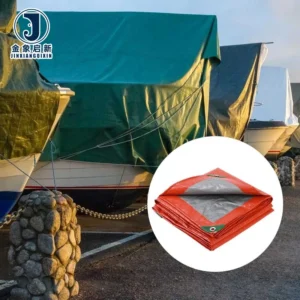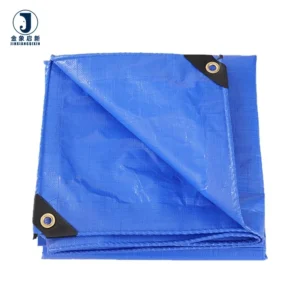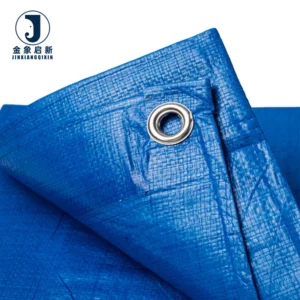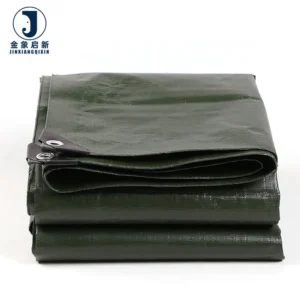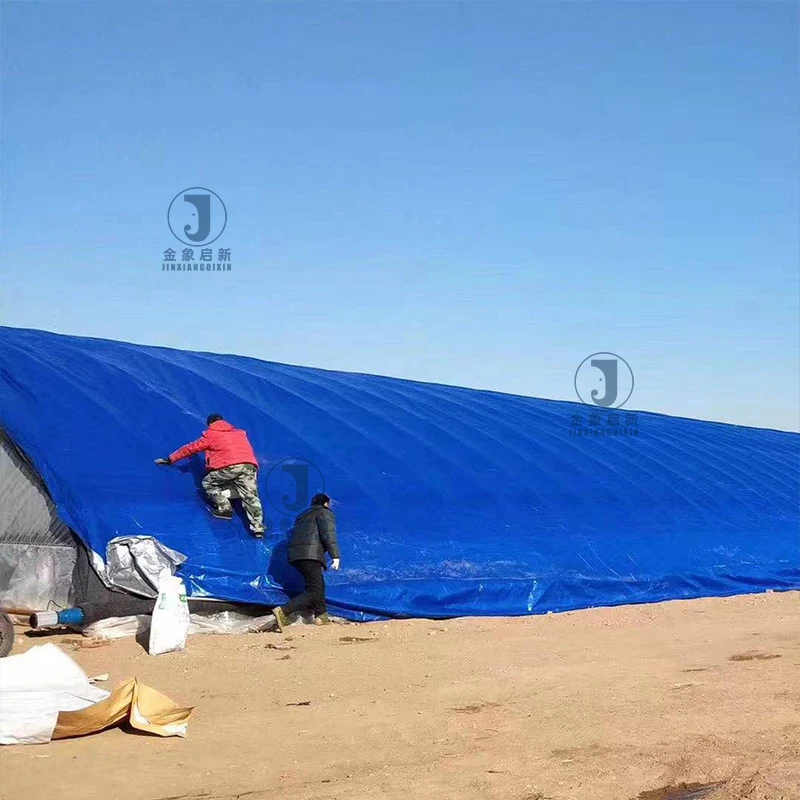
Bulk Consistency Control — dedicated QA checks on every roll for GSM, weave density, and colour match before a single metre ships.
Technical Specifications
| Parameter | Value |
|---|---|
| Product Type | PE Tarpaulin |
| Material | HDPE weaving with LDPE lamination on both sides |
| Weight (GSM) | 50g/m² ~ 220g/m² available |
| Total Thickness | 0.2–0.4 mm / 8–16 mil |
| Weave Density Mapping | 6×6 or 6×7 → 50–60 gsm; 7×7 or 7×8 → 60–80 gsm; 8×8 or 9×9 → 80–90 gsm; 8×10 → 90–100 gsm; 10×10 → 100–120 gsm; 12×12 → 120–150 gsm; 14×14 → 150–250 gsm; 14×16 → 250–300 gsm |
| Roll Width Options | 6 ft, 8 ft, 10 ft, 12 ft, 2 m, 4 m, 6 m |
| Roll Length Options | 100 yards, 100 meters, or custom |
| Color Options | Blue, Blue/Orange, Green, Grey, Black, Clear, Grey/Green, Orange, or custom |
| Waterproof | Yes |
| Tear Resistant | Yes |
| UV Treatment | Available (test basis not stated in source — request UV exposure report) |
| Anti-Mildew / Anti-Aging | Yes (grade not stated in source) |
| Flame Retardant | Not stated in source |
| Finished Edge | All four edges reinforced with PP rope in hem |
| Eyelets | Galvanized, every 3 ft or 1 m interval |
| Corner Reinforcement | Reinforced plastic corners |
| Key Features | Waterproof, washable, tear resistant, mildew proof, anti-aging |
Application Suitability
| Application | Exposure & Requirement |
|---|---|
| Truck and trailer flatbed covers | Continuous road vibration, wind flutter, rain ingress, UV exposure at highway speeds |
| Side curtain fabric for transport equipment | Repeated flexing at load points, abrasion against cargo edges, tie-down stress |
| Construction material covers on site | Puncture from sharp aggregate, moisture exposure during storage, wind uplift |
| Agricultural crop and timber covers | Prolonged outdoor weathering, mildew risk in humid storage, handling abrasion |
Why Truck Covers Sized to Generic Dimensions Cost Fleets More Than the Tarp Itself
Ordering a PE tarpaulin cut to your exact trailer model eliminates rework and cargo damage from ill-fitting generic covers.
Transport fleets often specify covers by a rounded dimension — say 4×6 m — only to discover on the loading dock that the eyelets sit too far from the trailer’s anchor points or the fabric bunches at the rear corners, leaving cargo exposed to rain and road spray. [NEED_CITE: fitment mismatch is a leading cause of tarp replacement in fleet operations] This is not a material failure; it is a specification failure. A cover that is even slightly oversized flaps in the slipstream, accelerating wear at the hem and pulling galvanized eyelets through the reinforced edge under sustained wind load.
Roll Stock and Finished Sheet Supply for Fleet Operations
Whether you need PE tarpaulin by the roll for in-house cutting or pre-finished sheets with PP rope hems and galvanized eyelets, the supply chain starts with the same HDPE woven base and LDPE lamination. Fleet operators buying roll stock at widths up to 6 m can cut to their own side curtain patterns, while those ordering finished sheets receive covers with reinforced plastic corners and eyelets spaced at 1 m intervals, ready to deploy on trucks and trailers without secondary fabrication.
Colour Matching Across Rolls and Finished Sheets
When a fleet orders multiple rolls or a batch of finished covers in the same colour, consistency between pieces matters the moment they are installed side by side on adjacent trailers. Batch dye control is applied at the weaving and lamination stage so that Blue/Orange or Green sheets from the same production run do not show visible shade variation once deployed. [NEED_CITE: visual shade tolerance standards for laminated PE fabrics] Buyers can request a pre-shipment colour comparison record before containers are sealed.
How Weave Density and GSM Together Determine Road-Ready Durability
GSM alone tells a procurement team how much material they are paying for, but it is the combination of HDPE weave count and LDPE coating weight that determines how the tarpaulin behaves under load. A 6×6 weave at 50 gsm serves light, short-term dust and splash covers, while a 14×14 weave at 150–250 gsm delivers the tear resistance needed for side curtains that flex with every corner taken at speed. The LDPE lamination on both sides seals the woven base against water ingress and adds puncture resistance at the points where the fabric presses against sharp cargo edges. Choosing the right density-to-weight pairing prevents both over-specification — paying for heavy-grade fabric on a load that only needs weather protection — and under-specification, where a thin cover tears at the first tie-down point.
The Hidden Cost of Skipping Pre-Shipment Weight Verification
When a quotation states a specific GSM but the rolls arriving at the yard weigh less, the fleet is running covers that are thinner and weaker than the specification it approved. This gap between quoted and delivered weight shortens service intervals, increases replacement frequency, and can leave cargo uninsured if the cover fails in a weather event. [NEED_CITE: pre-shipment inspection standards for coated and laminated fabrics] A 100% pre-shipment inspection with actual weighed samples per roll catches this discrepancy before the container leaves the factory.
Why Procurement Teams Source PE Tarpaulin Here
Three full production lines and 36 sets of professional equipment support bulk roll output with on-time container loading, so fleet schedules are not delayed by supply gaps. A 10-person R&D team handles custom width, colour, and cut-to-size pattern development, producing samples within days for buyer approval before mass production. Dedicated QA checks run at every production stage — from HDPE weaving tension through LDPE lamination weight — with 100% inspection before dispatch. ISO and CE certified processes underpin the quality documentation package that accompanies every shipment. Custom printing and branding on finished sheets are available for fleets that require corporate identity on their covers.
Documentation & Verification
- Material specification sheet listing confirmed GSM, HDPE weave count, and LDPE lamination weight per roll
- Pre-shipment inspection record with actual weighed GSM samples matched to the quoted grade
- Roll packing list with individual roll weights, widths, and batch codes for traceability
- Colour comparison record across all rolls or sheets within the same order
- Certificate of origin and customs documentation for destination-country clearance
Fabrication, Handling & Storage
- Heat-seal LDPE laminated surfaces at moderate temperature to avoid melting through the HDPE woven base
- PP rope hem reinforcement distributes tie-down load across the full edge rather than concentrating stress at individual eyelets
- Store rolls upright on hard paper tubes to prevent permanent creasing of the LDPE lamination layer
- Deploy reinforced plastic corners at trailer anchor points where the highest tie-down tension is applied
- Cut rolls on flat surfaces using the stated width options to minimise offcuts and seam joins on wide loads
What to Include in Your Enquiry
Provide the trailer make, model, and exact deck dimensions so the PE tarpaulin can be cut to fit rather than supplied in a generic size. Specify whether you require roll stock or finished sheets with eyelets, and indicate the weave density or GSM range that matches your load profile. If your fleet operates under a corporate colour standard or requires custom printing on the cover, include the Pantone or RAL reference with your target order quantity.
Frequently Asked Questions
Q: How is the GSM of a finished PE tarpaulin verified before and after lamination?
A: The HDPE base fabric is weighed before lamination and the finished sheet is weighed again after LDPE coating on both sides. A pre-shipment inspection record documents the actual GSM per roll, so you receive proof that the delivered weight matches your purchase order specification, not just the quotation figure.
Q: Can the finished tarpaulin be cut to my exact trailer model dimensions?
A: Yes. Provide your trailer make, model, and deck measurements and the cover is cut to those exact dimensions with PP rope hems, galvanized eyelets at 1 m intervals, and reinforced plastic corners. A sample is produced for your approval before the full batch enters production.
Q: What is the UV treatment basis for this PE tarpaulin?
A: UV treatment is available as an option, but the specific test basis is not stated in the current product documentation. Request a UV exposure test report matched to your expected outdoor service duration and climate zone before confirming the treatment grade for your fleet.
Q: How do eyelet spacing and PP rope reinforcement handle tie-down stress?
A: Galvanized eyelets are set every 3 ft or 1 m along the hem, and a PP rope runs inside the folded edge to distribute tension across the full perimeter. Reinforced plastic corners add extra layers at the highest-stress anchor points, reducing the risk of eyelet pull-through under road vibration and wind load.
Q: How is colour consistency maintained across multiple rolls or sheets?
A: All rolls or finished sheets in a single order are produced from the same batch of dyed HDPE yarn and LDPE compound. A colour comparison check is performed before dispatch, and a comparison record can be included in your documentation package so any shade variation is caught before shipment.