Coating Line Process Control — Every PVC tarpaulin roll leaves the line only after the coating weight, adhesion, and surface finish have been checked against the batch specification sheet.
Technical Specifications
| Parameter | Value |
|---|---|
| Product Type | PVC Tarpaulin Roll |
| Material Base | High-tenacity polyester woven scrim with PVC coating |
| Available Widths | 6ft, 8ft, 10ft, 12ft, 2m, 4m, 6m |
| Available Lengths | 100 yards, 100 meters, or custom roll length |
| GSM Range | 50g/m² ~ 300g/m² |
| Thickness | 0.2mm – 0.4mm (8 mil – 16 mil) or custom |
| Weave Density (6×6 / 6×7) | 50gsm ~ 60gsm |
| Weave Density (7×7 / 7×8) | 60gsm ~ 80gsm |
| Weave Density (8×8 / 9×9) | 80gsm ~ 90gsm |
| Weave Density (8×10) | 90gsm ~ 100gsm |
| Weave Density (10×10) | 100gsm ~ 120gsm |
| Weave Density (12×12) | 120gsm ~ 150gsm |
| Weave Density (14×14) | 150gsm ~ 250gsm |
| Weave Density (14×16) | 250gsm ~ 300gsm |
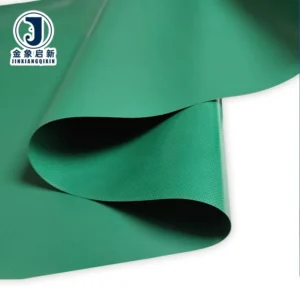
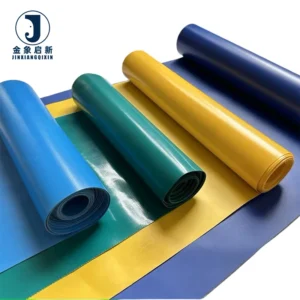
| Colour Options | Blue, Blue/Orange, Green, Grey, Black, Clear, Grey/Green, Orange, or custom |
| UV Treatment | Available — confirm the grade required for your market |
| Flame Retardant | Available — confirm the grade required for your market |
| Anti-Static Treatment | Available — confirm the grade required for your market |
| Key Features | Waterproof, washable, tear resistant, weather proof, mildew proof, anti-aging |
| Roll Packaging | Hard paper core, wrapped in matching tarpaulin sheet |
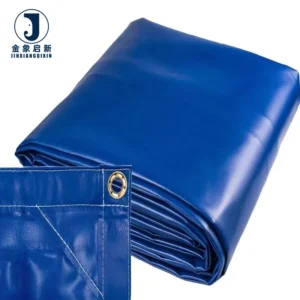
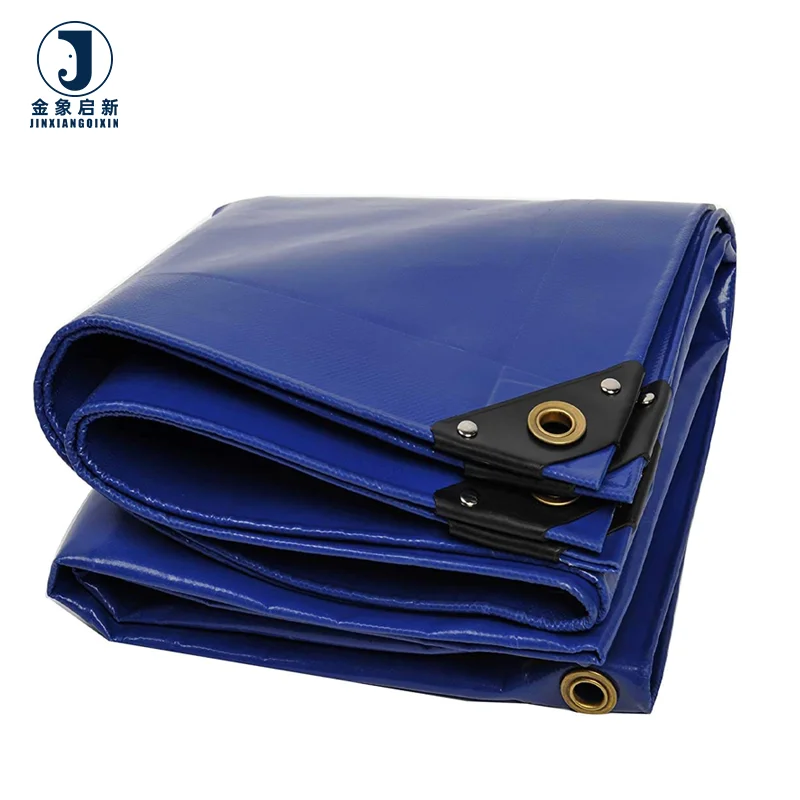
| Finished Edge | All four edges reinforced with PP rope in hem |
| Eyelet Interval | Every 3ft or 1 meter |
| Corner Reinforcement | Reinforced plastic corners |
| Certification | ISO, CE |
Application Suitability
| Application | Exposure & Requirement |
|---|---|
| Poultry house curtains | Repeated roll-up and drop-down cycling, ammonia-laden air, wash-down moisture, temperature fluctuation |
| Truck side curtains and transport covers | Road vibration, constant flexing at tie-down points, UV and weather exposure, abrasion from load shift |
| Agricultural crop and timber covers | Prolonged outdoor UV exposure, wind uplift stress, rain and condensation contact |
| Construction scaffolding and material wraps | Site dust and debris impact, scaffold tube abrasion, wind-driven rain |
| Home and garden furniture and pool covers | Standing water, chlorine or chemical splash, seasonal fold-and-store creasing |
Why Roll-to-Roll Colour Drift Costs More Than You Think
Colour consistency across a bulk order is a process control outcome, not a dye-lot gamble.
When a fleet operator orders twenty rolls for a trailer curtain renewal programme, even a slight shade shift between roll eight and roll fifteen becomes visible once the panels hang side by side on the loading dock. Buyers often accept a quotation based on a Pantone reference, only to find the delivered PVC tarpaulin roll aftermarket supplier batch carries a noticeable variation that forces sorting, re-cutting, or partial rejection. [NEED_CITE: batch colour consistency standards for coated technical textiles]. The root cause typically traces back to inconsistent pigment dispersion in the coating compound or temperature variation across the oven zones during the lamination pass.
How the Weave and Coating Combine on a Moving Truck
The polyester scrim provides the tensile skeleton, but it is the PVC coating that transfers load across the weave intersections and prevents yarn pull-out at stress concentrations. On a truck side curtain, the fabric flexes thousands of times per trip as the trailer articulates through corners and over speed bumps. A PVC tarpaulin roll aftermarket supplier that controls coating penetration into the scrim achieves better inter-yarn bonding, which directly influences how the panel handles repeated flex cycles without cracking or delaminating at fold lines.
Thermal Welding Behaviour at Fabrication Stage
When a fabricator heat-welds seams on poultry curtain panels, the PVC coating must melt and flow uniformly at the joint without scorching the base yarns. Coating weight and plasticiser content determine the window between insufficient fusion and thermal degradation. Rolls with inconsistent coating thickness force the welder to adjust temperature and dwell time mid-run, leading to weak joints that open under the cyclic load of daily curtain operation. [NEED_CITE: thermal welding parameters for PVC coated polyester fabrics]
Reading GSM in Context With Base Fabric Density
GSM alone tells you how much material sits on the scale, but it does not reveal how that mass is distributed between the base yarns and the coating compound. A roll that reaches its target weight through heavy coating over a sparse weave will feel stiff yet tear easily along the weft, because there are fewer yarns per centimetre to arrest a rip. Conversely, a tighter 14×14 weave at the same GSM places more strength in the yarn structure and less in the coating layer, yielding a fabric that resists tear propagation even when a puncture occurs during installation or use.
Anti-Static and Flame Retardant Grades in Poultry Environments
In enclosed poultry housing, dust accumulation on curtain surfaces can become a combustion risk when static charge builds through repeated fabric movement. Anti-static treatment reduces surface resistivity so that charge dissipates rather than accumulating. However, the specific grade of anti-static agent and its durability through wash cycles must be confirmed against the testing standard applicable in your region. Flame retardant performance similarly depends on the additive system used in the PVC compound — a generic claim without a cited grade leaves the buyer exposed at the point of site inspection.
What Happens When Coating Adhesion Falls Short
Delamination between the PVC layer and the polyester scrim rarely shows up during a quick visual inspection at the warehouse. It surfaces weeks later when a truck curtain flexes in cold weather, or when a poultry curtain is wound onto its roller tube under tension. The coating lifts from the base fabric in patches, exposing bare yarns to moisture and abrasion. This failure mode is driven by insufficient bonding during the coating process — often caused by incorrect oven temperature or inadequate primer application on the scrim. [NEED_CITE: adhesion test methods for coated fabrics per ISO 1421]. Buyers who specify only GSM and colour, without requiring an adhesion value on the test report, accept this risk unknowingly.
Why Process Control Matters More Than Line Speed
The facility runs three full production lines with 36 sets of professional equipment, but throughput means nothing if the coating weight drifts outside tolerance during a long run. The 10-person R&D team develops material formulations and sample rolls within days for custom width, colour, and treatment combinations. Every production stage includes dedicated QA/QC checkpoints, and each roll undergoes inspection before it is cleared for dispatch. This means that a PVC tarpaulin roll aftermarket supplier can maintain batch consistency across a container load rather than relying on post-production sorting to remove off-spec material. The result is predictable fabrication behaviour when the rolls reach the customer’s cutting table or welding jig.
Documentation & Verification
- Material specification sheet stating GSM, base fabric weave, and PVC coating compound reference
- Test report for UV or flame retardant grades where the buyer has specified a treatment level
- Pre-shipment inspection record confirming roll count, dimensions, and visual quality
- Roll packing list with individual roll weights and lengths for receiving verification
- Certificate of origin and customs documentation aligned with destination country requirements
Fabrication, Handling & Storage
- Set welder temperature and dwell time to match the specific PVC coating thickness before starting production runs
- Allow eyelet spacing to align with PP rope reinforcement in the hem for even load distribution
- Store rolls upright on their cores to prevent flat spots and permanent creasing in the coating layer
- Unroll in ambient temperatures above 10°C to avoid coating stiffness and micro-cracking at fold lines
- Use mild detergent and soft brush for cleaning; avoid solvents that attack the PVC plasticiser system
What We Need From Your Next Enquiry
Provide the specific truck or trailer models the side curtains must fit, along with the operating climate and expected flex frequency. If you are sourcing rolls for poultry curtain fabrication, state the roller tube diameter, drop height, and whether anti-static or flame retardant treatment is required by your local agricultural code. Indicate your target width, annual volume, and whether you need finished panels with welded hems and eyelets or mill rolls for your own fabrication line.
Frequently Asked Questions
Q: How is roll-to-roll colour consistency guaranteed across a bulk order?
A: Pigment is metered into the PVC compound by weight before each coating run, and oven zone temperatures are logged continuously. Production is paused if the inline colour reading drifts outside the agreed tolerance. A reference swatch from the approved sample is held on file and compared against every roll at the final inspection station before packing.
Q: Can I order custom width, colour, or print without high minimums?
A: The three production lines allow shorter changeover runs compared to single-line operations. Custom widths and Pantone-matched colours are developed through the R&D team, with sample rolls produced within days for buyer approval. Minimum order quantities depend on the specific width and treatment combination requested.
Q: How do I verify the actual GSM matches the quotation?
A: Each shipment is accompanied by a pre-shipment inspection record that documents the measured weight per square metre for sampled rolls. Buyers can also cut a measured swatch from the received roll and weigh it on a calibrated scale to cross-check against the stated specification before fabrication begins.
Q: What documentation accompanies the shipment?
A: The dispatch package includes a material specification sheet, roll packing list with individual weights and lengths, certificate of origin, and any applicable test reports for UV or flame retardant treatment. ISO and CE certificates are provided as part of the standard documentation set for customs clearance at destination.